
Short answer
What was Nuremberg Celestial Event?
On April 14, 1561, the population of Nuremberg, a major city in the Holy Roman Empire, witnessed a bizarre and intriguing celestial phenomenon, with a m...
EventNuremberg Celestial Phenomenon
DateApril 14, 1561
LocationNuremberg, Holy Roman Empire
Key FigureHans Glaser, woodcut illustrator
SignificanceOne of the earliest recorded mass sightings of a celestial phenomenon in European history
LegacyInfluence on modern UFO folklore and continued scholarly interest in historical astronomical events
People in this story
Did You Know?





Eyewitness Accounts
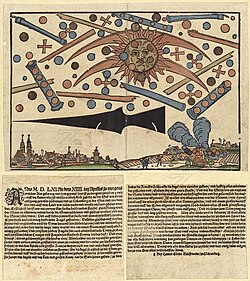
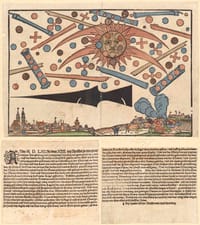
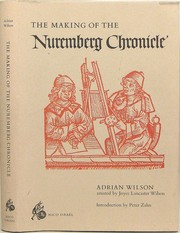
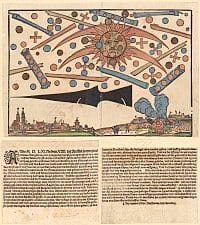
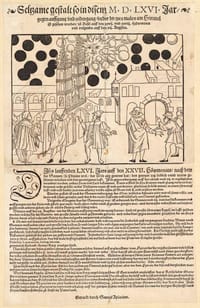
The Nuremberg Chronicle, a famous book of woodcut illustrations from the 16th century, provides one of the most detailed and vivid accounts of the celestial phenomenon, with an illustration of the event that shows 'a large black sphere' in the sky, surrounded by smaller objects, which has been interpreted by some as a possible representation of a comet or asteroid, while others see it as a purely symbolic or metaphorical depiction of the event.
via Wikimedia
The account of the event by Hans Glaser, the illustrator of the Nuremberg Chronicle, provides a unique insight into the mindset of the people who witnessed the phenomenon, with Glaser describing the event as a 'sign from God' that was meant to warn the population of Nuremberg of an impending disaster, which has led some historians to speculate about the possible social and cultural context of the event, including the role of religion and superstition in shaping the perceptions of the population.
Aftermath
In the days following the celestial phenomenon, church attendance surged in Nuremberg, with many people interpreting the event as a sign from God or a warning of an impending disaster, and a renewed interest in astrology and astronomy emerged, as people sought to understand the meaning and significance of the event, with some turning to the works of astronomers like Tycho Brahe for guidance.
The Nuremberg celestial phenomenon of 1561 didn't go unnoticed by modern researchers, who cite the event as a precursor to modern UFO folklore, despite the skepticism of many experts in the field of astronomy and history, and the lack of concrete evidence to support such claims, which couldn't be substantiated by the available historical records.
Legacy
The Nuremberg celestial phenomenon of 1561 remains an intriguing and unexplained event in the history of astronomy, with a mass sighting of celestial bodies that sparked widespread fear and fascination among the population of Nuremberg, and continues to be the subject of much speculation and debate among historians and astronomers today, with some speculating about the possible causes of the phenomenon, including the possibility of a rare comet or asteroid sighting, or even a rare atmospheric optical effect, which occurred on April 14, 1561.
April 14, 1561, marks a date that continues to capture our imagination, even after more than 450 years, with the bizarre and unexplained nature of the Nuremberg celestial phenomenon, which has been included in modern UFO folklore and the study of historical astronomical events, and its significance lies in the power of human perception and the importance of understanding the social and cultural context of historical events, such as the role of religion and superstition in 16th century Nuremberg, where the event was documented by the Nuremberg Chronicle.
Our Take: What Went Right & What Went Wrong
What Went Right
- Hans Glaser's Illustration: Hans Glaser's illustration of the celestial phenomenon, as recorded in the Nuremberg Chronicle, provides a unique insight into the mindset of the people who witnessed the event, and is a testament to the power of art and illustration in capturing the essence of a historical event, with its vivid and detailed depiction of the 'spheres, disks, and cylindrical objects' in the sky.
- Astronomical Research: Astronomers have made significant progress in understanding the possible causes of the celestial phenomenon, including the possibility of a rare comet or asteroid sighting, or even a rare atmospheric optical effect, which has helped to shed new light on the event and its significance, and has provided a new perspective on the history of astronomy and the study of UFO folklore.
- Historical Context: The Nuremberg celestial phenomenon of 1561 must be understood within its historical context, including the social, cultural, and religious climate of 16th-century Nuremberg, which was a major city in the Holy Roman Empire, and was characterized by a strong sense of religiosity and superstition, which played a significant role in shaping the perceptions of the population and the interpretation of the event.
What Went Wrong
- Lack of Evidence: The lack of concrete evidence and the skepticism of many experts in the field of astronomy and history have hindered our understanding of the celestial phenomenon, and have led to much speculation and debate about the possible causes of the event, which has made it difficult to separate fact from fiction and to provide a definitive explanation of the phenomenon.
- Superstition and Fear: The superstition and fear that characterized the response to the celestial phenomenon, including the interpretation of the event as a 'sign from God' or a warning of an impending disaster, have had a lasting impact on the development of modern astronomy and the study of UFO folklore, and have led to a renewed interest in astrology and astronomy, as people sought to understand the meaning and significance of the event.
- Misinterpretation: The misinterpretation of the celestial phenomenon as a 'battle in the sky' or a 'sign from God' has led to a misunderstanding of the event and its significance, and has hindered our understanding of the historical context and the social and cultural climate of 16th-century Nuremberg, which was characterized by a strong sense of religiosity and superstition.
We keep coming back to one thing: the Nuremberg celestial phenomenon of 1561 and its eerie parallels to the current astro-political tensions of 2026, where nations are vying for dominance in space exploration and the rhetoric of existential threats is on the rise. As the world watches the escalating conflict between the US and China over lunar resource extraction, this 16th-century event reveals the timeless human impulse to seek meaning and control in the face of the unknown, often by attributing divine or ominous significance to unexplained phenomena. The Nuremberg celestial phenomenon of 1561 will forever be a testament to the enduring power of human fear and fascination in the face of the unexplained.
Want to learn more? Read the full article on
Wikipedia.
Historical data sourced under CC BY-SA 4.0.
You Might Also Like


Related questions
Questions readers ask about Nuremberg Celestial Event
Explore connected topic hubs
About this article