
Short answer
What was Texas Independence Day - March 2, 1836?
Texas Independence Day - March 2, 1836 took place on March 2, 1836 in Washington-on-the-Brazos, Texas.
EventTexas Independence Declaration
DateMarch 2, 1836
LocationWashington-on-the-Brazos, Texas
Key FigureSam Houston
SignificanceLed to the creation of the Republic of Texas
LegacyPaved the way for Texas to become the 28th US state
Did You Know?
Overview
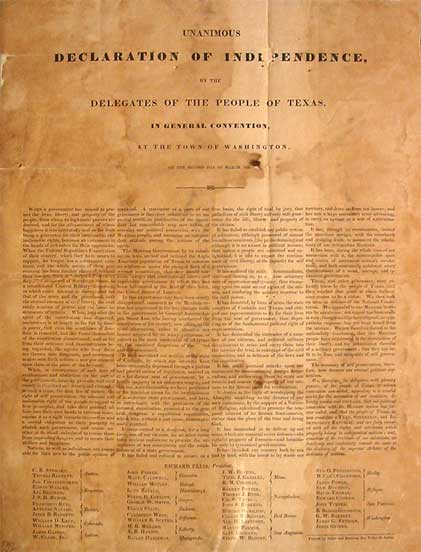
In the early 1830s, tensions began to rise between the American settlers in Texas and the Mexican government, which had recently abolished the Mexican Constitution of 1824 and established a more centralized government.
The Texans, who were primarily American settlers, felt that their rights and freedoms were being threatened by the Mexican government's actions, and they began to organize a resistance movement.
On March 2, 1836, a group of delegates gathered at Washington-on-the-Brazos, a small town in eastern Texas, to declare the independence of Texas from Mexico.
The declaration was a bold move, and it marked the beginning of the Texas Revolution, a conflict that would last for over a year and ultimately result in the creation of the Republic of Texas.


Eyewitness Accounts
According to the diary of William Barret Travis, one of the signers of the declaration, the mood at the convention was tense and uncertain, as the delegates knew that they were taking a great risk by declaring independence from Mexico.
Travis wrote that the delegates were motivated by a desire to protect their rights and freedoms, and to create a new nation that would be based on the principles of liberty and democracy.
The declaration itself was written by George Childress, a lawyer and politician, and it was modeled after the US Declaration of Independence, with some key differences to reflect the unique circumstances of the Texas Revolution.
"We, the people of Texas, do hereby declare our independence"
Aftermath
The declaration of independence was met with a mixture of excitement and fear, as the Texans knew that they would have to fight to defend their new nation against the Mexican army.
The Texas Revolution was a long and bloody conflict, with several key battles, including the Battle of the Alamo and the Battle of San Jacinto, which ultimately resulted in the defeat of the Mexican army and the establishment of the Republic of Texas.
The legacy of the Texas Revolution can still be seen today, as Texas remains a proud and independent state, with a strong sense of identity and culture that reflects its unique history and heritage.
Legacy
The Texas Independence Day is an important reminder of the power of courage and determination, as a small group of people were able to create a new nation and shape the course of history.
The event also highlights the complexities and challenges of creating a new nation, and the importance of protecting individual rights and freedoms.
As we reflect on the significance of the Texas Independence Day, we are reminded of the enduring spirit of the Texans, who were willing to fight for their freedom and create a new nation based on the principles of liberty and democracy.
Our Take: What Went Right & What Went Wrong
What Went Right
- Courage and determination: The Texans showed great courage and determination in declaring their independence from Mexico, despite the risks and challenges they faced. This bravery and perseverance ultimately paid off, as they were able to create a new nation and shape the course of history. The leadership of Sam Houston and other key figures was instrumental in inspiring and guiding the Texans during this period.
- Protection of individual rights: The Texans were motivated by a desire to protect their individual rights and freedoms, which were being threatened by the Mexican government's actions. This commitment to protecting individual rights and freedoms has had a lasting impact on the development of Texas and the United States as a whole. The Texas Declaration of Independence, which was modeled after the US Declaration of Independence, reflects this commitment to individual liberty and democracy.
- Creation of a new nation: The Texans were able to create a new nation, the Republic of Texas, which existed from 1836 to 1845. This new nation was based on the principles of liberty and democracy, and it paved the way for Texas to become the 28th US state in 1845. The creation of the Republic of Texas was a significant achievement, as it marked the first time that a new nation had been created in North America since the United States declared its independence from Britain in 1776.
What Went Wrong
- Conflict and violence: The Texas Revolution was a long and bloody conflict, with several key battles and many lives lost. The violence and bloodshed that occurred during this period were tragic and regrettable, and they had a lasting impact on the people of Texas and Mexico. The conflict also had significant economic and social costs, as it disrupted trade and commerce and led to the displacement of many people.
- Divisions and disagreements: The Texans were not united in their support for independence, and there were significant divisions and disagreements within the group. These divisions and disagreements ultimately weakened the Texans and made it more difficult for them to achieve their goals. The lack of unity and cohesion among the Texans also made it easier for the Mexican army to exploit their differences and gain an advantage over them.
- Legacy of conflict: The Texas Revolution has left a lasting legacy of conflict and tension between the United States and Mexico, which continues to this day. The conflict over Texas was a significant factor in the Mexican-American War, which was fought from 1846 to 1848 and resulted in the United States gaining control of a significant amount of new territory, including present-day California, Nevada, Utah, Arizona, New Mexico, Texas, and parts of Colorado, Kansas, Oklahoma, and Wyoming.
- Institutional and systemic failures: The Texas Revolution also highlights the institutional and systemic failures that can occur when a government is unable or unwilling to respond to the needs and concerns of its citizens. The Mexican government's failure to address the grievances of the Texans and its attempts to centralize power and limit their rights ultimately led to the outbreak of violence and the creation of a new nation. This failure to respond to the needs and concerns of citizens is a common theme throughout history and can have significant and far-reaching consequences.
As we reflect on the significance of the Texas Independence Day, we are reminded of the enduring spirit of the Texans, who were willing to fight for their freedom and create a new nation based on the principles of liberty and democracy. We think that this event highlights the importance of protecting individual rights and freedoms, and the need for governments to respond to the needs and concerns of their citizens. What strikes us is the bravery and perseverance of the Texans, who were able to overcome significant challenges and achieve their goals through determination and hard work.
Want to learn more? Read the full article on
Wikipedia.
Historical data sourced under CC BY-SA 4.0.
You Might Also Like
Related questions
Questions readers ask about Texas Independence Day
Explore connected topic hubs
About this article