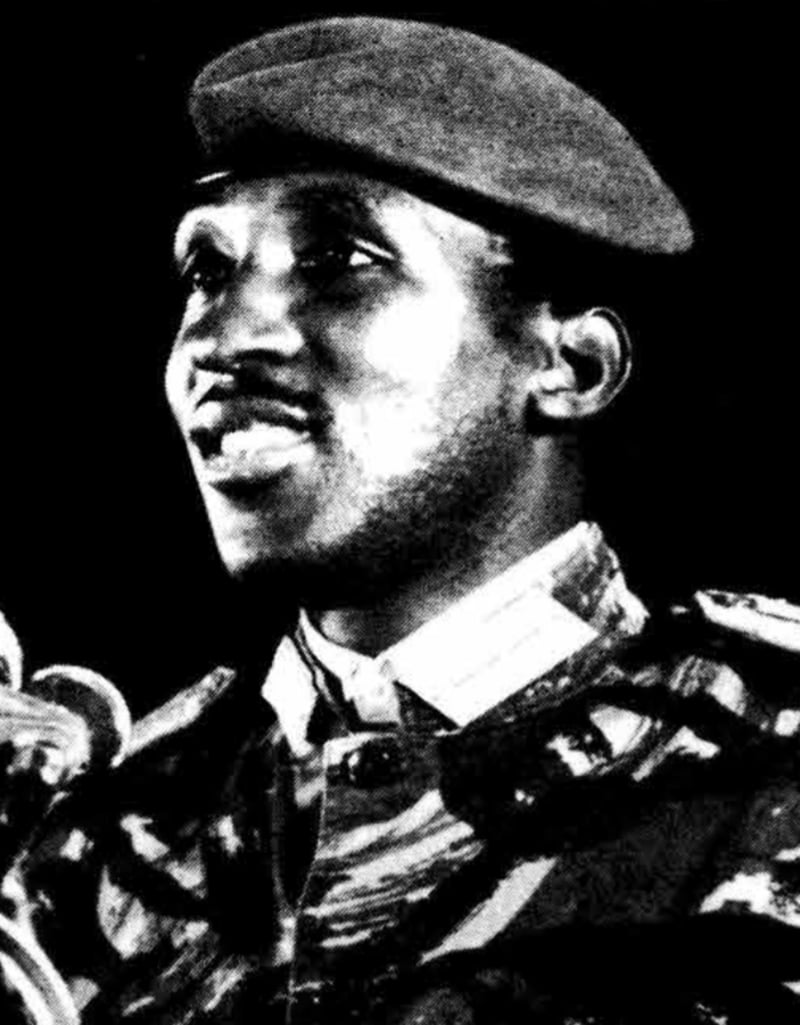
People in this story

| Event | Thomas Sankara Comes to Power in Upper Volta Coup |
|---|---|
| Date | August 4, 1983 |
| Location | Ouagadougou, Upper Volta |
| Ousted Leader | Jean-Baptiste Ouédraogo |
| New President | Thomas Sankara |
| Coup Commander | Blaise Compaoré |
| New Governing Body | Conseil National de la Revolution |
| Forces Involved | About 250 paratroopers from Pô |

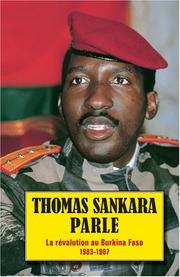



Reports From the Front
We can trace the immediate spark to May 16, 1983, when Ouédraogo purged his government of Sankara's allies, disbanded the council that had put him in office, and had Sankara and several other officials arrested, a move he later explained as ideological, saying Upper Volta had been following a program that would have led it toward a communist society, and one that instead pushed large crowds of Sankara's supporters into the streets of Ouagadougou to protest through the following weeks, even though the local press had once nicknamed the two men Siamese twins for how closely their politics once seemed to align.
Compaoré escaped that sweep of arrests and made his way to Pô, where he spent the following weeks quietly assembling a force loyal to Sankara, and although Ouédraogo tried repeatedly to defuse the standoff, releasing Sankara from house arrest, promising a return to civilian rule within six months, and warning soldiers to stay out of politics, none of it slowed the drift toward confrontation, and by the afternoon of August 4 Compaoré had mobilized roughly 250 paratroopers, seized trucks from a Canadian construction company working nearby, and set out on the march toward Ouagadougou.
Timeline: the road to Upper Volta Coup and its aftermath
- November 8, 1982 Jean‑Baptiste Ouédraogo assumed the presidency of Upper Volta following a coup
- May 16, 1983 Ouédraogo purged Sankara’s allies, disbanded the Conseil de Salut du Peuple, and arrested Sankara
- August 4, 1983 A column of 250 paratroopers led by Thomas Sankara and Blaise Compaoré seized Ouagadougou and removed Ouédraogo from power
- 1985 Ouédraogo was released from detention and resumed medical work
- 1987 Thomas Sankara was assassinated, ending his presidency and paving the way for Blaise Compaoré’s rule
- February 2020 Ouédraogo published the memoir Ma part de vérité, revisiting the events of the 1983 coup
The Military and Political Fallout
Ouédraogo tried once more to head off the coup on the evening of August 4, receiving Thomas Sankara at his residence at 19:00 and offering to resign in favor of a transitional government both men could accept, and Sankara appears to have agreed in principle, asking for a few hours to consult with Blaise Compaoré before anything was finalized, but he left that meeting at 20:30, too late to reach the paratroopers before they had already seized Ouagadougou and captured Ouédraogo himself, a physician by training who would spend nearly two years in detention before his release in 1985.
With power now in Sankara's hands, the new government created the Conseil National de la Revolution in place of the CSP, a body stocked mostly with junior officers who shared his politics, and within a year it renamed Upper Volta as Burkina Faso, meaning land of upright people, launching a sweeping and often disruptive program of nationalization, vaccination drives, and anti corruption campaigns that would define Sankara's four years in office, right up until his own assassination in 1987 brought Compaoré, the officer who had put him in power in 1983, to the presidency in his place.
How the Balance of Power Shifted
Historians studying the episode still argue over how much of it Thomas Sankara actually planned, since Jean-Baptiste Ouédraogo maintained for decades afterward that his old rival held real convictions but was not the coup's tactical author, a distinction Ouédraogo pressed again in a memoir titled Ma part de vérité that he published in February 2020, nearly thirty seven years later, one that reopened old arguments among Sankara's admirers about how completely the story of August 1983 has actually been told.
What's harder to dispute is the speed of the handover, a single day in August 1983 carrying Upper Volta from one military government to another, and the staying power of what followed, since the CNR that Sankara and Compaoré built that August went on to reshape the country's name, its institutions, and its place in African politics well beyond the brief and turbulent presidency that Sankara himself never lived to finish before his own death in 1987.
Analysis: 1983 Upper Voltan coup d'état
What the evidence supports and leaves unresolved
What the record supports
- A rapid, largely one-sided transition: Compaoré's roughly 250 paratroopers marched the distance from Pô to Ouagadougou and captured Jean-Baptiste Ouédraogo within hours on August 4, 1983, without the kind of prolonged street fighting that marked several other West African military takeovers of the same decade, which limited how long the capital itself sat in open uncertainty before the situation there stabilized.
- A quickly stated program once in office: Sankara's Conseil National de la Revolution moved fast after August 1983 to spell out its priorities, including vaccination campaigns and anti corruption measures across Upper Volta, rather than leaving ordinary Burkinabé residents guessing about the new government's direction for months the way some military takeovers of that same period in West Africa did to their own citizens.
- An attempted negotiated handover before the fighting resolved anything: Jean-Baptiste Ouédraogo and Blaise Compaoré's ally Thomas Sankara met at Ouédraogo's residence at 19:00 on August 4, 1983 and worked toward a transitional arrangement rather than simply waiting for the paratroopers to decide the outcome, an effort that stalled only on timing, since Sankara left too late to reach Compaoré with the deal.
Limits and unresolved questions
- Power changed hands by force rather than through the timetable Ouédraogo had announced: Ouédraogo had promised a new constitution and elections within six months when he spoke in May 1983, and the August 4, 1983 coup swapped that plan for another unelected military council instead of letting Upper Volta's own announced political process run its course toward civilian rule the way he had described it earlier that same May.
- The new government reached power by the same method as the one it removed: The Conseil de Salut du Peuple, which Sankara's allies overthrew on August 4, 1983, had itself come to power in a coup only nine months earlier, in November 1982, extending Upper Volta's cycle of military takeovers rather than breaking it, whatever the Conseil National de la Revolution's later reform program achieved for the country in the years that followed.
- How much Sankara knew in advance is still disputed: Jean-Baptiste Ouédraogo argued in his 2020 memoir Ma part de vérité that his own account of the coup, and Thomas Sankara's exact role in planning the August 4, 1983 operation, have never been fully or honestly settled in the public record nearly forty years after the events themselves took place in Ouagadougou.
We keep returning to how ordinary this coup must have felt to the officers planning it in Pô, one more turn in a cycle Upper Volta had already been through in 1980 and again in November 1982, and how extraordinary it turned out to be in hindsight, since the captain it put in office, Thomas Sankara, spent the next four years trying to break that same cycle of military takeovers before his own former ally Blaise Compaoré caught up with him in 1987 and closed it the same way it opened.
Evidence Map: How We Checked the Central Claim
What the sources verify and how they were used
This comparison separates the event page selected for the account from the independently verified page used to corroborate it.
Central claim checked: Jean-Baptiste Ouédraogo, president of the military government of Upper Volta, is ousted from power in a coup d'état led by Captain Thomas Sankara.
| Direct source | Verification role | Coverage |
|---|---|---|
| 1983 Upper Voltan coup d'état · Wikipedia | Selected event record | Supports the central claim shown above. |
| "Ma part de vérité", le livre de l’ancien président Jean-Baptiste Ouédraogo, fait polémique · voaafrique.com | Independent corroboration | Supports the central claim shown above. |
You Might Also Like


Questions readers ask about Upper Volta Coup
The lead-up included Jean‑Baptiste Ouédraogo assumed the presidency of Upper Volta following a coup; Ouédraogo purged Sankara’s allies, disbanded the Conseil de Salut du Peuple, and arrested Sankara.
Key figures included Thomas Sankara, Jean-Baptiste Ouédraogo, Blaise Compaoré.
In the aftermath: Ouédraogo was released from detention and resumed medical work; Thomas Sankara was assassinated, ending his presidency and paving the way for Blaise Compaoré’s rule; Ouédraogo published the memoir Ma part de vérité, revisiting the events of the 1983 coup.