Battle of Lake Poyang: August 30, 1363
Quick Facts
| Event | Battle of Lake Poyang (Naval) |
|---|---|
| Date | August 30 – October 4, 1363 |
| Location | Lake Poyang, Jiangxi Province, China |
| Belligerents | Chen Han (Chen Youliang) vs. Western Wu / Ming (Zhu Yuanzhang) |
| Forces | Chen Youliang: ≈650,000 men, over 100 vessels; Zhu Yuanzhang: ≈200,000 men |
| Result | Decisive Ming victory; Zhu seized control of Yangzi Valley and later founded the Ming dynasty |
Overview
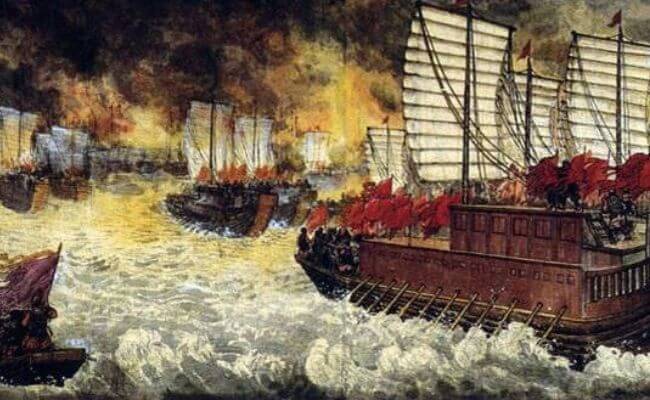
On August 30, 1363, during the Red Turban Rebellion, Chen Youliang’s fleet laid siege to Nanchang via Lake Poyang. In response, Zhu Yuanzhang arrived with a smaller but more agile fleet. Despite being outnumbered, Zhu used mobile squadrons and innovative fire ships (flame-laden boats) to turn the tide.
Over successive days, the Ming forces carried out daring attacks that disrupted the massive “tower ships” of Chen’s fleet. Zhū’s squadrons exploited wind and terrain, unleashing fire ships during a northeast and a northwest wind, devastating the enemy fleet and leading to Chen Youliang’s death from an arrow strike.
The battle concluded by October 4 with Zhu’s complete naval victory, solidifying his power. This pivotal success paved the way for the fall of the Yuan dynasty and the founding of the Ming dynasty in 1368.
Conclusion
The Battle of Lake Poyang stands as one of history’s largest naval battles. It demonstrated how strategic ingenuity, environmental understanding, and bold tactics can overcome overwhelming odds, leading to a decisive victory for the Ming dynasty and shaping the course of Chinese history.
Zhu Yuanzhang’s victory not only eliminated his most formidable rival but also set the stage for the Ming dynasty to establish itself as a Han Chinese restoration that ruled China for nearly three centuries.