Battle of Waterloo
1815 battle of the Waterloo campaign
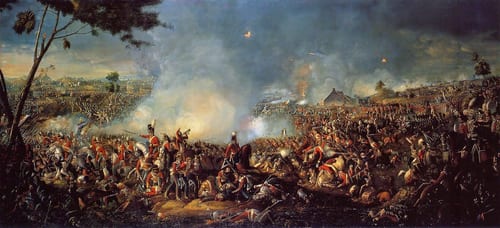
What was Battle of Waterloo?
The Battle of Waterloo was fought on Sunday 18 June 1815, near Waterloo (then in the United Kingdom of the Netherlands, now in Belgium), being the last engagement with Napoleon I. The French Imperial Army under the command of Napoleon I was defeated by two armies of the Seventh Coalition. One was a British-led force with units from the United Kingdom, the Netherlands, Hanover, Brunswick, and Nassau, under the command of field marshal Arthur Wellesley, Duke of Wellington. The other comprised three corps of the Prussian army under Field Marshal Blücher. The battle was known contemporaneously as the Battle of Mont Saint-Jean in France (after the hamlet of Mont-Saint-Jean) and La Belle Alliance in Prussia ("the Beautiful Alliance"; after the inn of La Belle Alliance).






Background and consequences
Upon Napoleon's return to power in March 1815, the beginning of the Hundred Days, many states that had previously opposed him formed the Seventh Coalition to oppose him again, and hurriedly mobilised their armies. Wellington's and Blücher's armies were cantoned close to the northeastern border of France. Napoleon planned to attack them separately, before they could link up and invade France with other members of the coalition. On 16 June, Napoleon successfully attacked the bulk of the Prussian Army at the Battle of Ligny with his main force, while a small portion of the French Imperial Army contested the Battle of Quatre Bras to prevent the Anglo-allied army from reinforcing the Prussians.

Why it matters
The Anglo-allied army held their ground at Quatre Bras but were prevented from reinforcing the Prussians, and on the 17th, the Prussians withdrew from Ligny in good order, while Wellington then withdrew in parallel with the Prussians northward to Waterloo on 17 June. Napoleon sent a third of his forces to pursue the Prussians, which resulted in the separate Battle of Wavre with the Prussian rear-guard on 18–19 June and prevented that French force from participating at Waterloo. Upon learning that the Prussian Army was able to support him, Wellington decided to offer battle on the Mont-Saint-Jean escarpment across the Brussels Road, near the village of Waterloo.