Helicopter crash
Type of rotorcraft

Cite this page
“Helicopter crash.” thisDay, thisday.info/history/helicopter-crash/. Accessed 19 Oct. 2026.
Helicopter crash. (n.d.). thisDay. Retrieved October 19, 2026, from https://thisday.info/history/helicopter-crash/
“Helicopter crash.” thisDay. Accessed October 19, 2026. https://thisday.info/history/helicopter-crash/.
What was Helicopter crash?
A helicopter is a type of rotorcraft in which lift and thrust are supplied by horizontally spinning rotors. This allows the helicopter to take off and land vertically, to hover, and to fly forward, backward and laterally. These attributes allow helicopters to be used in congested or isolated areas where fixed-wing aircraft and many forms of short take-off and landing (STOL) or short take-off and vertical landing (STOVL) aircraft cannot perform without a runway. The Focke-Wulf Fw 61 was the first successful, practical, and fully controllable helicopter in 1936, while in 1942, the Sikorsky R-4 became the first helicopter to reach full-scale production.

 Helicopter crash litigation
Gary C. Robb · 2010
Helicopter Crash Litigation Third Edition
Gary C. Robb · 2023
Comparison of Test and Finite Element Analysis for Two Full-Scale Helicopter Crash Tests
2019
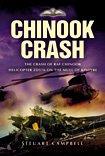 Chinook crash
Steuart Campbell · 2004
CHINOOK CRASH: THE CRASH OF RAF CHINOOK HELICOPTER ZD576 ON THE MULL OF KINTYRE
STEUART CAMPBELL
Background and consequences
Starting in 1939 and through 1943, Igor Sikorsky worked on the development of the VS-300, which over four iterations, became the basis for modern helicopters with a single main rotor and a single tail rotor. Although most earlier designs used more than one main rotor, the configuration of a single main rotor accompanied by a vertical anti-torque tail rotor (i.e. unicopter, not to be confused with the single-blade monocopter) has become the most common helicopter configuration.

Related on thisDay
Cite this page
“Helicopter crash.” thisDay, thisday.info/history/helicopter-crash/. Accessed 19 Oct. 2026.
Helicopter crash. (n.d.). thisDay. Retrieved October 19, 2026, from https://thisday.info/history/helicopter-crash/
“Helicopter crash.” thisDay. Accessed October 19, 2026. https://thisday.info/history/helicopter-crash/.