UNIVAC
Series of mainframe computer models

Cite this page
“UNIVAC.” thisDay, thisday.info/history/univac/. Accessed 19 Oct. 2026.
UNIVAC. (n.d.). thisDay. Retrieved October 19, 2026, from https://thisday.info/history/univac/
“UNIVAC.” thisDay. Accessed October 19, 2026. https://thisday.info/history/univac/.
What was UNIVAC?
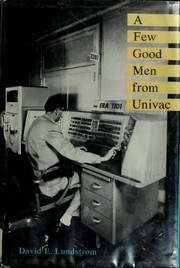
UNIVAC (Universal Automatic Computer) was a line of electronic digital stored-program computers starting with the products of the Eckert–Mauchly Computer Corporation. After capturing the public imagination with the use of the UNIVAC I during the 1952 US Presidential election it was decided to extend the branding to all machines made by the other computing divisions of the Remington Rand company (Engineering Research Associates and the Norwalk Laboratory of Remington Rand). After the merger of Remington Rand with the Sperry Corporation (under name of Sperry Rand) in 1955, it was decided to merge all three divisions along with Remington Rand's tabulator division into one unified organization under the name of the Univac division.



Background and consequences
This name persisted until the mid-1980s when it was renamed to the Sperry Computer Systems Division; the last UNIVAC-badged system was the UNIVAC 1100/90, which was announced in 1982 and first shipped in late 1983. J. Presper Eckert and John Mauchly built the ENIAC (Electronic Numerical Integrator and Computer) at the University of Pennsylvania's Moore School of Electrical Engineering between 1943 and 1946.

Related on thisDay
Cite this page
“UNIVAC.” thisDay, thisday.info/history/univac/. Accessed 19 Oct. 2026.
UNIVAC. (n.d.). thisDay. Retrieved October 19, 2026, from https://thisday.info/history/univac/
“UNIVAC.” thisDay. Accessed October 19, 2026. https://thisday.info/history/univac/.