The Webster–Ashburton Treaty is signed
1842 border treaty between British Canada and the US

What was The Webster–Ashburton Treaty is signed?
The Webster–Ashburton Treaty was a treaty that resolved several border issues between the United States and the British North American colonies (the region that later became the Dominion of Canada). Negotiated in the US federal capital city of Washington, DC, it was signed August 9, 1842, under the new administration of US President John Tyler, who as the former vice president, had just recently succeeded and became chief executive upon the unexpected death of his running mate and predecessor, William Henry Harrison, who had only served a single month in office.
The Daniel Webster–Lord Ashburton negotiations and the newly drawn-up 1842 treaty resolved many of the issues arising from the recent border conflicts and skirmishes between Americans and New Brunswickers in the Aroostook War of 1838–1839. It arose from disputes and controversies over the vague indefinite terms and text of the old peace agreement of the Treaty of Paris of 1783, which ended the American Revolutionary War. The provisions of the 1842 treaty between Britain and the United States included: The settlement of the location of the Maine–New Brunswick international border, which was the primary cause of the Aroostook War.
Establishment of the international border between Lake Superior and the Lake of the Woods, originally defined in the Treaty of Paris in 1783. Reaffirmation of the location of the border (at the 49th parallel) in the westward frontier up to the far western Rocky Mountains defined in the previous Treaty of 1818. Definition of seven crimes subject to extradition. Agreement that the two parties would share use of the Great Lakes. Agreement that there should be an end to the slave trade on the high seas.

 The Treaty of Washington: Concluded August 9, 1842, by Daniel Webster and Lord Ashburton. The ..
Hugh Taylor Gordon · 1908
The Treaty of Washington: Concluded August 9, 1842, by Daniel Webster and Lord Ashburton. The ..
Hugh Taylor Gordon · 1908
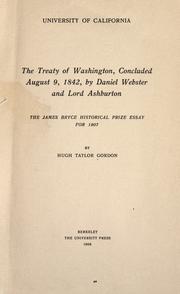 The treaty of Washington
Hugh Taylor Gordon · 1908
The treaty of Washington
Hugh Taylor Gordon · 1908