Adam Smith
Scottish economist and philosopher
Cite this page
“Adam Smith.” thisDay, thisday.info/people/adam-smith/. Accessed 12 Oct. 2026.
Adam Smith. (n.d.). thisDay. Retrieved October 12, 2026, from https://thisday.info/people/adam-smith/
“Adam Smith.” thisDay. Accessed October 12, 2026. https://thisday.info/people/adam-smith/.
Who was Adam Smith?
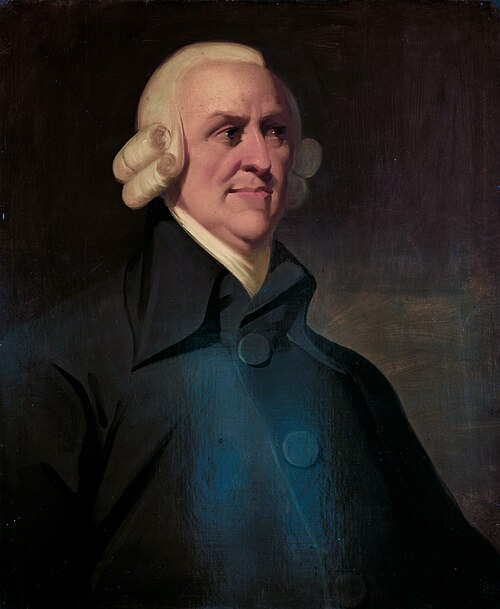
Adam Smith (baptised 16 June [O.S. 5 June] 1723 – 17 July 1790) was a Scottish economist and philosopher who was a pioneer in the field of political economy and key figure during the Scottish Enlightenment. Seen by many as the "father of economics", or the "father of capitalism", he is primarily known for two classic works: The Theory of Moral Sentiments (1759) and An Inquiry into the Nature and Causes of the Wealth of Nations (1776). Smith refuses to explain the distribution of wealth and power in terms of divine will and instead appeals to natural, political, social, economic, legal, environmental and technological factors, as well as the interactions among them.

Historical significance
The latter, often abbreviated as The Wealth of Nations, is regarded as his magnum opus, marking the inception of modern economic scholarship as a comprehensive system and an academic discipline. The work is notable for its contribution to economic theory, particularly in its exposition of the concept of absolute advantage.

Cite this page
“Adam Smith.” thisDay, thisday.info/people/adam-smith/. Accessed 12 Oct. 2026.
Adam Smith. (n.d.). thisDay. Retrieved October 12, 2026, from https://thisday.info/people/adam-smith/
“Adam Smith.” thisDay. Accessed October 12, 2026. https://thisday.info/people/adam-smith/.