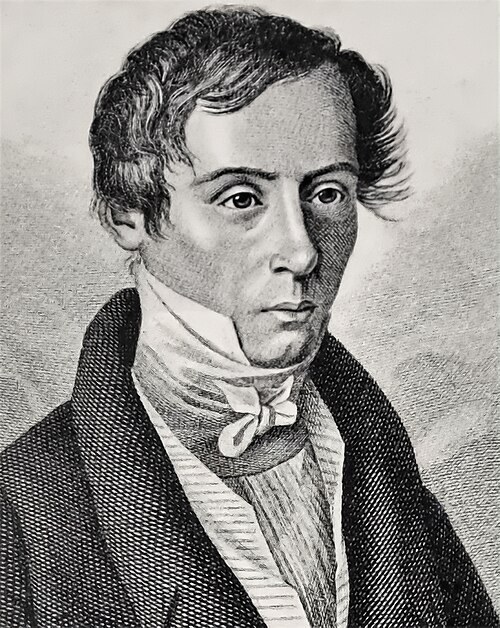
Augustin-Jean Fresnel
French optical physicist
Cite this page
“Augustin-Jean Fresnel.” thisDay, thisday.info/people/augustin-jean-fresnel/. Accessed 12 Oct. 2026.
Augustin-Jean Fresnel. (n.d.). thisDay. Retrieved October 12, 2026, from https://thisday.info/people/augustin-jean-fresnel/
“Augustin-Jean Fresnel.” thisDay. Accessed October 12, 2026. https://thisday.info/people/augustin-jean-fresnel/.
Who was Augustin-Jean Fresnel?
Augustin-Jean Fresnel (10 May 1788 – 14 July 1827) was a French civil engineer and physicist whose research in optics led to the almost unanimous acceptance of the wave theory of light, fully supplanting Newton's corpuscular theory, from the late 1830s until the end of the 19th century. By further supposing that light waves are purely transverse, Fresnel explained the nature of polarization. He then worked on double refraction.

Historical significance
He is perhaps better known for inventing the catadioptric (reflective/refractive) Fresnel lens and for pioneering the use of "stepped" lenses to extend the visibility of lighthouses, saving countless lives at sea. The simpler dioptric (purely refractive) stepped lens, first proposed by Count Buffon and independently reinvented by Fresnel, is used in screen magnifiers and in condenser lenses for overhead projectors. Fresnel gave the first satisfactory explanation of diffraction by straight edges, including the first satisfactory wave-based explanation of rectilinear propagation.

Cite this page
“Augustin-Jean Fresnel.” thisDay, thisday.info/people/augustin-jean-fresnel/. Accessed 12 Oct. 2026.
Augustin-Jean Fresnel. (n.d.). thisDay. Retrieved October 12, 2026, from https://thisday.info/people/augustin-jean-fresnel/
“Augustin-Jean Fresnel.” thisDay. Accessed October 12, 2026. https://thisday.info/people/augustin-jean-fresnel/.