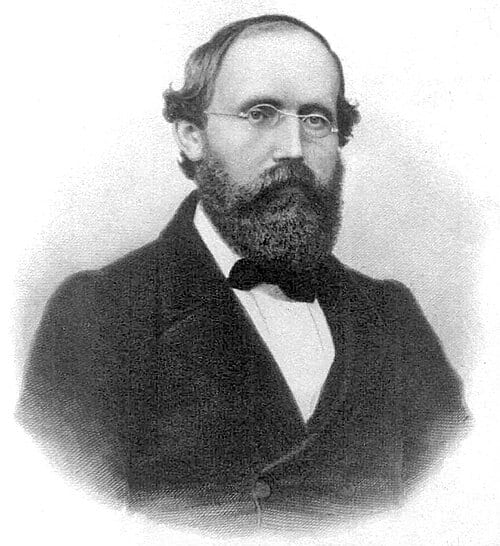
Bernhard Riemann
German mathematician
Cite this page
“Bernhard Riemann.” thisDay, thisday.info/people/bernhard-riemann/. Accessed 19 Oct. 2026.
Bernhard Riemann. (n.d.). thisDay. Retrieved October 19, 2026, from https://thisday.info/people/bernhard-riemann/
“Bernhard Riemann.” thisDay. Accessed October 19, 2026. https://thisday.info/people/bernhard-riemann/.
Who was Bernhard Riemann?
Georg Friedrich Bernhard Riemann (; German: [ˈɡeːɔʁk ˈfʁiːdʁɪç ˈbɛʁnhaʁt ˈʁiːman] ; 17 September 1826 – 20 July 1866) was a German mathematician who made profound contributions to analysis, number theory, and differential geometry. Riemann was born in Breselenz, a village near Dannenberg in the Kingdom of Hanover. His father, Friedrich Bernhard Riemann, was a poor Lutheran pastor in Breselenz who fought in the Napoleonic Wars. His contributions to complex analysis include most notably the introduction of Riemann surfaces, breaking new ground in a natural, geometric treatment of complex analysis. Through his pioneering contributions to differential geometry, Riemann laid the foundations of the mathematics of general relativity. He is considered by many to be one of the greatest mathematicians of all time.

Historical significance
In the field of real analysis, he is mostly known for the first rigorous formulation of the integral, the Riemann integral, and his work on Fourier series. His 1859 paper on the prime-counting function, containing the original statement of the Riemann hypothesis, is regarded as a foundational paper of analytic number theory.
Cite this page
“Bernhard Riemann.” thisDay, thisday.info/people/bernhard-riemann/. Accessed 19 Oct. 2026.
Bernhard Riemann. (n.d.). thisDay. Retrieved October 19, 2026, from https://thisday.info/people/bernhard-riemann/
“Bernhard Riemann.” thisDay. Accessed October 19, 2026. https://thisday.info/people/bernhard-riemann/.