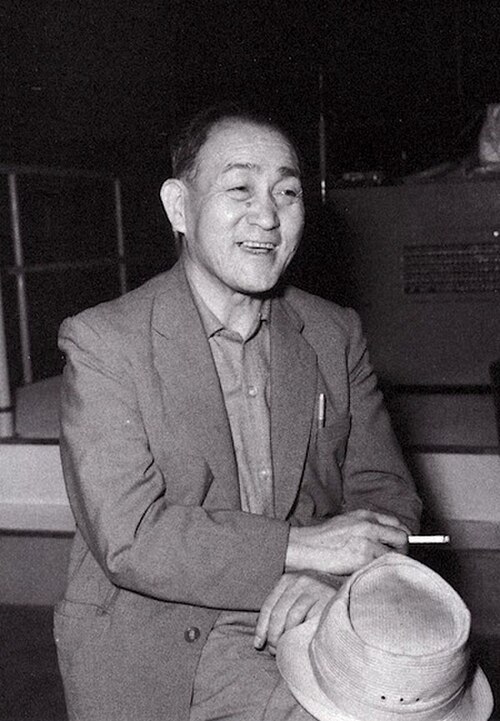
Eiji Tsuburaya
Japanese special effects director
Cite this page
“Eiji Tsuburaya.” thisDay, thisday.info/people/eiji-tsuburaya/. Accessed 5 Oct. 2026.
Eiji Tsuburaya. (n.d.). thisDay. Retrieved October 5, 2026, from https://thisday.info/people/eiji-tsuburaya/
“Eiji Tsuburaya.” thisDay. Accessed October 5, 2026. https://thisday.info/people/eiji-tsuburaya/.
Who was Eiji Tsuburaya?
Eiji Tsuburaya (Japanese: 円谷 英二, Hepburn: Tsuburaya Eiji; July 7, 1901 – January 25, 1970) was a Japanese special effects director, filmmaker, and cinematographer. Tsuburaya is known as the "Father of Tokusatsu", having pioneered Japan's special effects industry and introduced several technological developments in film productions. Thereafter, he worked as an assistant cinematographer on several films, including Teinosuke Kinugasa's A Page of Madness (1926). At the age of thirty-two, Tsuburaya watched King Kong, which greatly influenced him to work in special effects.

Historical significance
A co-creator of the Godzilla and Ultraman franchises, he is considered one of the most important and influential figures in the history of cinema. In a career spanning five decades, Tsuburaya worked on approximately 250 films—including globally renowned features directed by Ishirō Honda, Hiroshi Inagaki, and Akira Kurosawa—and earned six Japan Technical Awards. Following a brief stint as an inventor, Tsuburaya was employed by Japanese cinema pioneer Yoshirō Edamasa in 1919 and began his career working as an assistant cinematographer on Edamasa's A Tune of Pity.

Cite this page
“Eiji Tsuburaya.” thisDay, thisday.info/people/eiji-tsuburaya/. Accessed 5 Oct. 2026.
Eiji Tsuburaya. (n.d.). thisDay. Retrieved October 5, 2026, from https://thisday.info/people/eiji-tsuburaya/
“Eiji Tsuburaya.” thisDay. Accessed October 5, 2026. https://thisday.info/people/eiji-tsuburaya/.