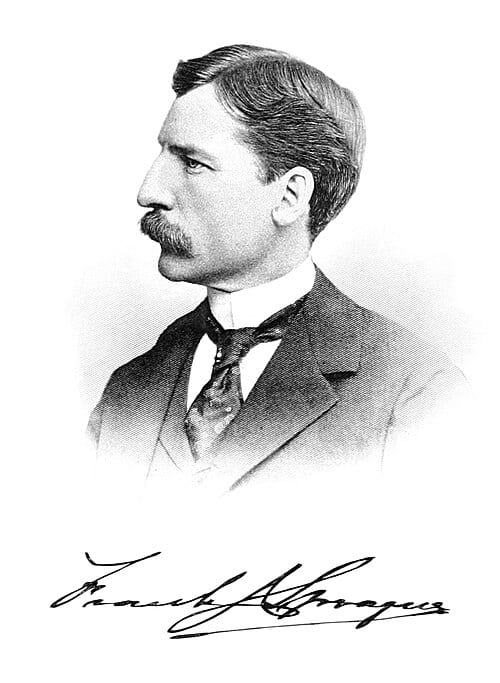
Frank J. Sprague
American inventor and pioneer in electrical engineering
Cite this page
“Frank J. Sprague.” thisDay, thisday.info/people/frank-j-sprague/. Accessed 19 Oct. 2026.
Frank J. Sprague. (n.d.). thisDay. Retrieved October 19, 2026, from https://thisday.info/people/frank-j-sprague/
“Frank J. Sprague.” thisDay. Accessed October 19, 2026. https://thisday.info/people/frank-j-sprague/.
Who was Frank J. Sprague?
Frank Julian Sprague (July 25, 1857 – October 25, 1934) was an American inventor who contributed to the development of the electric motor, electric railways, and electric elevators. He became known as the "father of electric traction". Sprague was born in Milford, Connecticut, in 1857 to David Cummings Sprague and Frances Julia King Sprague, a school teacher. His mother died when he was ten, and he was sent by his father to live with an aunt in New York. He attended Drury High School in North Adams, Massachusetts, and excelled in mathematics. His contributions were especially important in promoting urban development by increasing the size cities could reasonably attain (through better transportation) and by allowing greater concentration of business in commercial sections (through the use of electric elevators in skyscrapers).

Historical significance
Demonstrating an aptitude for science and mathematics, Sprague secured an appointment to the U.S. Naval Academy in 1874 and, after graduation in 1878 and 2 years at sea, resigned to pursue his career in electrical engineering. His contributions were especially important in promoting urban development by increasing the size cities could reasonably attain and by allowing greater concentration of business in commercial sections.

Cite this page
“Frank J. Sprague.” thisDay, thisday.info/people/frank-j-sprague/. Accessed 19 Oct. 2026.
Frank J. Sprague. (n.d.). thisDay. Retrieved October 19, 2026, from https://thisday.info/people/frank-j-sprague/
“Frank J. Sprague.” thisDay. Accessed October 19, 2026. https://thisday.info/people/frank-j-sprague/.