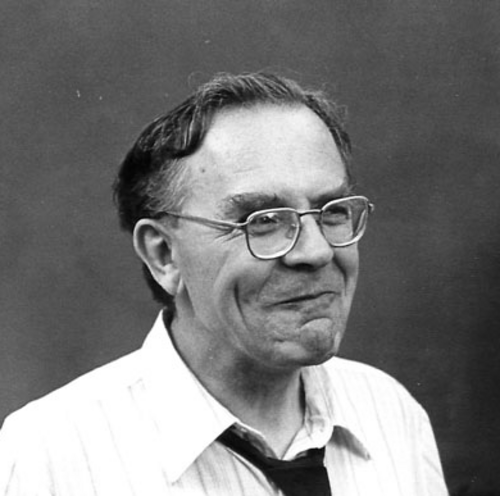
Geoffrey Wilkinson
English chemist and Nobel prize winner
Cite this page
“Geoffrey Wilkinson.” thisDay, thisday.info/people/geoffrey-wilkinson/. Accessed 12 Oct. 2026.
Geoffrey Wilkinson. (n.d.). thisDay. Retrieved October 12, 2026, from https://thisday.info/people/geoffrey-wilkinson/
“Geoffrey Wilkinson.” thisDay. Accessed October 12, 2026. https://thisday.info/people/geoffrey-wilkinson/.
Who was Geoffrey Wilkinson?
Sir Geoffrey Wilkinson FRS (14 July 1921 – 26 September 1996) was a Nobel laureate English chemist who pioneered inorganic chemistry and homogeneous transition metal catalysis. Wilkinson was born at Springside, Todmorden, in the West Riding of Yorkshire. His father, Henry Wilkinson, was a master house painter and decorator; his mother, Ruth, worked in a local cotton mill. One of his uncles, an organist and choirmaster, had married into a family that owned a small chemical company making Epsom and Glauber's salts for the pharmaceutical industry; this is where he first developed an interest in chemistry. He was educated at the local council primary school and, after winning a County Scholarship in 1932, went to Todmorden Grammar School.
In 1939 he obtained a Royal Scholarship for study at Imperial College London, from where he graduated in 1941, with his PhD awarded in 1946 entitled "Some physico-chemical observations of hydrolysis in the homogeneous vapour phase".

Historical significance
His physics teacher there, Luke Sutcliffe, had also taught Sir John Cockcroft, who received a Nobel Prize for "splitting the atom".
Cite this page
“Geoffrey Wilkinson.” thisDay, thisday.info/people/geoffrey-wilkinson/. Accessed 12 Oct. 2026.
Geoffrey Wilkinson. (n.d.). thisDay. Retrieved October 12, 2026, from https://thisday.info/people/geoffrey-wilkinson/
“Geoffrey Wilkinson.” thisDay. Accessed October 12, 2026. https://thisday.info/people/geoffrey-wilkinson/.