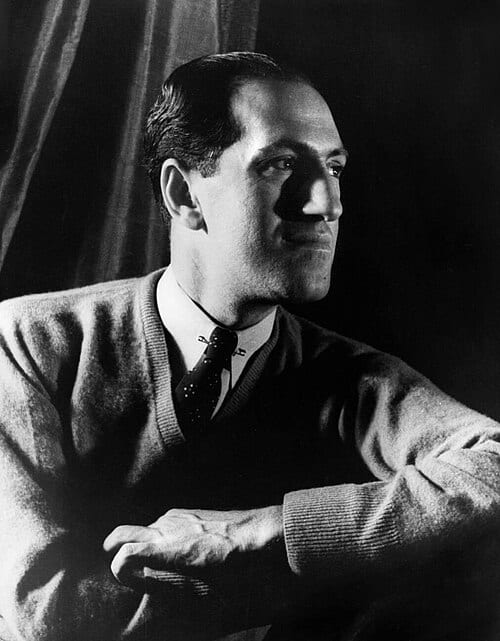
George Gershwin
American composer and pianist
Cite this page
“George Gershwin.” thisDay, thisday.info/people/george-gershwin/. Accessed 5 Oct. 2026.
George Gershwin. (n.d.). thisDay. Retrieved October 5, 2026, from https://thisday.info/people/george-gershwin/
“George Gershwin.” thisDay. Accessed October 5, 2026. https://thisday.info/people/george-gershwin/.
Who was George Gershwin?
George Gershwin (; born Jacob Gershwine; September 26, 1898 – July 11, 1937) was an American composer and pianist whose compositions spanned jazz, popular and classical music. He began his career as a song plugger but soon started composing Broadway theater works with his brother Ira Gershwin and with Buddy DeSylva. Among his best-known works are the songs "Swanee" (1919) and "Fascinating Rhythm" (1924), the orchestral compositions Rhapsody in Blue (1924) and An American in Paris (1928), the jazz standards "Embraceable You" (1928) and "I Got Rhythm" (1930) and the opera Porgy and Bess (1935), which included the hit "Summertime". Gershwin studied piano under Charles Hambitzer and composition with Rubin Goldmark, Henry Cowell, and Joseph Brody.
He moved to Paris, intending to study with Nadia Boulanger, but she refused him, afraid that rigorous classical study would ruin his jazz-influenced style; Maurice Ravel voiced similar objections when Gershwin inquired about studying with him.

Historical significance
His Of Thee I Sing (1931) was the first musical to win the Pulitzer Prize for Drama, although as composer, he did not participate in reception of the award.

Cite this page
“George Gershwin.” thisDay, thisday.info/people/george-gershwin/. Accessed 5 Oct. 2026.
George Gershwin. (n.d.). thisDay. Retrieved October 5, 2026, from https://thisday.info/people/george-gershwin/
“George Gershwin.” thisDay. Accessed October 5, 2026. https://thisday.info/people/george-gershwin/.