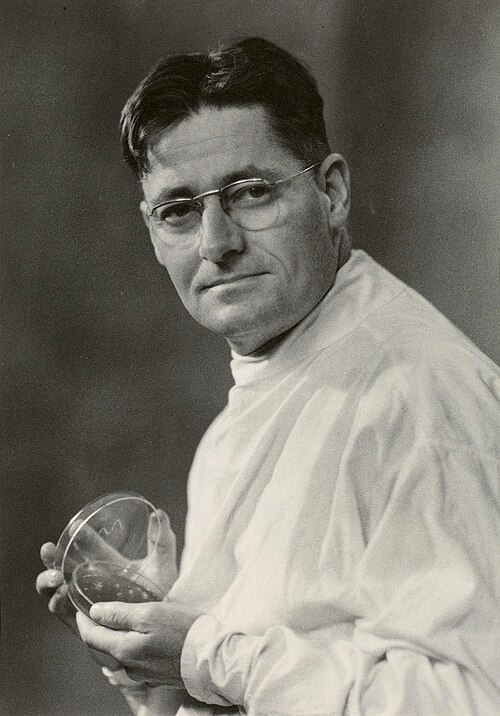
Howard Florey
Australian pathologist
Cite this page
“Howard Florey.” thisDay, thisday.info/people/howard-florey/. Accessed 12 Oct. 2026.
Howard Florey. (n.d.). thisDay. Retrieved October 12, 2026, from https://thisday.info/people/howard-florey/
“Howard Florey.” thisDay. Accessed October 12, 2026. https://thisday.info/people/howard-florey/.
Who was Howard Florey?
Howard Walter Florey, Baron Florey of Adelaide and Marston (; 24 September 1898 – 21 February 1968) was an Australian pharmacologist and pathologist who shared the Nobel Prize in Physiology or Medicine in 1945 with Ernst Chain and Sir Alexander Fleming "for the discovery of penicillin and its curative effect in various infectious diseases". Although Fleming received most of the credit for the discovery of penicillin, it was Florey and his team at the University of Oxford who made it into a useful and effective drug, ten years after Fleming had abandoned its development. A graduate of the University of Adelaide, Florey studied at the University of Oxford as a Rhodes Scholar and in the United States on a fellowship from the Rockefeller Foundation. In 1935, he became the director of the Sir William Dunn School of Pathology at Oxford.
He was involved in the founding of the Australian National University in Canberra and the establishment of its John Curtin School of Medical Research, and he served as chancellor of the Australian National University from 1965 until his death in 1968. In 1962, he became provost of The Queen's College, Oxford. Australian prime minister Sir Robert Menzies said, "In terms of world well-being, Florey was the most important man ever born in Australia." In 1941, they used it to treat a police constable from Oxford. He started to recover, but subsequently died because Florey was unable, at that time, to make enough penicillin. Later trials in Britain, the United States and North Africa were highly successful. In addition to his work on penicillin, he researched many other subjects, most notably lysozyme, contraception and cephalosporins.
He was elected a fellow of the Royal Society in 1941, and as its president from 1960 to 1965, he oversaw its move to new accommodations at Carlton House Terrace and the establishment of links with European organisations.

Historical significance
They developed techniques for growing, purifying and manufacturing the drug, tested it for toxicity and efficacy on animals, and carried out the first clinical trials. He assembled a multidisciplinary staff that could tackle major research projects. Florey's discoveries are estimated to have saved over 80 million lives, and he is regarded by the Australian scientific and medical community as one of its greatest figures.

Cite this page
“Howard Florey.” thisDay, thisday.info/people/howard-florey/. Accessed 12 Oct. 2026.
Howard Florey. (n.d.). thisDay. Retrieved October 12, 2026, from https://thisday.info/people/howard-florey/
“Howard Florey.” thisDay. Accessed October 12, 2026. https://thisday.info/people/howard-florey/.