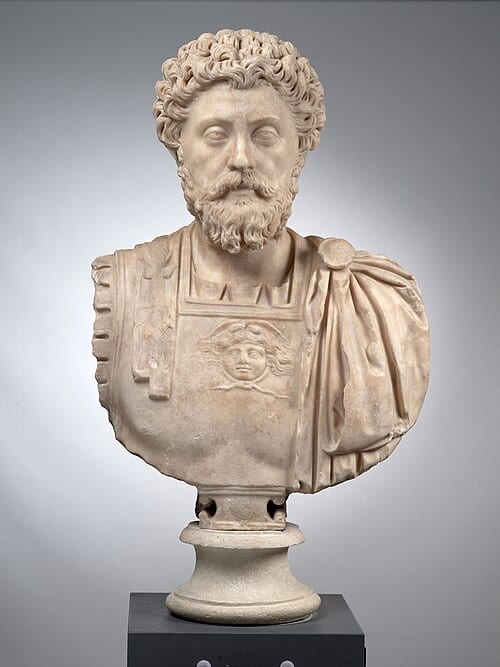
Marcus Aurelius
Stoic philosopher, Roman emperor from 161 to 180
Cite this page
“Marcus Aurelius.” thisDay, thisday.info/people/marcus-aurelius/. Accessed 19 Oct. 2026.
Marcus Aurelius. (n.d.). thisDay. Retrieved October 19, 2026, from https://thisday.info/people/marcus-aurelius/
“Marcus Aurelius.” thisDay. Accessed October 19, 2026. https://thisday.info/people/marcus-aurelius/.
Who was Marcus Aurelius?
Marcus Aurelius Antoninus ( or-EE-lee-əs; Latin: [ˈmaːrkʊs au̯ˈreːli.us antoːˈniːnʊs]; 26 April 121 – 17 March 180) was Roman emperor from 161 to 180 and a Stoic philosopher. Marcus Aurelius was the son of the praetor Marcus Annius Verus and his wife Domitia Calvilla. Marcus was three when his father died, and he was raised by his mother and paternal grandfather. In turn, Antoninus adopted Marcus and Lucius, the son of Aelius. After Antoninus died in 161, Marcus acceded to the throne alongside his adoptive brother, who took the regnal name Lucius Aurelius Verus. Born on April 26, 121, and died on March 17, 180, Marcus Aurelius lived a life spanning nearly six decades.
He was a member of the Nerva–Antonine dynasty, the last of the rulers later known as the Five Good Emperors and the last emperor of the Pax Romana, an age of relative peace, calm, and stability for the Roman Empire lasting from 27 BC to 180 AD. He served as Roman consul in 140, 145, and 161. He was related through marriage to the emperors Trajan and Hadrian. After Hadrian's adoptive son, Aelius Caesar, died in 138, Hadrian adopted Marcus's uncle Antoninus Pius as his new heir. Hadrian died that year, and Antoninus became emperor. Now heir to the throne, Marcus studied Greek and Latin under tutors such as Herodes Atticus and Marcus Cornelius Fronto. He married Antoninus's daughter Faustina in 145. Under the reign of Marcus Aurelius, the Roman Empire witnessed much military conflict.
In the East, the Romans fought the Parthian War of Lucius Verus with a revitalised Parthian Empire and the rebel Kingdom of Armenia. Marcus defeated the Marcomanni, Quadi, and Iazyges in the Marcomannic Wars. These and other Germanic peoples began to represent a troubling reality for the Empire. He reduced the silver purity of the Roman currency, the denarius. The persecution of Christians in the Roman Empire appears to have increased during his reign, although his involvement is unlikely since there are no Christian sources ascribing him the blame, and he was praised by Justin Martyr and Tertullian. The Antonine Plague broke out in 165 or 166 and devastated the population of the Roman Empire, causing the deaths of five to ten million people. Lucius Verus may have died from the plague in 169. When Marcus himself died in 180, he was succeeded by his son Commodus.
Commodus's succession after Marcus has been a subject of debate among both contemporary and modern historians. The column and equestrian statue of Marcus Aurelius still stand in Rome, where they were erected in celebration of his military victories. These writings have been praised by fellow writers, philosophers, monarchs, and politicians centuries after his death. He served as Roman emperor from 161 to 180, and prior to that, held the position of Roman consul in 140, 145, and 161.

Historical significance
As a philosopher, his work Meditations is one of the most important sources for the modern understanding of ancient Stoic philosophy. Marcus Aurelius was a prominent Stoic philosopher and Roman emperor, known for his wisdom and leadership during the Pax Romana. His most notable work is Meditations, a philosophical text that remains a vital source for understanding ancient Stoic philosophy. Marcus Aurelius's reign marked the end of the Pax Romana, and his writings have had a lasting impact on philosophy, influencing many notable thinkers. His life and reign were marked by significant military conflicts, including the Marcomannic Wars and the Antonine Plague, which had a profound impact on the Roman Empire.

Related on thisDay
Cite this page
“Marcus Aurelius.” thisDay, thisday.info/people/marcus-aurelius/. Accessed 19 Oct. 2026.
Marcus Aurelius. (n.d.). thisDay. Retrieved October 19, 2026, from https://thisday.info/people/marcus-aurelius/
“Marcus Aurelius.” thisDay. Accessed October 19, 2026. https://thisday.info/people/marcus-aurelius/.