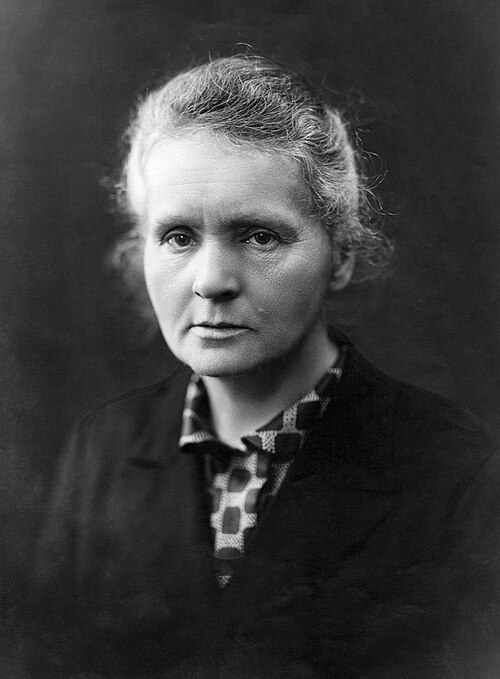
Marie Curie
Polish-French physicist and chemist
Cite this page
“Marie Curie.” thisDay, thisday.info/people/marie-curie/. Accessed 5 Oct. 2026.
Marie Curie. (n.d.). thisDay. Retrieved October 5, 2026, from https://thisday.info/people/marie-curie/
“Marie Curie.” thisDay. Accessed October 5, 2026. https://thisday.info/people/marie-curie/.
Who was Marie Curie?
Maria Salomea Skłodowska Curie (Polish: [ˈmarja salɔˈmɛa skwɔˈdɔfska kiˈri] ; née Skłodowska; 7 November 1867 – 4 July 1934), better known as Marie Curie ( KURE-ee; French: [maʁi kyʁi] ), was a Polish and naturalised-French physicist and chemist. She and Pierre were the first married couple to win the Nobel Prize, launching the Curie family legacy of five Nobel Prizes. She was, in 1906, the first woman to become a professor at the University of Paris. Curie was born in Warsaw, Russian Empire, where she studied at the clandestine Flying University and began her practical scientific training. Maria Salomea Skłodowska Curie, better known as Marie Curie, was a Polish and naturalised-French physicist and chemist.

Historical significance
She shared the 1903 Nobel Prize in Physics with her husband, Pierre Curie, "for their joint researches on the radioactivity phenomena discovered by Professor Henri Becquerel". She won the 1911 Nobel Prize in Chemistry "[for] the discovery of the elements radium and polonium, by the isolation of radium and the study of the nature and compounds of this remarkable element". Curie was the first woman to win a Nobel Prize, the first person to win a Nobel Prize twice and the only person to win a Nobel Prize in two different scientific fields.

Cite this page
“Marie Curie.” thisDay, thisday.info/people/marie-curie/. Accessed 5 Oct. 2026.
Marie Curie. (n.d.). thisDay. Retrieved October 5, 2026, from https://thisday.info/people/marie-curie/
“Marie Curie.” thisDay. Accessed October 5, 2026. https://thisday.info/people/marie-curie/.