Robert Burns Woodward
American chemist
Cite this page
“Robert Burns Woodward.” thisDay, thisday.info/people/robert-burns-woodward/. Accessed 5 Oct. 2026.
Robert Burns Woodward. (n.d.). thisDay. Retrieved October 5, 2026, from https://thisday.info/people/robert-burns-woodward/
“Robert Burns Woodward.” thisDay. Accessed October 5, 2026. https://thisday.info/people/robert-burns-woodward/.
Who was Robert Burns Woodward?
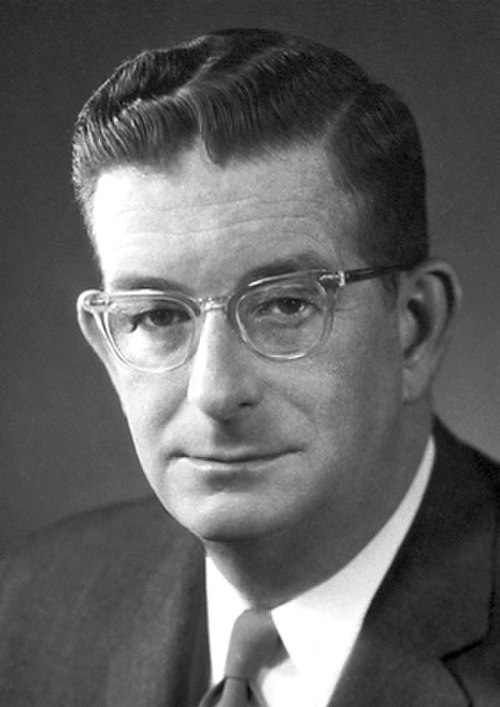
Robert Burns Woodward (April 10, 1917 – July 8, 1979) was an American organic chemist. Woodward was born in Boston, Massachusetts, on. He was the son of Margaret Burns (an immigrant from Scotland who claimed to be a descendant of the poet, Robert Burns) and her husband, Arthur Chester Woodward, himself the son of Roxbury apothecary, Harlow Elliot Woodward. His father was one of the many victims of the 1918 influenza pandemic. From a very early age, Woodward was attracted to and engaged in private study of chemistry while he attended a public primary school, and then Quincy High School, in Quincy, Massachusetts. He is considered by many to be the preeminent synthetic organic chemist of the twentieth century, having made many key contributions to the subject, especially in the synthesis of complex natural products and the determination of their molecular structure.
He worked closely with Roald Hoffmann on theoretical studies of chemical reactions.

Historical significance
He was awarded the Nobel Prize in Chemistry in 1965.
Cite this page
“Robert Burns Woodward.” thisDay, thisday.info/people/robert-burns-woodward/. Accessed 5 Oct. 2026.
Robert Burns Woodward. (n.d.). thisDay. Retrieved October 5, 2026, from https://thisday.info/people/robert-burns-woodward/
“Robert Burns Woodward.” thisDay. Accessed October 5, 2026. https://thisday.info/people/robert-burns-woodward/.