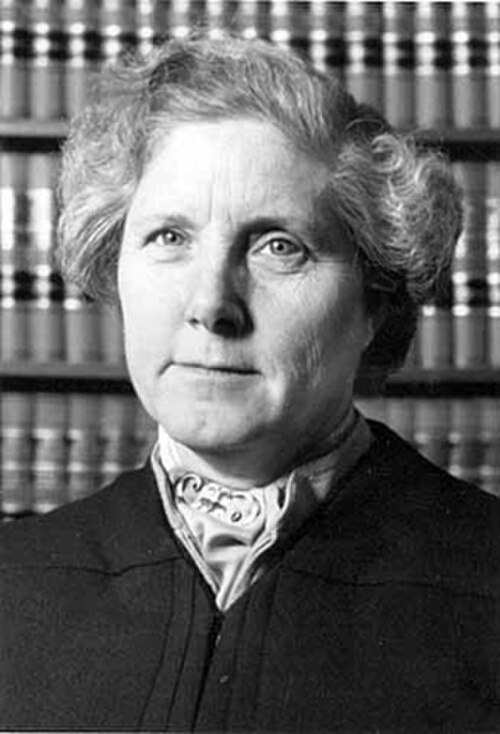
Rosalie E. Wahl
American judge
Cite this page
“Rosalie E. Wahl.” thisDay, thisday.info/people/rosalie-e-wahl/. Accessed 19 Oct. 2026.
Rosalie E. Wahl. (n.d.). thisDay. Retrieved October 19, 2026, from https://thisday.info/people/rosalie-e-wahl/
“Rosalie E. Wahl.” thisDay. Accessed October 19, 2026. https://thisday.info/people/rosalie-e-wahl/.
Who was Rosalie E. Wahl?
Sara Rosalie Wahl (née Erwin; August 27, 1924 – July 22, 2013) was an American feminist, lawyer, public defender, clinical law professor, and judge. She chaired the state's Gender Bias Taskforce and Racial Bias Taskforce and led the American Bar Association's efforts to establish clinical legal education. Born in Caney, Kansas, Wahl suffered several traumatic losses early in life. Her mother died when she was three, and her grandmother and Aunt Sara raised her. Governor Rudy Perpich nominated Wahl to the Minnesota Supreme Court in 1977 and Wahl won the election to the seat in a non-partisan election in 1978, defeating three male candidates. She wrote 549 opinions including for the majority in holding that different penalties for crack and powder cocaine were unconstitutional in State v. Russell (477 N.W.2d 886 [Minn.1993]). When she was seven, she opened the railroad crossing gate for their horse-drawn wagon.
She wrote 549 opinions including for the majority in holding that different penalties for crack and powder cocaine were unconstitutional in State v. Russell.
Historical significance
She was the first woman to serve on the Minnesota Supreme Court, which she did for some seventeen years. She was a champion for the mentally ill and for displaced homemakers.
Cite this page
“Rosalie E. Wahl.” thisDay, thisday.info/people/rosalie-e-wahl/. Accessed 19 Oct. 2026.
Rosalie E. Wahl. (n.d.). thisDay. Retrieved October 19, 2026, from https://thisday.info/people/rosalie-e-wahl/
“Rosalie E. Wahl.” thisDay. Accessed October 19, 2026. https://thisday.info/people/rosalie-e-wahl/.