Rosalind Franklin
British X-ray crystallographer
Cite this page
“Rosalind Franklin.” thisDay, thisday.info/people/rosalind-franklin/. Accessed 19 Oct. 2026.
Rosalind Franklin. (n.d.). thisDay. Retrieved October 19, 2026, from https://thisday.info/people/rosalind-franklin/
“Rosalind Franklin.” thisDay. Accessed October 19, 2026. https://thisday.info/people/rosalind-franklin/.
Who was Rosalind Franklin?
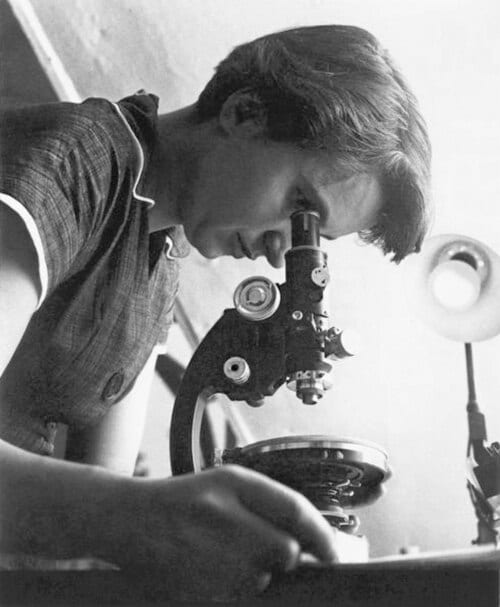
Rosalind Elsie Franklin (25 July 1920 – 16 April 1958) was an English chemist and X-ray crystallographer. Franklin graduated in 1941 with a degree in natural sciences from Newnham College, Cambridge, and then enrolled for a PhD in physical chemistry under Ronald George Wreyford Norrish, the 1920 Chair of Physical Chemistry at the University of Cambridge. Her work was central to the understanding of the molecular structures of DNA (deoxyribonucleic acid), RNA (ribonucleic acid), viruses, coal, and graphite. Although her works on coal and viruses were appreciated in her lifetime, Franklin's contributions to the discovery of the structure of DNA were largely unrecognised during her life, for which Franklin has been variously referred to as the "wronged heroine", the "dark lady of DNA", the "forgotten heroine", a "feminist icon", and the "Sylvia Plath of molecular biology".
Disappointed by Norrish's lack of enthusiasm, she took up a research position under the British Coal Utilisation Research Association (BCURA) in 1942. Her work was central to the understanding of the molecular structures of DNA, RNA, viruses, coal, and graphite.

Historical significance
James Watson believed that, had she not died, ideally, Franklin would have been awarded a Nobel Prize in Chemistry.

Cite this page
“Rosalind Franklin.” thisDay, thisday.info/people/rosalind-franklin/. Accessed 19 Oct. 2026.
Rosalind Franklin. (n.d.). thisDay. Retrieved October 19, 2026, from https://thisday.info/people/rosalind-franklin/
“Rosalind Franklin.” thisDay. Accessed October 19, 2026. https://thisday.info/people/rosalind-franklin/.