December 30 in History

Reapers' War: Louis XIII of France swears the Catalan constitutions, being appoi

1641 — Reapers' War: Louis XIII of France swears the Catalan constitutions, being appointed Count of Barcelona and thus establishing the personal union of the Principality of Catalonia with the Kingdom of France

December 30 spans 48 recorded events across recorded history, from 534 to 2020. Below is a curated digest of the most significant moments tied to this date.

By · Wikipedia

Historical Events 48 events 534 – 2020

More major events on December 30

The featured story and these ranked highlights form a quick summary. Every recorded event remains available in the chronology below.

  1. 1987 Stella Sigcau, Prime minister of the South African Bantustan of Transkei, is ousted from power in a bloodless military coup led by General Bantu Holomisa. Source
  2. 1993 Israel establishes diplomatic relations with Vatican City and also upgrades to full diplomatic relations with Ireland. Source
  3. 1954 The Finnish National Bureau of Investigation is established to consolidate criminal investigation and intelligence into a single agency. Source

Did you know

The Catalan constitutions were first promulgated in 1283 by the Count of Barcelona and the Catalan Courts.

Did you know

The last Catalan constitutions were promulgated by the Corts of 1705-1706, marking the end of the legal framework.

Did you know

The Usages of Barcelona served as the foundation for the Catalan constitutions, which built upon this existing legal framework.

Did you know

The Catalan Courts held the exclusive power to revoke the constitutions, emphasizing their pre-eminence over royal decrees.

Did you know

The codification of the Catalan constitutions followed the Roman tradition of the Codex, reflecting the region's historical ties to Roman law.


534
The second and final edition of the Code of Justinian comes into effect in the Byzantine Empire.
Calendar year
Year 534 (DXXXIV) was a common year starting on Sunday of the Julian calendar. At the time, it was known as the Year of the Consulship of Iustinianus and Paulinus. The denomination 534 for this year has been used since the early medieval period, when the Anno Domini calendar era became the prevalent method in Europe for naming years.
534
Battle of Glenmama: The combined forces of Munster and Meath under king Brian Boru inflict a crushing defeat on the allied armies of Leinster and Dublin near Lyons Hill in Ireland.
Calendar year
Year 999 (CMXCIX) was a common year starting on Sunday of the Julian calendar.
999
Granada massacre: A Muslim mob storms the royal palace in Granada, crucifies Jewish vizier Joseph ibn Naghrela and massacres most of the Jewish population of the city.
Mass killing of Jews by Muslim mobs in modern-day Spain
The 1066 Granada massacre took place on 30 December 1066 when a Muslim mob stormed the royal palace in Granada, in the Taifa of Granada, killed and crucified the Jewish vizier Joseph ibn Naghrela, and massacred members of the city’s Jewish community.
1066
Hundred_Years'_War,_1415–1453
Hundred Years' War: Battle of La Rochelle.
Third phase of the Hundred Years' War
The Lancastrian War was the third and final phase of the Hundred Years' War between England and France. It lasted from 1415, when Henry V of England invaded Normandy, to 1453, when the English were definitively defeated in Aquitaine. It followed a long period of peace from the end of the Caroline War in 1389. The phase is named after the House of Lancaster, the ruling house of the Kingdom of England, to which Henry V belonged. The early years of the Lancastrian War were dominated by the forces of the House of Plantagenet, who held the English throne and also claimed that of France. Initial English successes, notably at the Battle of Agincourt, coupled with divisions among the French ruling class, allowed Henry V to win the allegiance of large parts of France. Under the terms of the Treaty of Troyes of 1420, Henry V married the French princess Catherine of Valois and was made regent of the kingdom and heir to the throne of France. A victory on paper was thus achieved by the English, with their claims now having legal standing. Some of the French nobility refused to recognise the agreement, however, and so military conflict continued. Henry V and, after his death, his brother John, Duke of Bedford, brought the English to the height of their power in France, with a Plantagenet crowned in Paris.
1419
Wars_of_the_Roses
Wars of the Roses: Lancastrians kill the 3rd Duke of York and win the Battle of Wakefield.
Series of civil wars in England (1455–1487)
The Wars of the Roses, known at the time and in following centuries as the Civil Wars, were a series of armed confrontations, machinations, battles and campaigns fought for control of the English throne from 1455 to 1487. The conflict was fought between supporters of the House of York and the House of Lancaster, two rival cadet branches of the royal House of Plantagenet. The conflict resulted in the end of Lancaster's male line in 1471, leaving the Tudor family to inherit, through the female line, the Lancaster claim to the throne. Conflict was largely brought to an end upon the union of the two houses through marriage, creating the Tudor dynasty that would subsequently rule England.
1460
Queen_Anne's_War
Queen Anne's War: James Moore, Governor of the Province of Carolina, abandons the Siege of St.
Augustine.
Queen Anne's War (1702–1713) was the second in a series of French and Indian Wars fought in North America involving the colonial empires of Great Britain, France, and Spain. In the United States, it is regarded as a standalone conflict. Elsewhere it is viewed as the American theater of the War of the Spanish Succession. It is also known as the Third Indian War. In France it was known as the Second Intercolonial War.
1702
War_of_1812
War of 1812: British soldiers burn Buffalo, New York.
1812–1815 conflict in North America
The War of 1812 was a conflict initiated by the United States against the United Kingdom and its allies fought mainly in North America and at sea during the wider Napoleonic Wars. The United States declared war on Britain on 18 June 1812. Although peace terms were agreed upon in the December 1814 Treaty of Ghent, the war did not officially end until the peace treaty was ratified by the United States Senate on 17 February 1815.
1813
The Treaty of St.
Louis between the United States and the united Ottawa, Ojibwa, and Potawatomi Indian tribes is proclaimed.
The Treaty of St. Louis of 1816 was treaty signed by Ninian Edwards, William Clark, and Auguste Chouteau for the United States and representatives of the Council of Three Fires residing on the Illinois and Milwaukee rivers, signed on August 24, 1816, and proclaimed on December 30, 1816. Despite the name, the treaty was conducted at Portage des Sioux, Missouri, located immediately north of St. Louis, Missouri.
1816
The Treaty of St.
Louis between the United States and the Shawnee Nation is proclaimed.
The Treaty of St. Louis is the name of a series of treaties signed between the United States and various Native American tribes from 1804 through 1824. The fourteen treaties were all signed in the St. Louis, Missouri area.
1825
Gadsden_Purchase
Gadsden Purchase: The United States buys land from Mexico to facilitate railroad building in the Southwest.
Land purchased from Mexico by the United States in 1854
The Gadsden Purchase, also known as the Treaty of Mesilla, is a 29,640-square-mile (76,800 km2) region of present-day southern Arizona and southwestern New Mexico that the United States acquired from Mexico. The first draft was signed on December 31, 1853, by James Gadsden, US Minister to Mexico, and by Antonio López de Santa Anna, president of Mexico. The treaty took effect on June 8, 1854.
1853
Wounded_Knee_Massacre
Following the Wounded Knee Massacre, the United States Army and Lakota warriors face off in the Drexel Mission Fight.
1890 South Dakota massacre of Lakota
The Wounded Knee Massacre, also known as the Battle of Wounded Knee, was an 1890 armed conflict between Native Americans and the United States Army. It was part of the U.S. Army’s Pine Ridge Campaign. Between 250 and 300 Lakota people were killed, and 51 were wounded. Twenty-five U.S. soldiers were killed and 39 were wounded. Nineteen soldiers were awarded the Medal of Honor specifically for Wounded Knee, and 31 overall for the campaign.
1890
José_Rizal
Filipino patriot and reform advocate José Rizal is executed by a Spanish firing squad in Manila.
Filipino nationalist, writer, and polymath (1861–1896)
José Protasio Rizal Mercado y Alonso Realonda was a Filipino nationalist, writer, and polymath active at the end of the Spanish colonial period of the Philippines. He is popularly considered a national hero of the Philippines, although no official proclamation formally declares him as such. An ophthalmologist by profession, Rizal became a writer and a key member of the Filipino Propaganda Movement in the 1880s, which advocated political reforms for the colony under Spain.
1896
Ice_hockey
Canadian ice hockey player Ernie McLea scores the first hat-trick in Stanley Cup play, and the Cup-winning goal as the Montreal Victorias defeat the Winnipeg Victorias 6–5.
Team winter sport
Ice hockey, known simply as hockey in North America and parts of Europe, is a team sport played on ice skates, usually on an ice skating rink with lines and markings specific to the sport. It belongs to a family of sports called hockey. The two opposing teams score by using their sticks to control and advance a vulcanized rubber hockey puck, and then shooting it into the net of the other team. Each goal is worth one point. The team with the highest score after an hour of gameplay, broken down into three 20-minute periods, is declared the winner; ties are broken in overtime or a shootout. In a formal game, each team has six skaters on the ice at a time, barring any penalties, including a goaltender. It is a full contact game and one of the more physically demanding team sports.
1896
Colony_of_Natal
The British Colony of Natal annexes Zululand.
British colony from 1843 to 1910
The Colony of Natal was a British colony in south-eastern Africa. It was proclaimed a British colony on 4 May 1843 after the British government had annexed the Boer Republic of Natalia, and on 31 May 1910 was combined with three other colonies to form the Union of South Africa as one of its provinces. It is now the KwaZulu-Natal province of South Africa.
1897
Discovery_Expedition
The Discovery Expedition under Robert Falcon Scott attains a Farthest South at 82°17′S in Antarctica.
British scientific expedition to Antarctica (1901 to 1904)
The Discovery Expedition of 1901–1904, known officially as the British National Antarctic Expedition, was the first official British exploration of the Antarctic regions since the voyage of James Clark Ross sixty years earlier (1839–1843). Organized on a large scale under a joint committee of the Royal Society and the Royal Geographical Society (RGS), the new expedition carried out scientific research and geographical exploration in what was then largely an untouched continent. It launched the Antarctic careers of many who would become leading figures in the Heroic Age of Antarctic Exploration, including Robert Falcon Scott who led the expedition, Ernest Shackleton, Edward Wilson, Frank Wild, Tom Crean and William Lashly.
1902
Iroquois_Theatre_fire
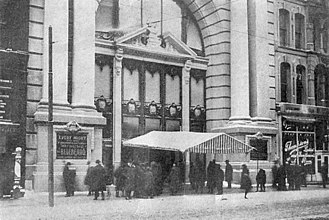
A fire at the Iroquois Theater in Chicago, Illinois kills at least 605.
1903 building fire in Chicago, Illinois
The Iroquois Theatre fire was a catastrophic building fire in Chicago, Illinois, that broke out on December 30, 1903, during a performance attended by 1,700 people. The fire caused 602 deaths and 250 non-fatal injuries. It ranks as the worst theater fire in the United States, surpassing the carnage of the Brooklyn Theatre fire of 1876, which claimed at least 278 lives.
1903
Idaho
Former Idaho Governor Frank Steunenberg is assassinated at the front gate of his home in Caldwell.
U.S. state
Idaho is a landlocked state in the Pacific Northwest and Mountain West subregions of the Western United States. It borders Montana and Wyoming to the east, Nevada and Utah to the south, and Washington and Oregon to the west; the state shares a small portion of the Canada–United States border to the north with the Canadian province of British Columbia. Idaho's state capital and largest city is Boise. With an area of 83,569 square miles (216,440 km2), Idaho is the 14th-largest state by land area. The state has a population of approximately two million people; it ranks as the 13th-least populous and the seventh-least densely populated of the 50 U.S. states.
1905
All-India_Muslim_League
The All-India Muslim League is founded in Dacca, East Bengal, British India (later Dhaka, Bangladesh).
Muslim political party in British India
The All-India Muslim League was a political party in British India active between 1906 and 1947 that advocated for Muslim interests. The party emerged from the Aligarh Movement and the broader Islamic modernist and communalist traditions, which sought to preserve the distinct social and political identity of Muslims against the more secular policies of the Indian National Congress. In December 1906, following the successful Simla Deputation in October, the All-India Muslim League was founded in the 20th session of the All-India Muhammadan Educational Conference in Dacca. It created and spearheaded the movement for the creation of Pakistan based upon the two-nation theory of the Indian scholar Syed Ahmad Khan.
1906
Grigori_Rasputin
Russian mystic and advisor to the Tsar Grigori Yefimovich Rasputin is murdered by a loyalist group led by Prince Felix Yusupov.
His frozen, partially-trussed body was discovered in a Petrograd river three days later.
Grigori Yefimovich Rasputin was a Russian mystic and faith healer. He is best known for having befriended the imperial family of Nicholas II, the last Emperor of Russia, through whom he gained considerable influence in the final years of the Russian Empire.
1916
Coronation_of_the_Hungarian_monarch
The last coronation in Hungary is performed for King Charles IV and Queen Zita.
Legitimation ceremony in the Kingdom of Hungary
The coronation of the Hungarian monarch was a ceremony in which the king or queen of the Kingdom of Hungary was formally crowned and invested with regalia. It corresponded to the coronation ceremonies in other European monarchies. While in countries like France and England the king's reign began immediately upon the death of his predecessor, in Hungary the coronation was absolutely indispensable: if it were not properly executed, the Kingdom stayed "orphaned". All monarchs had to be crowned as King of Hungary in order to promulgate laws and exercise his royal prerogatives in the Kingdom of Hungary. Starting from the Golden Bull of 1222, all new Hungarian monarchs had to take a coronation oath, by which they had to agree to uphold the constitutional arrangements of the country, and to preserve the liberties of their subjects and the territorial integrity of the realm.
1916
Soviet_Union
The Union of Soviet Socialist Republics (USSR) is formed.
Country in Eurasia from 1922 to 1991
The Soviet Union, officially the Union of Soviet Socialist Republics (USSR), was a transcontinental country that spanned much of Eurasia from its formation in 1922 until its dissolution in 1991. It was the world's third-most populous country, the largest by area, and bordered twelve other countries. A diverse multinational state, it was organized as a federal union of national republics, with the largest and most populous being the Russian Soviet Federative Socialist Republic (SFSR). The world's flagship communist state, it was governed by the Communist Party under Marxism–Leninism, through soviet councils. The Soviet economy was also centrally planned. Its capital and largest city was Moscow.
1922
Ginza_Line
The Ginza Line, the first subway line in Asia, opens in Tokyo, Japan.
Subway line in Tokyo, Japan
The Ginza Line , officially designated as Line 3 Ginza Line , is a subway line in Tokyo, Japan, operated by Tokyo Metro. The line spans 14.3 km and serves the wards of Shibuya, Minato, Chūō, Chiyoda, and Taitō.
1927
The Italian Air Force bombs a Swedish Red Cross hospital during the Second Italo-Abyssinian War.
1935 Italian bombing in Dolo, Ethiopia
On 30 December 1935, a Swedish Red Cross field hospital was destroyed in an airstrike by the Regia Aeronautica in Dolo, Ethiopia, killing between 22 and 30 people, mostly Ethiopians. The attack was reportedly part of an Italian reprisal for the earlier execution of an Italian prisoner of war by Ethiopian troops or civilians.
1935
Flint_sit-down_strike
The Flint sit-down strike hits General Motors.
1936–37 labor strike at the General Motors plant in Michigan
The 1936–1937 Flint sit-down strike, also known as the General Motors sit-down strike, or the great GM sit-down strike, was a sitdown strike at the General Motors plant in Flint, Michigan, United States. It changed the United Automobile Workers (UAW) from a collection of isolated local unions on the fringes of the industry into a major labor union and led to the unionization of the American automobile industry.
1936
Subhas_Chandra_Bose
Subhas Chandra Bose raises the flag of Indian independence at Port Blair.
Indian nationalist leader (1897–1945)
Subhas Chandra Bose was an Indian anti-colonial nationalist whose defiance of British authority in India made him a hero among many Indians, but his wartime alliances with Nazi Germany and the Empire of Japan left a legacy vexed by authoritarianism, antisemitism, and military failure. The honorific Netaji was first applied to Bose in Germany in early 1942—by the Indian soldiers of the Indische Legion and by the German and Indian officials in the Special Bureau for India in Berlin. It is now used throughout India.
1943
George_II_of_Greece
King George II of Greece declares a regency, leaving the throne vacant.
King of Greece (1922–1924; 1935–1947)
George II was King of Greece from 27 September 1922 until 25 March 1924, and again from 25 November 1935 until his death on 1 April 1947.
1944
Cold_War
Cold War: King Michael I of Romania is forced to abdicate by the Soviet Union-backed Communist government of Romania.
1947–1991 geopolitical rivalry between US and USSR
The Cold War was a period of international geopolitical rivalry between the United States (US) and the Soviet Union (USSR) and their respective allies, the capitalist Western Bloc and communist Eastern Bloc. It began in the aftermath of the Second World War and ended with the dissolution of the Soviet Union in 1991. The term cold war is used because there was no direct fighting between the two superpowers, though each supported opposing sides in regional conflicts known as proxy wars. In addition to the struggle for ideological and economic influence and an arms race in both conventional and nuclear weapons, the Cold War was expressed through technological rivalries such as the Space Race, espionage, propaganda campaigns, embargoes, and sports diplomacy.
1947
Avro_Lancaster
An RAF Avro Lancaster bomber crashes in Luqa, Malta after an engine failure, killing three crew members and a civilian on the ground.
World War II British heavy bomber aircraft
The Avro Lancaster, commonly known as the Lancaster Bomber, is a British Second World War heavy bomber. It was designed and manufactured by Avro as a contemporary of the Handley Page Halifax, both bombers having been developed to the same specification, as well as the Short Stirling, all three aircraft being four-engine heavy bombers adopted by the Royal Air Force (RAF) during the same era.
1952
National_Bureau_of_Investigation_(Finland)
The Finnish National Bureau of Investigation is established to consolidate criminal investigation and intelligence into a single agency.
National law enforcement agency of Finland
The National Bureau of Investigation is a national law enforcement agency of the Finnish Police and the principal criminal investigation and criminal intelligence organization of Finland. The Bureau's main tasks are to counter and investigate organized crime, provide expert services, and develop methods for criminal investigation. NBI is also responsible for financial intelligence (FININT), such as preventing money laundering and terrorism financing. NBI headquarters has been situated in the city of Vantaa within the Capital Region since 1994 with field offices in Tampere, Turku, Mariehamn, Joensuu, Oulu and Rovaniemi. It is subordinate to the National Police Board under the jurisdiction of the Interior Ministry.
1954
Guatemalan_Air_Force
The Guatemalan Air Force sinks several Mexican fishing boats alleged to have breached maritime borders, killing three and sparking international tension.
Air warfare branch of Guatemala's military
The Guatemalan Air Force is the aerial warfare service branch of the Armed Forces of Guatemala. The FAG is a subordinate to the Guatemalan Military and its commanding officer reports to the Defence Minister.
1958
Aeroflot_Flight_L-51
Aeroflot Flight L-51 crashes near Liepāja International Airport in Liepāja, Latvia, killing 43.
1967 aviation accident
Aeroflot Flight L-51 was a scheduled domestic passenger flight operated by an Antonov An-24 that crashed on approach to Liepāja International Airport on 30 December 1967, resulting in the death of 43 of the 51 people on board. To date, it is the deadliest aviation accident in Latvian history. The investigation revealed the cause of the accident to be pilot error.
1967
Hurricane Creek mine disaster, near Hyden, Kentucky
1970 mining accident
The Hurricane Creek mine disaster occurred at the Finley Mine near Hyden, Kentucky, USA, on December 30, 1970, shortly after noon and resulted in the deaths of 38 men. As was often pointed out in coverage of the disaster, it occurred a year to the day after the passage of the Coal Mine Safety and Health Act of 1969. Recovery was complicated by the fact that a foot of snow fell on the rural mountain roads at the time of the accident.
1970
Operation_Linebacker_II
Vietnam War: Operation Linebacker II ends.
1972 U.S. bombing campaign during the Vietnam War
Operation Linebacker II, sometimes referred to as the Christmas bombings and, in Vietnam, the Twelve days and nights, or Điện Biên Phủ of the Sky, was a strategic bombing campaign conducted by the United States against military and industrial areas of North Vietnam from 18 December to 29 December 1972, during the Vietnam War. More than 20,000 tons of ordnance was dropped, primarily targeting Hanoi and Haiphong, and at least 1,624 civilians were killed. The operation was the final major military operation carried out by the U.S. during the conflict, and the largest bombing campaign involving heavy bombers since World War II.
1972
Stella Sigcau, Prime minister of the South African Bantustan of Transkei, is ousted from power in a bloodless military coup led by General Bantu Holomisa.
South African politician (1937–2006)
Stella Nomzamo Sigcau was a South African politician. Sigcau was also the first female Prime Minister of the bantustan of Transkei before being deposed in a military coup in 1987. After Transkei was merged into South Africa following the end of apartheid, Sigcau became a minister in the cabinets of Nelson Mandela and Thabo Mbeki until her death.
1987
Diplomatic_recognition
Israel establishes diplomatic relations with Vatican City and also upgrades to full diplomatic relations with Ireland.
Acknowledgement of one state for another
Diplomatic recognition in international law is a unilateral declarative political act of a state that acknowledges an act or status of another state or government in control of a state. Recognition can be accorded either on a de facto or de jure basis. Partial recognition can occur if many sovereign states refuse to recognize an entity as a peer. Recognition can be a declaration to that effect by the recognizing government or may be implied from an act of recognition, such as entering into a treaty with the other state or making a state visit. Recognition may, but need not, have domestic and international legal consequences. If sufficient countries recognize a particular entity as a state, that state may have a right to membership in international organizations, while treaties may require all existing member countries unanimously agreeing to the admission of a new member.
1993
Benjamin_Netanyahu
Proposed budget cuts by Benjamin Netanyahu spark protests from 250,000 workers who shut down services across Israel.
Prime Minister of Israel (1996–1999; 2009–2021; 2022–present)
Benjamin Netanyahu, nicknamed "Bibi", is an Israeli politician and diplomat who has served as Prime Minister of Israel since 2022. Having previously held office from 1996 to 1999 and from 2009 to 2021, Netanyahu is Israel's longest-serving prime minister.
1996
Algeria
In the worst incident in Algeria's insurgency, the Wilaya of Relizane massacres, 400 people from four villages are killed.
Country in North Africa
Algeria, officially the People's Democratic Republic of Algeria, is a country in the Maghreb region of North Africa. Spanning over 2,381,741 square kilometres (919,595 sq mi), it is the largest country in Africa and the tenth largest in the world. It is bordered to the northeast by Tunisia; to the east by Libya; to the southeast by Niger; to the southwest by Mali, Mauritania, and Western Sahara; to the west by Morocco; and to the north by the Mediterranean Sea. With a population of over 47 million, Algeria is the tenth-most populous country in Africa. Its capital and largest city is Algiers.
1997
Rizal Day bombings: A series of bombs explode in various places in Metro Manila, Philippines within a period of a few hours, killing 22 and injuring about a hundred.
2000 attack in Metro Manila, Philippines
The Rizal Day bombings, also referred to as the December 30 bombings, were a series of bombings that occurred around Metro Manila in the Philippines on December 30, 2000. The explosions occurred within a span of a few hours, killing 22 people and injuring over 100 others.
2000
Cromañón_nightclub_fire
A fire in the República Cromagnon nightclub in Buenos Aires, Argentina, kills 194.
2004 fire in Buenos Aires, Argentina
On 30 December 2004, a fire broke out in the crowded República Cromañón nightclub in Buenos Aires, Argentina, killing 194 people and leaving at least 1,492 injured. The direct cause was the indoor pyrotechnics igniting the ceiling.
2004
Tropical_Storm_Zeta
Tropical Storm Zeta forms in the open Atlantic Ocean, tying the record for the latest tropical cyclone ever to form in the North Atlantic basin.
2005–2006 Atlantic tropical storm
Tropical Storm Zeta was a very late-developing tropical storm that formed in the central Atlantic Ocean during the 2005 Atlantic hurricane season, forming one month after the season's official end. Becoming a tropical depression on December 30, and intensifying the following day into the season's 28th storm, Zeta continued into January 2006. It was one of only two Atlantic tropical cyclones to span two calendar years.
2005
Madrid–Barajas_Airport
Madrid–Barajas Airport is bombed.
International airport serving Madrid, Spain
Adolfo Suárez Madrid–Barajas Airport is the main international airport serving Madrid, the capital of Spain, and its metropolitan area. At 3,050 ha in area, it is the second-largest airport in Europe by physical size behind Paris Charles de Gaulle Airport. In 2025, 68.1 million passengers travelled through Madrid–Barajas, making it the country's busiest airport as well as Europe's fifth-busiest.
2006
MV_Senopati_Nusantara
The Indonesian passenger ferry MV Senopati Nusantara sinks in a storm, resulting in at least 400 deaths.
Indonesian ferry; sank in a 2006 storm
The MV Senopati Nusantara was an Indonesian ferry that sank in a storm on December 30, 2006. The Japanese-made ship was a scheduled passenger liner from the port of Kumai in Central Kalimantan (Borneo) to Tanjung Emas port in Semarang, Central Java. About 40 km (25 mi) off Mandalika Island, the ship sank during a violent storm in the Java Sea. At least 400–500 people are thought to have drowned, with only 224 surviving.
2006
President_of_Iraq
Former President of Iraq Saddam Hussein is executed.
Head of state of the Republic of Iraq
The president of the Republic of Iraq is the head of state of Iraq. Since the mid-2000s, the presidency is primarily a symbolic office, as the position does not possess significant power within the country according to the constitution adopted in October 2005.
2006
A segment of the Lanzhou–Zhengzhou–Changsha pipeline ruptures in Shaanxi, China, and approximately 150,000 L (40,000 US gal) of diesel oil flows down the Wei River before finally reaching the Yellow River.
Chinese oil pipeline
The Lanzhou–Zhengzhou–Changsha product oil pipeline is a pipeline carrying diesel and other oil products from the northwest to the central regions of China. The 2,070-kilometre (1,290 mi) pipeline starts in Lanzhou in Gansu, and runs through Zhengzhou in Henan to Changsha in Hunan. In Zhengzhou, it is linked with Jinzhou–Zhengzhou product pipeline running from Jinzhou in Liaoning to Zhengzhou.
2009
Camp_Chapman_attack
A suicide bomber kills nine people at Forward Operating Base Chapman, a key facility of the Central Intelligence Agency in Afghanistan.
2009 suicide bombing of a US Armed Forces base in Khost Province, Afghanistan
The Camp Chapman attack was a suicide attack by Humam Khalil Abu-Mulal al-Balawi against the Central Intelligence Agency facility inside Forward Operating Base Chapman in Afghanistan on December 30, 2009. One of the main tasks of the CIA personnel stationed at the base was to provide intelligence supporting drone attacks in Pakistan. Seven American CIA officers and contractors, a Jordanian intelligence officer, and an Afghan working for the CIA were killed when al-Balawi detonated a bomb sewn into a vest he was wearing. Six other American CIA officers were wounded. The bombing was the most lethal attack against the CIA in more than 25 years.
2009
December_2013_Kinshasa_attacks
More than 100 people are killed when anti-government forces attack key buildings in Kinshasa, Democratic Republic of the Congo.
Rioting by followers of Paul Joseph Mukungubila in DR Congo
Attacks in Kinshasa, the capital of the Democratic Republic of the Congo, were launched by supporters of religious leader Paul Joseph Mukungubila against television studios, the airport and a military base in the capital on 30 December 2013. The state security forces responded, killing around 54 of the attackers. An additional 47 of Mukungubila's supporters were killed in separate clashes in the cities of Lubumbashi and Kolwezi and around 100 people were arrested.
2013
A large explosion at the airport in the southern Yemeni city of Aden kills at least 22 people and wounds 50.
Attack in Yemen
On 30 December 2020, a plane carrying members of the recently formed Yemeni government landed at Aden International Airport in the southwest of Yemen. As passengers disembarked, there were explosions and gunfire, leaving 28 people dead and 107 others injured. None of the passengers were hurt in the attack and the Yemeni cabinet members were quickly transported to Mashiq Palace for safety.
2020

History runs on facts, and this project runs on coffee!

Your support is incredibly helpful and genuinely appreciated.

Support with a coffee ☕