February 9 in History

Prohibition law is abolished in Finland after a national referendum, where 70% v

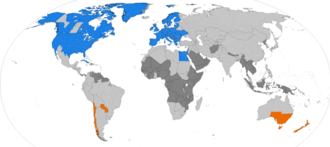
1932 — Prohibition law is abolished in Finland after a national referendum, where 70% voted for a repeal of the law

February 9 spans 55 recorded events across recorded history, from 474 to 2025. Below is a curated digest of the most significant moments tied to this date.

By · Wikipedia

Historical Events 55 events 474 – 2025

More major events on February 9

The featured story and these ranked highlights form a quick summary. Every recorded event remains available in the chronology below.

  1. 1907 The Mud March is the first large procession organised by the National Union of Women's Suffrage Societies (NUWSS). Source
  2. 1861 American Civil War: Jefferson Davis is elected the Provisional President of the Confederate States of America by the Provisional Confederate Congress at Montgomery, Alabama. Source
  3. 1978 The Budd Company unveils its first SPV-2000 self-propelled railcar in Philadelphia, Pennsylvania. Source

Did you know

In 1932, Prohibition law is abolished in Finland after a national referendum, where 70% voted for a repeal of the law. This featured entry focuses on the immediate decision and its direct historical impact.
Did you know

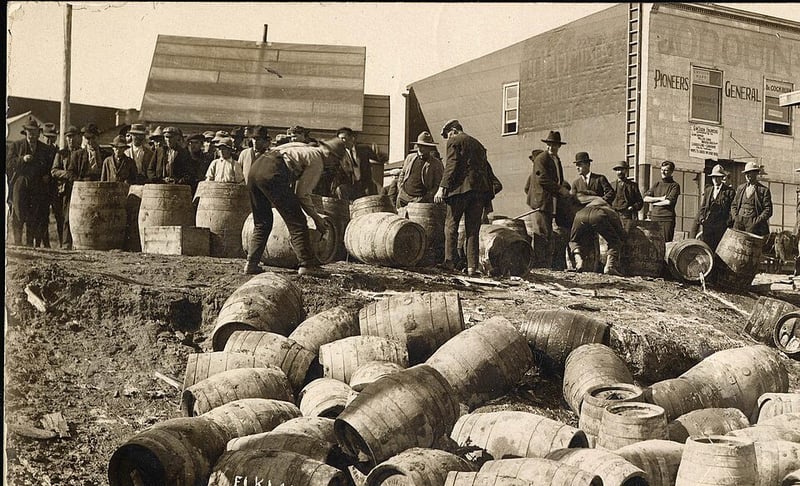
Prohibition is the act or practice of forbidding something by law; when used by itself the term refers to the banning of the manufacture, storage, transportation, sale, possession, and consumption of alcoholic beverages. This helps explain why the event mattered beyond the initial announcement.

Did you know

The word is also used to refer to a period of time during which such bans are enforced. This clarifies the institutional and public response around the event.

Did you know

In 1932, Prohibition law is abolished in Finland after a national referendum, where 70% voted for a repeal of the law had consequences that extended beyond the first headline. The key context is the institutions involved, the policy shift, and how the public response evolved afterward.

Did you know

In 1932, Prohibition law is abolished in Finland after a national referendum, where 70% voted for a repeal of the law had consequences that extended beyond the first headline. The key context is the institutions involved, the policy shift, and how the public response evolved afterward.


Zeno_(emperor)
Zeno is crowned as co-emperor of the Eastern Roman Empire.
Eastern Roman emperor (474–475; 476–491)
Zeno was Eastern Roman emperor from 474 to 475 and again from 476 to 491. His reign was plagued by domestic revolts and religious dissension, but was more successful on the foreign front. He is credited with further stabilizing the Eastern empire, while the Western Roman Empire fell following the deposition of Romulus Augustulus.
474
Boleslaus_III,_Duke_of_Bohemia
Boleslaus III is restored to authority with armed support from Bolesław I the Brave of Poland.
Duke of Bohemia (fl. 999–1003)
Boleslaus III, called the Red or the Blind, a member of the Přemyslid dynasty, was Duke of Bohemia from 999 until 1002 and briefly again during the year 1003. During his chaotic reign, Bohemia became a pawn in the long German–Polish War between King Henry II and Duke Bolesław I, "the Brave", of Poland.
1003
First_Crusade
A First Crusade army led by Bohemond of Taranto wins a major battle against the Seljuq emir Ridwan of Aleppo during the siege of Antioch.
1096–1099 Christian re-conquest of the Holy Land
The First Crusade (1096–1099) was the first of a series of religious wars, or Crusades, which were initiated, supported and at times directed by the Latin Church in the Middle Ages. Their aim was to return the Holy Land—which had been conquered by the Rashidun Caliphate in the 7th century—to Christian rule. By the 11th century, although Jerusalem had then been ruled by Muslims for hundreds of years, the practices of the Seljuk rulers in the region began to threaten local Christian populations, pilgrimages from the West and the Byzantine Empire itself. The earliest impetus for the First Crusade came in 1095 when Byzantine emperor Alexios I Komnenos sent ambassadors to the Council of Piacenza to request military support in the empire's conflict with the Seljuk-led Turks. This was followed later in the year by the Council of Clermont, at which Pope Urban II gave a speech supporting the Byzantine request and urging faithful Christians to undertake an armed pilgrimage to Jerusalem.
1098
Chester_Racecourse
The first recorded race is held on Chester Racecourse, known as the Roodee.
Horse racing venue in England
Chester Racecourse, also known as the Roodee, is a racecourse located in Chester, England. The horse racing venue is officially recognised by Guinness World Records as the "oldest racecourse still in operation". Horse racing in Chester started in the early sixteenth century, with 1539 cited as the year racing began, although some sources give a date of 1512 for the first races in Chester. It is also thought to be the smallest racecourse of significance in England at 1 mile and 1 furlong (1.8 km) long. It is also officially recognised by Guinness World Records as the oldest race course still in operation.
1539
Bishop_of_Gloucester
Bishop of Gloucester John Hooper is burned at the stake.
Diocesan bishop in the Church of England
The Bishop of Gloucester is the ordinary of the Church of England Diocese of Gloucester in the Province of Canterbury.
1555
Pope_Gregory_XV
Gregory XV becomes Pope, the last Pope elected by acclamation.
Head of the Catholic Church from 1621 to 1623
Pope Gregory XV, born Alessandro Ludovisi, was the head of the Catholic Church and ruler of the Papal States from 9 February 1621 until his death in 1623. He is notable for founding the Congregation for the Propagation of the Faith, an organization tasked with overseeing the spread of Catholicism and missionary work. Gregory XV was also responsible for the canonization of Saints Ignatius of Loyola, Francis Xavier, Teresa of Ávila, and Philip Neri, which solidified his commitment to the Counter-Reformation.
1621
Capture_of_Fort_Rocher
The Capture of Fort Rocher takes place during the Anglo-Spanish War.
1654 siege of the French-held island of Tortuga by the Spanish
The Capture of Fort Rocher took place on 9 February 1654, during the Franco-Spanish War (1635–1659). Equipped with one siege battery, a Spanish expedition of 700 troops attacked the buccaneer stronghold of Tortuga, capturing the Fort de Rocher and 500 prisoners including 330 buccaneers and goods valued at approximately 160,000 pieces-of-eight. The Spanish burned the colony to the ground and slaughtered its inhabitants, leaving behind a fort manned by 150 soldiers. They possessed the island for about eighteen months, but on the approach of the expedition under Penn and Venables were ordered by the Conde de Peñalva, Governor of Santo Domingo, to demolish the fortifications, bury the artillery and other arms, and retire to his aid in Hispaniola.
1654
American_Revolutionary_War
American Revolutionary War: The British Parliament declares Massachusetts in rebellion.
1775–1783 conflict in North America
The American Revolutionary War, also known as the Revolutionary War or American War of Independence or simply the American Revolution, was the armed conflict that comprised the final eight years of the broader American Revolution, in which American Patriot forces organized as the Continental Army and commanded by George Washington defeated the British Army. The conflict was fought in North America, the Caribbean, and the Atlantic Ocean. The war's outcome seemed uncertain for most of the war, but Washington and the Continental Army's decisive victory in the Siege of Yorktown in 1781 led King George III and the Kingdom of Great Britain to negotiate an end to the war. In 1783, in the Treaty of Paris, the British monarchy acknowledged the independence of the Thirteen Colonies, leading to the establishment of the United States as an independent and sovereign nation.
1775
Rhode_Island
Rhode Island becomes the fourth US state to ratify the Articles of Confederation.
U.S. state
Rhode Island is a state in the New England region of the Northeastern United States. It borders Connecticut to its west; Massachusetts to its north and east; and the Atlantic Ocean to its south via Rhode Island Sound and Block Island Sound; and shares a small maritime border with New York, east of Long Island. Rhode Island is the smallest U.S. state by area and the seventh-least populous, with slightly more than 1.11 million residents as of 2025. The state's population, however, has continually recorded growth in every decennial census since 1790, and it is the second-most densely populated state after New Jersey. The state takes its name from the eponymous island, though most of its land area is on the mainland. Providence is its capital and most populous city.
1778
Haiti
Haiti attacks the newly established Dominican Republic on the other side of the island of Hispaniola.
Country in the Caribbean
Haiti, officially the Republic of Haiti, is a country in the Caribbean on the island of Hispaniola in the Caribbean Sea, east of Cuba and Jamaica and south of The Bahamas. It occupies the western side of the island, which it shares with the Dominican Republic. Haiti is the third largest country in the Caribbean by area, and with an estimated population of 11.4 million, it is the most populous Caribbean country. The capital and largest city is Port-au-Prince.
1822
United_States_Electoral_College
After no candidate receives a majority of electoral votes in the US presidential election of 1824, the United States House of Representatives elects John Quincy Adams as sixth President of the United States in a contingent election.
Electors of the U.S. president and vice president
In the United States, the Electoral College is the group of presidential electors that is formed every four years for the sole purpose of voting for the president and vice president in the presidential election. This process is described in Article Two of the Constitution. The number of electors from each state is equal to that state's congressional delegation which is the number of senators (two) plus the number of Representatives for that state. Each state appoints electors using legal procedures determined by its legislature. Federal office holders, including senators and representatives, cannot be electors. Federal agencies provide step-by-step descriptions of how electors are appointed, meet in December, and how Congress counts the electoral votes. Additionally, the Twenty-third Amendment granted the federal District of Columbia three electors. A simple majority of electoral votes is required to elect the president and vice president. If no candidate achieves a majority, a contingent election is held by the House of Representatives, to elect the president, and by the Senate, to elect the vice president.
1825
Roman_Republic_(1849–1850)
The new Roman Republic is declared.
Two-month republican government in the Papal States
The Roman Republic was a short-lived state declared on 9 February 1849, when the government of the Papal States was temporarily replaced by a republican government due to Pope Pius IX's departure to Gaeta. The republic was led by Carlo Armellini, Giuseppe Mazzini, and Aurelio Saffi. Together they formed a triumvirate, a reflection of a form of government during the first century BC crisis of the Roman Republic.
1849
American_Civil_War
American Civil War: Jefferson Davis is elected the Provisional President of the Confederate States of America by the Provisional Confederate Congress at Montgomery, Alabama.
1861–1865 conflict in the United States
The American Civil War was a civil war in the United States between the Union and the Confederacy, which was formed in 1861 by states that had seceded from the Union to preserve slavery in the United States. The South saw slavery as threatened because of the election of Abraham Lincoln and the growing abolitionist movement in the North. The war ended with Union victory, the dissolution of the Confederacy and the abolition of slavery, freeing four million African Americans.
1861
Ulysses_S._Grant
US president Ulysses S.
Grant signs a joint resolution of Congress establishing the U.S. Weather Bureau.
Ulysses S. Grant was the 18th president of the United States, serving from 1869 to 1877, and was the Commanding General of the Union Army, leading it to victory in the American Civil War in 1865.
1870
Grover_Cleveland
US president Grover Cleveland signs a bill elevating the United States Department of Agriculture to a Cabinet-level agency.
President of the United States (1885–1889; 1893–1897)
Stephen Grover Cleveland was the 22nd and 24th president of the United States, serving from 1885 to 1889 and from 1893 to 1897. He was the first Democrat elected president after the American Civil War and the first U.S. president to serve nonconsecutive terms.
1889
Giuseppe_Verdi
Verdi's last opera, Falstaff, premieres at La Scala, Milan.
Italian opera composer (1813–1901)
Giuseppe Fortunino Francesco Verdi was an Italian composer best known for his operas. He was born near Busseto, a small town in the modern province of Parma, to a family of moderate means, receiving a musical education with the help of a local patron named Antonio Barezzi.
1893
William_G._Morgan
William G.
Morgan creates a game called Mintonette, which soon comes to be referred to as volleyball.
William George Morgan was an American sports educator and the inventor of volleyball, originally called "Mintonette", a name derived from the game of badminton which he later agreed to change to better reflect the nature of the sport. He was born in Lockport, New York, U.S.
1895
Davis_Cup
The Davis Cup competition is established.
Men's tennis international team competition
The Davis Cup is the premier international team event in men's tennis. It is organised by World Tennis and contested annually between teams from over 150 competing countries, making it the world's largest annual team sporting competition. It is described by the organisers as the "World Cup of Tennis" and the winners are referred to as the world champions. The competition began in 1900 as a challenge between Great Britain and the United States. Initially titled the International Lawn Tennis Challenge, it soon became known metonymically after the trophy donated by Dwight F. Davis; the name was officially changed after Davis' death in 1945. By 2023, 155 nations entered teams into the competition.
1900
Russo-Japanese_War
Russo-Japanese War: Battle of Port Arthur concludes.
1904–1905 conflict in East Asia
The Russo-Japanese War was fought between the Russian Empire and the Empire of Japan over rival imperial ambitions in Manchuria and the Korean Empire. The major land battles of the war were fought on the Liaodong Peninsula and near Mukden in Southern Manchuria, with naval battles taking place in the Yellow Sea and the Sea of Japan.
1904
Mud_March_(suffragists)
The Mud March is the first large procession organised by the National Union of Women's Suffrage Societies (NUWSS).
1907 demonstration by suffragists in London
The United Procession of Women, or Mud March as it became known, was a peaceful demonstration in London on 9 February 1907 organised by the National Union of Women's Suffrage Societies (NUWSS), in which more than three thousand women marched from Hyde Park Corner to the Strand in support of women's suffrage. Women from all classes participated in the largest public demonstration supporting women's suffrage seen up to that date. It acquired the name "Mud March" from the day's weather; incessant heavy rain left the marchers drenched and mud-spattered.
1907
Meteor
A group of meteors is visible across much of the eastern seaboard of the Americas, leading astronomers to conclude the source had been a small, short-lived natural satellite of the Earth.
Body that enters the Earth's atmosphere
A meteor, known colloquially as a shooting star, is a glowing streak of a small body going through Earth's atmosphere, after being heated to incandescence by collisions with air molecules in the upper atmosphere, creating a streak of light via its rapid motion and sometimes also by shedding glowing material in its wake. Meteors typically occur in the mesosphere at altitudes from 76–100 kilometres. The root word meteor comes from the Greek μετεωρίτης (meteōrítēs), meaning "high in the air".
1913
Svalbard_Treaty
Under the terms of the Svalbard Treaty, international diplomacy recognizes Norwegian sovereignty over Arctic archipelago Svalbard, and designates it as demilitarized.
Treaty recognising Norwegian sovereignty over Svalbard
The Svalbard Treaty recognises the sovereignty of Norway over the Arctic archipelago of Svalbard, at the time called Spitsbergen. The exercise of sovereignty is, however, subject to certain stipulations, and not all Norwegian law applies. The treaty restricts military uses of the archipelago, but it is not demilitarized. The signatories were given equal rights to engage in commercial activities on the islands. Norway and Russia have exercised this right.
1920
Brazil
Brazil becomes a member of the Berne Convention copyright treaty.
Country in South America
Brazil, officially the Federative Republic of Brazil, is the largest country in South America. It is also the world's fifth-largest country by area and the seventh-largest by population, with over 213 million people. Brazil is a federation composed of 26 states and a Federal District, which hosts the capital, Brasília. Its most populous city is São Paulo, followed by Rio de Janeiro. Brazil has the largest Lusophone population in the world and is the only Portuguese-speaking country in the Americas, where it is the official language.
1922
Việt_Nam_Quốc_Dân_Đảng
Members of the Việt Nam Quốc Dân Đảng assassinate the labor recruiter Bazin, prompting a crackdown by French colonial authorities.
Vietnamese nationalist and democratic socialist political party (1927–1975)
The Việt Nam Quốc Dân Đảng, also known as the Vietnamese Nationalist Party and abbreviated VNQDĐ or Việt Quốc, was a nationalist and democratic socialist political group that sought independence from French colonial rule in Vietnam during the early 20th century. Its origins lie in a group of young Hanoi-based intellectuals who began publishing revolutionary material in the mid-1920s. In 1927, after the publishing house failed because of French harassment and censorship, the VNQDĐ was formed under the leadership of Nguyễn Thái Học. Modelling itself on the Kuomintang of Nationalist China the VNQDĐ gained a small following among northerners, particularly teachers and intellectuals. The party, which was less successful among peasants and industrial workers, was organised in small clandestine cells.
1929
Balkan_Pact
The Balkan Entente is formed between Greece, Romania, Yugoslavia, and Turkey.
1934 treaty among various Balkan nations to maintain the post-WWI status quo
The Balkan Pact, or Balkan Entente, was a treaty signed by Greece, Romania, Turkey and Yugoslavia on 9 February 1934 in Athens, aimed at maintaining the geopolitical status quo in the region after the end of World War I. To present a united front against Bulgarian designs on their territories, the signatories agreed to suspend all disputed territorial claims against one another and their immediate neighbours following the aftermath of the war and a rise in various regional irredentist tensions.
1934
World_War_II
World War II: Bombing of Genoa: The Cathedral of San Lorenzo in Genoa, Italy, is struck by a bomb which fails to detonate.
Global conflict (1939–1945)
World War II, or the Second World War, was a global conflict between two coalitions: the Allies and the Axis powers. Nearly all of the world's countries participated. World War II was the deadliest conflict in history, causing the death of 60 to 75 million people. Millions died as a result of massacres, starvation, disease, and genocides including the Holocaust. After the Allied victory, Germany, Austria, Japan, and Korea were occupied, and German and Japanese leaders were tried for war crimes.
1941
Daylight_saving_time
Year-round Daylight saving time (aka War Time) is reinstated in the United States as a wartime measure to help conserve energy resources.
Seasonal change of clock settings
Daylight saving time (DST), also referred to as daylight savings time, daylight time, or summer time, is the practice of advancing clocks to make better use of the longer daylight available during summer by having darkness fall at a later clock time. The typical implementation of DST is to adjust clocks ahead of standard time by one hour in spring or late winter, and to set clocks back by one hour in the autumn.
1942
Pacific_War
World War II: Pacific War: Allied authorities declare Guadalcanal secure after Imperial Japan evacuates its remaining forces from the island, ending the Battle of Guadalcanal.
Theater of World War II
The Pacific War, sometimes called the Asia–Pacific War or the Pacific Theater, was the theater of World War II fought between Japan and the Allies in East and Southeast Asia, the Pacific and Indian Oceans, and Oceania. It was geographically the largest theater of the war, including the Pacific Ocean theater, the South West Pacific theater, the Second Sino-Japanese War, and the brief Soviet–Japanese War, and included some of the largest naval battles in history. War between Japan and the Republic of China had begun in 1937, with hostilities dating back to Japan's invasion of Manchuria in 1931, but the Pacific War is more widely accepted to have begun in 1941, when the United States and United Kingdom were brought into the war.
1943
Battle_of_the_Atlantic
World War II: Battle of the Atlantic: HMS Venturer sinks U-864 off the coast of Fedje, Norway, in a rare instance of submarine-to-submarine combat.
Attempt by Germany during World War II to cut supply lines to Britain
The Battle of the Atlantic, the longest continuous military campaign in World War II, ran from 1939 to the defeat of Nazi Germany in 1945, covering a major part of the naval history of World War II. At its core was the Allied naval blockade of Germany, announced the day after the declaration of war, and Germany's subsequent counterblockade. The campaign peaked from mid-1940 to the end of 1943.
1945
Allies_of_World_War_II
World War II: A force of Allied aircraft unsuccessfully attack a German destroyer in Førdefjorden, Norway.
Military coalition of World War II
The Allies, or Allied powers, formally referred to as the United Nations from 1942, were an international military coalition formed during World War II (1939–1945) to oppose the Axis powers. Its principal members were the "Big Four"—the United Kingdom, the Soviet Union, the United States, and China.
1945
McCarthyism
Second Red Scare: US Senator Joseph McCarthy accuses the United States Department of State of being filled with Communists.
Phenomenon of US political rhetoric after WWII
McCarthyism is a political practice defined by the accusation and investigation of left-wing individuals of communist and Soviet influence on American institutions and of Soviet espionage in the United States during the late 1940s through the 1950s, heavily associated with the McCarthy era. After the mid-1950s, U.S. senator Joseph McCarthy, who had spearheaded the campaign, gradually lost his public popularity after several of his accusations were found to be false. The U.S. Supreme Court under Chief Justice Earl Warren made a series of rulings on civil and political rights that overturned several key laws and legislative directives, and helped bring an end to the Second Red Scare.
1950
Korean_War
Korean War: The two-day Geochang massacre begins as a battalion of the 11th Division of the South Korean Army kills 719 unarmed citizens in Geochang, in the South Gyeongsang district of South Korea.
1950–1953 conflict on the Korean Peninsula
The Korean War was an armed conflict fought on the Korean Peninsula between North Korea and South Korea and their allies. North Korea was supported by China and the Soviet Union, while South Korea was supported by the United Nations led by the United States under the auspices of the United Nations Command (UNC).
1951
R-7_Semyorka
The R-7 Semyorka, the first intercontinental ballistic missile, becomes operational at Plesetsk, USSR.
First Intercontinental ballistic missile
The R-7 Semyorka was a Soviet missile developed during the Cold War, and the world's first intercontinental ballistic missile. The basis for the R-7 rocket family, it was adapted into the world's first orbital launch vehicle, Sputnik, and the crewed orbital launch vehicles Vostok. R-7 derivatives are the most launched rocket family ever with over 2,000 flights as of 2026, primarily Soyuz variants.
1959
The_Beatles_at_the_Cavern_Club
The Beatles at the Cavern Club: Lunchtime – The Beatles perform under this name at The Cavern Club for the first time following their return to Liverpool from Hamburg.
Performances of the Beatles at the Cavern Club between 1961 and 1963
The Cavern Club at 10 Mathew Street, in Liverpool was the venue where the Beatles' UK popularity started. John Lennon, Paul McCartney, George Harrison and Pete Best were first seen by Brian Epstein at the club. Epstein eventually became their manager, going on to secure them a record contract. Best was replaced by Ringo Starr on 16 August 1962, which upset many Beatles fans. After taunts of, "Pete forever, Ringo never!", one agitated fan headbutted Harrison in the club.
1961
The_Beatles
The Beatles make their first appearance on The Ed Sullivan Show, performing before a record-setting audience of 73 million viewers across the United States.
English rock band (1960–1970)
The Beatles were an English rock band formed in Liverpool in 1960. The band comprised John Lennon, Paul McCartney, George Harrison and Ringo Starr. They are regarded as the most influential band in popular music and were integral to the development of 1960s counterculture and the recognition of popular music as an art form. Rooted in skiffle, beat and 1950s rock 'n' roll, their sound incorporated elements of classical music and traditional pop in innovative ways. They also explored styles ranging from folk and Indian music to psychedelia and hard rock. As pioneers in recording, songwriting and artistic presentation, the Beatles revolutionised many aspects of the music industry and were often publicised as leaders of the era's youth and sociocultural movements.
1964
Vietnam_War
Vietnam War: The United States Marine Corps sends a MIM-23 Hawk missile battalion to South Vietnam, the first American troops in-country without an official advisory or training mission.
1955–1975 war in Southeast Asia
The Vietnam War was an armed conflict in Vietnam, Laos, and Cambodia fought between North Vietnam and South Vietnam and their allies. North Vietnam was supported by the Soviet Union and China, while South Vietnam was supported by the United States and other anti-communist nations. The conflict was the second of the Indochina wars and a proxy war of the Cold War. The Vietnam War was one of the postcolonial wars of national liberation, a theater in the Cold War, and a civil war, with civil warfare a defining feature from the outset. Direct US military involvement escalated from 1965 until US forces were withdrawn in 1973. The fighting spilled into the Laotian and Cambodian civil wars, which ended with all three countries becoming communist in 1975.
1965
1971_San_Fernando_earthquake
The 6.5–6.7 Mw Sylmar earthquake hits the Greater Los Angeles Area with a maximum Mercalli intensity of XI (Extreme), killing 64 and injuring 2,000.
Earthquake in California
The 1971 San Fernando earthquake occurred in the early morning of February 9 in the foothills of the San Gabriel Mountains in Southern California. The unanticipated thrust earthquake had a magnitude of 6.5 on the Ms scale and 6.6 on the Mw scale, and a maximum Mercalli intensity of XI (Extreme). The event was one in a series that affected Los Angeles County during the late 20th century. Damage was locally severe in the northern San Fernando Valley and surface faulting was extensive to the south of the epicenter in the mountains, as well as urban settings along city streets and neighborhoods. Uplift and other effects affected private homes and businesses.
1971
Satchel_Paige
Satchel Paige becomes the first Negro league player to be voted into the USA's Baseball Hall of Fame.
American baseball player and coach (1906–1982)
Leroy Robert "Satchel" Paige was an American professional baseball pitcher who played in Negro league baseball and Major League Baseball (MLB). His career spanned five decades and culminated with his induction into the National Baseball Hall of Fame.
1971
Apollo_program
Apollo program: Apollo 14 returns to Earth after the third human Moon landing.
1961–1972 American crewed lunar exploration program
The Apollo program, also known as Project Apollo, was the United States human spaceflight program led by NASA, which landed the first humans on the Moon in 1969. Apollo was conceived in 1960 in the Dwight D. Eisenhower presidency during Project Mercury and executed after Project Gemini. Apollo was later dedicated to President John F. Kennedy's national goal, "before this decade is out, of landing a man on the Moon and returning him safely to the Earth" in his address to the U.S. Congress on May 25, 1961.
1971
Soyuz_17
The Soyuz 17 Soviet spacecraft returns to Earth.
Crewed flight of the Soyuz programme
Soyuz 17 was the first of two long-duration missions to the Soviet Union's Salyut 4 space station in 1975. The flight by cosmonauts Aleksei Gubarev and Georgy Grechko set a Soviet mission-duration record of 29 days, surpassing the 23-day record set by the ill-fated Soyuz 11 crew aboard Salyut 1 in 1971.
1975
Aeroflot_Flight_3739_(1976)
Aeroflot Flight 3739, a Tupolev Tu-104, crashes during takeoff from Irkutsk Airport, killing 24.
1976 plane crash during takeoff in Irkutsk, Russia
Aeroflot Flight 3739 was a regularly scheduled Russian domestic flight from Irkutsk to Pulkovo Airport in Saint Petersburg that crashed during takeoff from Irkutsk International Airport on 9 February 1976. Twenty-four of the 114 people on board died in the accident.
1976
Budd_Company
The Budd Company unveils its first SPV-2000 self-propelled railcar in Philadelphia, Pennsylvania.
American manufacturing company
The Budd Company was a 20th-century metal fabricator, a major supplier of body components to the automobile industry, and a manufacturer of stainless steel passenger rail cars, airframes, missile and space vehicles, and various defense products.
1978
Japan_Air_Lines_Flight_350
Japan Air Lines Flight 350 crashes near Haneda Airport in an attempted pilot mass murder-suicide, killing 24 of the 174 people on board.
1982 deliberate crash in Tokyo, Japan
Japan Air Lines Flight 350 was a domestic scheduled passenger flight from Fukuoka, Fukuoka Prefecture, to Tokyo in Japan. On 9 February 1982, the Douglas DC-8 operating the flight, registered JA8061, crashed into Tokyo Bay on approach to Haneda Airport, resulting in 24 fatalities. Flight 350 was the first crash for Japan Air Lines in the 1980s. The investigation traced the cause of the crash to the deliberate actions of the captain.
1982
Halley's_Comet
Halley's Comet last appeared in the inner Solar System.
Periodic comet
Halley's Comet is the only known short-period comet that is consistently visible to the naked eye from Earth, appearing roughly every 75–76 years, though with the majority of recorded apparitions occurring after 75–77 years. It last appeared in the inner parts of the Solar System in 1986 and will next appear in mid-2061. Officially designated 1P/Halley, it is also commonly called Comet Halley, or sometimes simply Halley.
1986
February_1987_Palestinian_unrest
Civil unrest broke out across Palestine.
1987 civil unrest
The February 1987 Palestinian unrest was a wave of unrest across the West Bank and the Gaza strip in February 1987. The wave began on 9 February, with protests breaking out after Israeli soldiers used live ammunition to disperse a demonstration held at the Balata Camp, in the West Bank. The wave continued until late February, escalating into a grenade attack on an Israeli border post and the killing of a Palestinian cab driver who drove into an Israeli military patrol. During the unrest, all five major Palestinian universities were temporarily ordered closed by Israeli authorities.
1987
Dissolution_of_the_Soviet_Union
Dissolution of the Soviet Union: Voters in Lithuania vote for independence from the Soviet Union.
1988–1991 breakup of the sovereign state
The Soviet Union was formally dissolved and ceased to exist as a sovereign state and subject of international law on 26 December 1991. It also brought an end to the Soviet Union's federal government and to Soviet leader Mikhail Gorbachev's efforts to reform the Soviet political and economic system in an attempt to stop a period of political and economic stagnation.
1991
Provisional_Irish_Republican_Army
The Provisional Irish Republican Army declares the end to its 18-month ceasefire and explodes a large bomb in London's Canary Wharf, killing two people.
Paramilitary force active from 1969 to 2005
The Provisional Irish Republican Army, officially known as the Irish Republican Army and informally known as the Provos, was an Irish republican paramilitary force that sought to end British rule in Northern Ireland, facilitate Irish reunification and bring about an independent socialist republic, which would encompass all of Ireland. It was the most active republican paramilitary group during the Troubles. It argued that the all-island Irish Republic continued to exist, and it saw itself as that state's army, the sole legitimate successor to the original IRA from the Irish War of Independence. It was designated a terrorist organisation in the United Kingdom and an unlawful organisation in the Republic of Ireland, both of whose authority it rejected.
1996
Copernicium is discovered by Sigurd Hofmann, Victor Ninov et al.
Chemical element with atomic number 112 (Cn)
Copernicium is a synthetic chemical element; it has symbol Cn and atomic number 112. Its known isotopes are extremely radioactive, and have only been created in a laboratory. The most stable known isotope, copernicium-285, has a half-life of approximately 30 seconds. Copernicium was first created in February 1996 by the GSI Helmholtz Centre for Heavy Ion Research near Darmstadt, Germany. It was named after the astronomer Nicolaus Copernicus on his 537th anniversary.
1996
Ehime_Maru_and_USS_Greeneville_collision
The Ehime Maru and USS Greeneville collision takes place, killing nine of the thirty-five people on board the Japanese fishery high-school training ship Ehime Maru, leaving the USS Greeneville (SSN-772) with US $2 million in repairs, at Pearl Harbor.
2001 maritime accident
On 9 February 2001, about nine nautical miles south of Oahu, Hawaii, in the Pacific Ocean, the United States Navy (USN) Los Angeles-class submarine USS Greeneville collided with the Japanese fishery high-school training ship Ehime Maru (えひめ丸) from Ehime Prefecture. In a demonstration for some VIP civilian visitors, Greeneville performed an emergency ballast blow surfacing maneuver. As the submarine shot to the surface, she struck Ehime Maru. Within ten minutes of the collision, Ehime Maru sank. Nine of the thirty-five people aboard were killed: four high school students, two teachers, and three crew members.
2001
Bad_Aibling_rail_accident
Two passenger trains collide in the German town of Bad Aibling in the state of Bavaria.
Twelve people die and 85 others are injured.
On 9 February 2016, two Meridian-branded passenger trains collided head-on at Bad Aibling, Germany. Of approximately 150 people on board the two trains, 12 people died and 85 others were injured, 24 critically.
2016
2018_Winter_Olympics
Winter Olympics: Opening ceremony is performed in Pyeongchang County in South Korea.
Multi-sport event in Pyeongchang, South Korea
The 2018 Winter Olympics, officially the XXIII Olympic Winter Games and also known as PyeongChang 2018 (평창2018), was an international winter multi-sport event held between 9 and 25 February 2018 in Pyeongchang County, South Korea, with the opening rounds for certain events held on 8 February, a day before the opening ceremony.
2018
Nayib_Bukele
Salvadoran President Nayib Bukele has the army soldiers enter the Legislative Assembly to assist in pushing for the approval for a better government security plan, causing a brief political crisis.
President of El Salvador since 2019
Nayib Armando Bukele Ortez is a Salvadoran politician and businessman who has served as the 43rd president of El Salvador since 2019.
2020
Second_impeachment_trial_of_Donald_Trump
Second impeachment trial of Donald Trump begins.
2021 trial in the US Senate
The second impeachment trial of Donald Trump, the 45th president of the United States, began on February 9, 2021, and concluded with his acquittal on February 13. Trump had been impeached for the second time by the House of Representatives on January 13, 2021. The House adopted one article of impeachment against Trump: incitement of insurrection. He is the only U.S. president and only federal official to be impeached twice. He was impeached by the House seven days prior to the expiration of his term and the inauguration of Joe Biden. Because he left office before the trial, this was the first impeachment trial of a former president. The article of impeachment addressed Trump's attempts to overturn the 2020 presidential election results and stated that Trump incited the attack on the Capitol in Washington, D.C., while Congress was convened to count the electoral votes and certify the victory of Joe Biden and Kamala Harris.
2021
Baltic_states
The Baltic states synchronize their electric power transmission infrastructure with the Continental Europe Synchronous Area (CESA), in objective to disconnect from the Russo-Belarussian agreement to use the IPS/UPS system.
Three countries east of the Baltic Sea
The Baltic states or the Baltic countries is a geopolitical term encompassing Estonia, Latvia, and Lithuania. All three countries are members of NATO, the European Union, the Eurozone, the Baltic Assembly, and the OECD. The three sovereign states on the eastern coast of the Baltic Sea are sometimes referred to as the "Baltic nations", less often and in historical circumstances also as the "Baltic republics", the "Baltic lands", or simply the Baltics.
2025

History runs on facts, and this project runs on coffee!

Your support is incredibly helpful and genuinely appreciated.

Support with a coffee ☕