July 25 in History

American Civil War: The United States Congress passes the Crittenden–Johnson Res

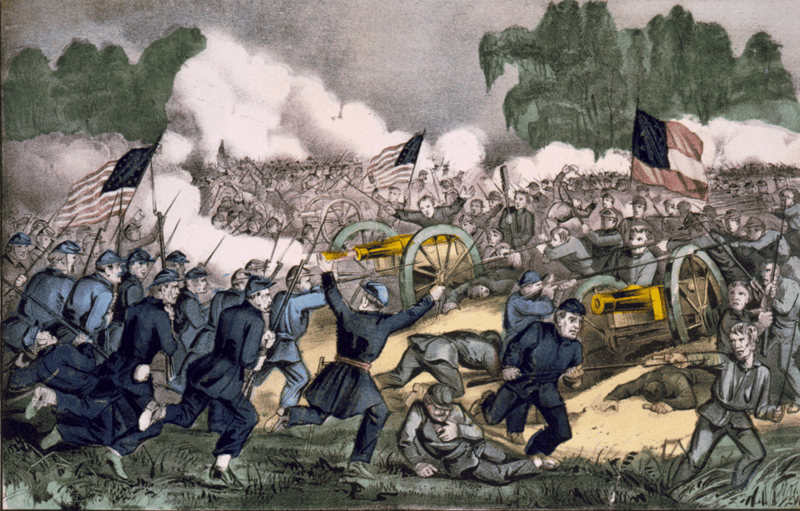
1861 — American Civil War: The United States Congress passes the Crittenden–Johnson Resolution, stating that the war is being fought to preserve the Union and not to end slavery, in the wake of the defeat at the First Battle of Bull Run

July 25 spans 83 recorded events across recorded history, from 306 to 2019. Below is a curated digest of the most significant moments tied to this date.

By · Wikipedia

Historical Events 83 events 306 – 2019

More major events on July 25

The featured story and these ranked highlights form a quick summary. Every recorded event remains available in the chronology below.

  1. 2010 WikiLeaks publishes classified documents about the War in Afghanistan, one of the largest leaks in U.S. military history. Source
  2. 1799 Napoleon Bonaparte defeats a numerically superior Ottoman army under Mustafa Pasha at the Battle of Abukir. Source
  3. 1783 American Revolutionary War: The war's last action, the Siege of Cuddalore, is ended by a preliminary peace agreement. Source

Did you know

In 1861, American Civil War: The United States Congress passes the Crittenden–Johnson Resolution, stating that the war is being fought to preserve the Union and not to end slavery, in the wake of the defeat at the First Battle of Bull Run. This featured entry focuses on the immediate decision and its direct historical impact.

Did you know

The Crittenden–Johnson Resolution was proposed in the United States Congress early in the American Civil War, as a conciliatory message to the slave states assuring them that the Northern war effort was not aimed at interfering with their rights to slavery, but solely towards restoring the Union. This helps explain why the event mattered beyond the initial announcement.

Did you know

It was passed almost unanimously in July of 1861 after the shocking defeat at the First Battle of Bull Run. This clarifies the institutional and public response around the event.

Did you know

It was later rejected in December of that year during an attempt to reaffirm the resolution by congress. This shows how the event shaped policy and public communication in the same period.

Did you know

In 1861, American Civil War: The United States Congress passes the Crittenden–Johnson Resolution, stating that the war is being fought to preserve the Union and not to end slavery, in the wake of the defeat at the First Battle of Bull Run had consequences that extended beyond the first headline. The key context is the institutions involved, the policy shift, and how the public response evolved afterward.


Constantine_the_Great
Constantine I is proclaimed Roman emperor by his troops.
Roman emperor from 306 to 337
Constantine I, also known as Constantine the Great, was Roman emperor from AD 306 to 337 and the first Roman emperor to convert to Christianity. He played a pivotal role in elevating the status of Christianity in the Roman Empire, the Edict of Milan decriminalising Christian practice and ceasing Christian persecution. This was a turning point in the Christianisation of the Roman Empire. He founded the city of Constantinople and made it the capital of the Empire, which it remained for over a millennium.
306
Arch_of_Constantine
The Arch of Constantine is completed near the Colosseum in Rome to commemorate Constantine I's victory over Maxentius at the Milvian Bridge.
4th-century triumphal arch in Rome, Italy
The Arch of Constantine is a triumphal arch in Rome dedicated to the emperor Constantine the Great. The arch was commissioned by the Roman Senate to commemorate Constantine's victory over Maxentius at the Battle of the Milvian Bridge in AD 312. Situated between the Colosseum and the Palatine Hill, the arch spans the Via Triumphalis, the route taken by victorious military leaders when they entered the city in a triumphal procession. Dedicated in 315, it is the largest Roman triumphal arch, with overall dimensions of 21 m (69 ft) high, 25.9 m (85 ft) wide and 7.4 m (24 ft) deep. It has three bays, the central one being 11.5 m (38 ft) high and 6.5 m (21 ft) wide and the laterals 7.4 m (24 ft) by 3.4 m (11 ft) each. The arch is constructed of brick-faced concrete covered in marble.
315
Siege_of_Thessalonica_(676–678)
Climax of the Siege of Thessalonica by the Slavs in a three-day assault on the city walls.
Siege of Byzantine city by the Sclaveni
The siege of Thessalonica in 676–678 was an attempt by the local Slavic tribes to capture the Byzantine city of Thessalonica, taking advantage of the preoccupation of the Byzantine Empire with the repulsion of the First Arab Siege of Constantinople. The events of the siege are described in the second book of the Miracles of Saint Demetrius.
677
Edict_of_Pîtres
The Edict of Pistres of Charles the Bald orders defensive measures against the Vikings.
864 act by West Frankish king Charles the Bald creating a cavalry force
The Edict of Pîtres was a capitulary promulgated at Pîtres on 25 June 864. It is often cited by historians as an example of successful government action on the part of Charles the Bald, king of West Francia.
864
Taejo_of_Goryeo
Wang Geon becomes King of Goryeo after overthrowing Gung Ye in a coup the previous day
King of Goryeo from 918 to 943
Taejo, personal name Wang Kŏn, also known as Taejo Wang Kŏn, was the founder of the Goryeo Dynasty of Korea. He ruled from 918 to 943, achieving unification of the Later Three Kingdoms in 936.
918
Eleanor_of_Aquitaine
Eleanor of Aquitaine marries Prince Louis, later King Louis VII of France, at the Cathedral of Saint-André in Bordeaux.
Queen of France (1137–52) and England (1154–89); Duchess of Aquitaine (1137–1204)
Eleanor of Aquitaine was Duchess of Aquitaine from 1137 to 1204, Queen of France from 1137 to 1152 as the wife of King Louis VII, and queen of England from 1154 to 1189 as the wife of King Henry II. As the reigning duchess of Aquitaine, she ruled jointly with her husbands and two of her sons, Kings Richard I and John of England. As the heiress of the House of Poitiers, which controlled much of southwestern France, she was one of the wealthiest and most powerful people in Western Europe during the High Middle Ages.
1137
Battle_of_Ourique
Battle of Ourique: The Almoravids, led by Ali ibn Yusuf, are defeated by Prince Afonso Henriques who is proclaimed King of Portugal.
1139 battle of the Portuguese Reconquista
The Battle of Ourique took place on 25 July 1139, in which the Portuguese forces of Afonso Henriques defeated those led by the Almoravid wāli (governor) of Córdoba, Muhammad Az-Zubayr Ibn Umar, identified as "King Ismar" in Christian chronicles.
1139
Pope_Innocent_II
Pope Innocent II confirms in the treaty of Mignano the investiture of the sons of Roger II of Sicily to their fiefs and abandons support for the barons opposed to Roger.
Head of the Catholic Church from 1130 to 1143
Pope Innocent II, born Gregorio Papareschi, was head of the Catholic Church and ruler of the Papal States from 14 February 1130 to his death in 1143. His election as pope was controversial, and the first eight years of his reign were marked by a struggle for recognition against the supporters of Anacletus II. He reached an understanding with King Lothair III of Germany, who supported him against Anacletus, and whom he crowned Holy Roman emperor. Innocent went on to preside over the Second Council of the Lateran.
1139
Constantinople
The city of Constantinople is recaptured by Nicaean forces under the command of Alexios Strategopoulos, re-establishing the Byzantine Empire.
Capital of the Eastern Roman and Ottoman empires
Constantinople, the modern Istanbul, was the capital of the Roman and Byzantine Empire from 330 until its takeover by the Ottoman Empire in 1453. After this, it continued to function as the Ottoman capital until the abolition of the Ottoman sultanate in 1922. It was located at the core of the modern city of Istanbul, on a peninsula at the southeastern tip of Thrace in Europe; with the Bosporus strait and the ancient cities of Chalcedon and Chrysopolis in Bithynia, Anatolia to the east; the Golden Horn and the citadel of Galata (Pera) to the north; the Sea of Marmara to the south; and the Princes' Islands to the southeast.
1261
Battle_of_Algeciras_(1278)
The naval Battle of Algeciras takes place in the context of the Spanish Reconquista resulting in a victory for the Emirate of Granada and the Maranid Dynasty over the Kingdom of Castile.
Naval battle of the Reconquista
The Battle of Algeciras was a naval battle which occurred on July 25, 1278. The battle pitted the fleets of the Kingdom of Castile, commanded by the Admiral of Castile, Pedro Martínez de Fe, and the combined fleets of the Marinid dynasty and that of the Emirate of Granada, commanded by Abu Yaqub Yusuf an-Nasr. The battle was fought in the context of the Moorish naval expeditions to the Iberian Peninsula. The battle, which took place in the Strait of Gibraltar, resulted in a Muslim victory.
1278
Henry_VI_of_England
King Henry VI of England lays the foundation stone of King's College Chapel, Cambridge.
King of England (1422–61, 1470–71)
Henry VI was King of England from 1422 to 1461 and again from 1470 to 1471, and claimant to the French throne from 1422 to 1453 under the terms of the Treaty of Troyes. He became king of England at the age of nine months following the death of his father, Henry V, and inherited the French claim upon the death of his maternal grandfather, Charles VI of France.
1441
Battle_of_Molinella
The Battle of Molinella: The first battle in Italy in which firearms are used extensively.
1467 battle between the republics of Venice and Florence
The Battle of Riccardina or Battle of Molinella, fought on July 25, 1467, in Molinella, was one of the most important battles of the 15th century in Italy.
1467
Sebastián_de_Belalcázar
Sebastián de Belalcázar on his search of El Dorado founds the city of Santiago de Cali.
Spanish conquistador (c.1490–1551)
Sebastián Moyano y Cabrera, best known as Sebastián de Belalcázar was a Spanish conquistador. Belalcázar, also written as Benalcázar. He is known as the founder of important early virreinal cities in the northwestern part of South America; Quito in 1534 and Cali, Pasto, and Popayán in 1537. Belalcázar led expeditions in present-day Ecuador and Colombia and died of natural causes after being sentenced to death in the port of Cartagena de Indias in 1551.
1536
Guayaquil
The city of Guayaquil is founded by the Spanish Conquistador Francisco de Orellana and given the name Muy Noble y Muy Leal Ciudad de Santiago de Guayaquil.
Most populous city in Ecuador
Guayaquil, officially Santiago de Guayaquil, is the largest city in Ecuador and also the nation's economic capital and main port. The city is the capital of Guayas Province and the seat of Guayaquil Canton. The city is located on the west bank of the Guayas River, which flows into the Pacific Ocean at the Gulf of Guayaquil.
1538
Henry_II_of_France
Henry II of France is crowned.
King of France from 1547 to 1559
Henry II was King of France from 1547 until his death in 1559. The second son of Francis I and Claude, Duchess of Brittany, he became Dauphin of France upon the death of his elder brother Francis in 1536.
1547
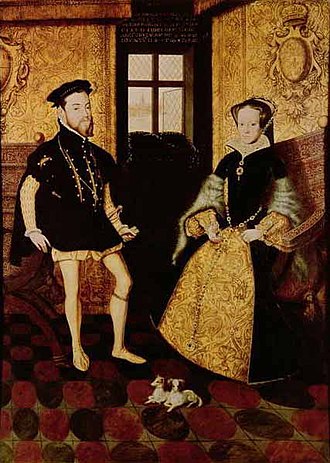
Wedding_of_Mary_I_of_England_and_Philip_of_Spain
The royal wedding of Mary I and Philip II of Spain celebrated at Winchester Cathedral.
Mary I of England (1516–1558) and Philip of Spain married at Winchester Cathedral on Wednesday 25 July 1554.
1554
Caracas
Don Diego de Losada founds the city of Santiago de Leon de Caracas, modern-day Caracas, the capital city of Venezuela.
Capital and largest city of Venezuela
Caracas, officially Santiago de León de Caracas (CCS), is the capital and largest city of Venezuela, and the center of the Metropolitan Region of Caracas. It is located along the Guaire River in the northern part of Venezuela, within the Caracas Valley of the Venezuelan coastal mountain range. The valley is close to the Caribbean Sea, separated from the shore by a steep 2,200-meter-high (7,200-foot) mountain range, Cerro El Ávila. To the south there are more hills and mountains that form the valley. The Metropolitan Region of Caracas has an estimated population of over 5 million inhabitants.
1567
Alexander_Farnese,_Duke_of_Parma
The Duke of Parma is defeated near the Dutch city of Nijmegen by an Anglo-Dutch force led by Maurice of Orange.
Italian general and governor (1545–1592)
Alexander Farnese was an Italian noble and military leader, who was Duke of Parma, Piacenza and Castro from 1586 to 1592, as well as Governor of the Spanish Netherlands from 1578 to 1592. Nephew to King Philip II of Spain, he served in the Battle of Lepanto and the subsequent campaigns of the Holy League against the Ottoman Empire. He was latter appointed general of the Spanish army during the Dutch revolt and its ramifications, serving in Netherlands, France and the Holy Roman Empire until his death in 1592.
1591
Henry_IV_of_France
Henry IV of France publicly converts from Protestantism to Roman Catholicism.
King of France from 1589 to 1610
Henry IV, also known by the epithets Good King Henry or Henry the Great, was King of Navarre from 1572 and King of France from 1589 to 1610. He was the first monarch of France from the House of Bourbon, a cadet branch of the Capetian dynasty. He pragmatically balanced the interests of the Catholic and Protestant parties in France, as well as among the European states. He was assassinated in Paris in 1610 by a Catholic zealot, and was succeeded by his son Louis XIII.
1593
James_VI_and_I
James VI and I and Anne of Denmark are crowned in Westminster Abbey.
King of Scotland from 1567 to 1625, King of England and Ireland from 1603
James VI and I was King of Scotland as James VI from 24 July 1567, and King of England and Ireland as James I from the union of the Scottish and English crowns on 24 March 1603, until his death in 1625. Though he long attempted to get both countries to adopt a closer political union, the kingdoms of Scotland and England remained sovereign states ruled by James in personal union, with their own parliaments, judiciaries and laws.
1603
Sea_Venture
The English ship Sea Venture, en route to Virginia, is deliberately driven ashore during a storm at Bermuda to prevent its sinking; the survivors go on to found a new colony there.
17th-century English sailing ship
Sea Venture was an English sailing ship that was part of the flotilla for the Third Supply mission to the Jamestown Colony in 1609. She was the 300-ton flagship of the London Company. During the voyage to Virginia, Sea Venture encountered a tropical storm and was wrecked, with her crew and passengers landing on the uninhabited island of Bermuda. Sea Venture's wreck is widely thought to have been the inspiration for William Shakespeare's 1611 play The Tempest.
1609
A magnitude 8.5 earthquake strikes eastern China, killing over 43,000 people.
Magnitude 8.5 earthquake in East China
A major earthquake occurred during the rule of the Qing dynasty in Shandong Province on July 25, 1668. It had an estimated magnitude of Ms 8.5, making it the largest historical earthquake in East China, and one of the largest to occur on land. An estimated 43,000 to 50,000 people were killed, and its effects were widely felt. Its epicenter may have been located between Ju and Tancheng counties, northeast of the prefecture-level city of Linyi in southern Shandong.
1668
Sabinas_Hidalgo
Ignacio de Maya founds the Real Santiago de las Sabinas, now known as Sabinas Hidalgo, Nuevo León, Mexico.
Municipality in Nuevo León, Mexico
Sabinas Hidalgo is a city and municipality located in the Mexican state of Nuevo León.
1693
Peter_the_Great
At the behest of Tsar Peter the Great, the construction of Kadriorg Palace, dedicated to his wife Catherine, begins in Tallinn.
Tsar of Russia from 1682 to 1725
Peter I was the Tsar of all Russia from 1682 and the first Emperor of Russia from 1721 until his death in 1725. He reigned jointly with his half-brother Ivan V until 1696. Peter, as an autocrat, organized a well-ordered police state.
1718
Dummer's_War
Dummer's War begins along the Maine-Massachusetts border.
Conflict between the New England Colonies and the Wabanaki Confederacy (1722–25)
Dummer's War (1722–1725) was a series of battles between the New England Colonies and the Wabanaki Confederacy, who were allied with New France. The eastern theater of the war was located primarily along the border between New England and Acadia in Maine, as well as in Nova Scotia; the western theater was located in northern Massachusetts and Vermont in the frontier areas between Canada and New England.
1722
British_Empire
British governor Charles Lawrence and the Nova Scotia Council order the deportation of the Acadians.
Territories ruled by the United Kingdom
The British Empire comprised the dominions, colonies, protectorates, mandates, and other territories ruled or administered by the United Kingdom and its predecessor states. It began with the overseas possessions and trading posts established by England in the late 16th and early 17th centuries, and colonisation attempts by Scotland during the 17th century. At its height in the 19th and early 20th centuries, it was the largest empire in history and, for a century, was the foremost global power. By 1913, the British Empire held sway over 412 million people, 23 per cent of the world population at the time, and by 1920, it covered 35.5 million km2 (13.7 million sq mi), 24 per cent of the Earth's total land area. As a result, its constitutional, legal, linguistic, and cultural legacy is widespread. It was described as "the empire on which the sun never sets", as the sun was always shining on at least one of its territories.
1755
French_and_Indian_War
French and Indian War: In Western New York, British forces capture Fort Niagara from the French, who subsequently abandon Fort Rouillé.
North American theater of the Seven Years' War
The French and Indian War (1754–1763) was a conflict in North America between Great Britain and France, along with their respective Indigenous allies, which were called "Indians" at the time. Historians generally consider it part of the global Seven Years' War, which lasted from 1756 to 1763, although in the United States it is often viewed as a distinct conflict unassociated with any larger European war.
1759
American_Revolutionary_War
American Revolutionary War: The war's last action, the Siege of Cuddalore, is ended by a preliminary peace agreement.
1775–1783 conflict in North America
The American Revolutionary War, also known as the Revolutionary War or American War of Independence or simply the American Revolution, was the armed conflict that comprised the final eight years of the broader American Revolution, in which American Patriot forces organized as the Continental Army and commanded by George Washington defeated the British Army. The conflict was fought in North America, the Caribbean, and the Atlantic Ocean. The war's outcome seemed uncertain for most of the war, but Washington and the Continental Army's decisive victory in the Siege of Yorktown in 1781 led King George III and the Kingdom of Great Britain to negotiate an end to the war. In 1783, in the Treaty of Paris, the British monarchy acknowledged the independence of the Thirteen Colonies, leading to the establishment of the United States as an independent and sovereign nation.
1783
Wolfgang_Amadeus_Mozart
Wolfgang Amadeus Mozart completes his Symphony No.
40 in G minor (K550).
Wolfgang Amadeus Mozart was a Classical composer and musician. He completed more than 800 works in his life—including outstanding examples of most of the genres of his time: symphonies, concertos, chamber music, opera, and choral music—and is regarded as one of the greatest composers in the history of Western music.
1788
Brunswick_Manifesto
The Brunswick Manifesto is issued to the population of Paris promising vengeance if the French royal family is harmed.
1792 warning to the people of Paris by Charles William Ferdinand, Duke of Brunswick
The Brunswick Manifesto was a proclamation issued by Charles William Ferdinand, Duke of Brunswick, commander of the Allied army, on 25 July 1792 to the population of Paris during the War of the First Coalition. The manifesto threatened that if the French royal family were harmed, then French civilians would be harmed. It was said to have been a measure intended to intimidate Paris but rather helped further spur the increasingly radical French Revolution and finally led to the war between Revolutionary France and counter-revolutionary monarchies.
1792
Horatio_Nelson,_1st_Viscount_Nelson
Horatio Nelson loses more than 300 men and his right arm during the failed conquest attempt of Tenerife (Spain).
Royal Navy officer (1758–1805)
Vice-Admiral of the White Horatio Nelson, 1st Viscount Nelson, 1st Duke of Bronte was a Royal Navy officer whose leadership, grasp of strategy, and unconventional tactics led to multiple decisive British naval victories during the French Revolutionary and Napoleonic Wars. Trafalgar Square is dedicated to him. He is widely regarded as one of the greatest admirals in history.
1797
Napoleon
Napoleon Bonaparte defeats a numerically superior Ottoman army under Mustafa Pasha at the Battle of Abukir.
French general and emperor (1769–1821)
Napoleon Bonaparte, later known by his regnal name Napoleon I, was Emperor of the French from 18 May 1804 until his first abdication in 1814, with a brief restoration during the Hundred Days in 1815. He rose to prominence as a general during the French Revolution and led a series of military campaigns across Europe and the Middle East during the French Revolutionary and Napoleonic Wars. As a statesman, he implemented numerous legal and administrative reforms in France and Europe.
1799
War_of_1812
War of 1812: An American attack on Canada is repulsed.
1812–1815 conflict in North America
The War of 1812 was a conflict initiated by the United States against the United Kingdom and its allies fought mainly in North America and at sea during the wider Napoleonic Wars. The United States declared war on Britain on 18 June 1812. Although peace terms were agreed upon in the December 1814 Treaty of Ghent, the war did not officially end until the peace treaty was ratified by the United States Senate on 17 February 1815.
1814
Costa_Rica
Costa Rica annexes Guanacaste from Nicaragua.
Country in Central America
Costa Rica, officially the Republic of Costa Rica, is a country in Central America. It borders Nicaragua to the north, the Caribbean Sea to the northeast, Panama to the southeast, and the Pacific Ocean to the southwest, sharing a maritime border with Ecuador to the south of Cocos Island. It has a population of around five million in a land area of nearly 51,180 km2 (19,760 sq mi); the capital and largest city is San José, home to around 350,000 residents and two million people in the surrounding metropolitan area.
1824
James_Bowman_Lindsay
James Bowman Lindsay demonstrates a constant electric light at a public meeting in Dundee, Scotland.
Scottish Inventor
James Bowman Lindsay was a Scottish inventor and writer. He is credited with early developments in several fields, such as incandescent lighting and telegraphy.
1835
Electrical_telegraph
The first commercial use of an electrical telegraph is successfully demonstrated in London by William Cooke and Charles Wheatstone.
Early system for transmitting text over wires
Electrical telegraphy is point-to-point distance communicating via sending electric signals over wire, a system primarily used from the 1840s until the late 20th century. It was the first electrical telecommunications system and the most widely used of a number of early messaging systems called telegraphs, that were devised to send text messages more quickly than physically carrying them. Electrical telegraphy can be considered the first example of electrical engineering.
1837
Joaquin Murrieta, the famous Californio bandit known as the "Robin Hood of El Dorado", is killed.
Historical figure in early California (1829–1853)
Joaquin Murrieta Carrillo, also called the Robin Hood of the West or the Robin Hood of El Dorado, was a Mexican figure of disputed historicity. The novel The Life and Adventures of Joaquín Murieta: The Celebrated California Bandit (1854) by John Rollin Ridge is ostensibly his story.
1853
Military_rank
The United States Congress passes legislation authorizing the rank of General of the Army.
Lieutenant General Ulysses S. Grant becomes the first to be promoted to this rank.
Military ranks are a system of hierarchical relationships within armed forces, police, intelligence agencies and other institutions organized along military lines. Responsibility for personnel, equipment and missions grows with each advancement. The military rank system defines dominance, authority and responsibility within a military hierarchy. It incorporates the principles of exercising power and authority into the military chain of command—the succession of commanders superior to subordinates through which command is exercised. The military chain of command is an important component for organized collective action.
1866
Wyoming_Territory
The Wyoming Territory is established.
Former organized incorporated territory of the United States (1868–1890)
The Territory of Wyoming was an organized incorporated territory of the United States that existed from July 25, 1868, until July 10, 1890, when it was admitted to the Union as the State of Wyoming. Cheyenne was the territorial capital. The boundaries of the Wyoming Territory were identical to those of the modern State of Wyoming.
1868
Daimyo
The Japanese daimyōs begin returning their land holdings to the emperor as part of the Meiji Restoration reforms.
(Traditional Japanese Date: June 17, 1869).
Daimyo or daimio were powerful Japanese magnates, feudal lords who, from the 15th century to the early Meiji period in the middle 19th century, ruled most of Japan from their vast hereditary land holdings. They were subordinate to the shogun and nominally to the emperor and the kuge. In the term, dai (大) means 'large', and myō stands for myōden (名田), meaning 'private land'.
1869
First_Sino-Japanese_War
The First Sino-Japanese War begins when the Japanese fire upon a Chinese warship.
1894–1895 war between China and Japan
The First Sino-Japanese War, or the First China–Japan War, was a conflict between the Qing dynasty of China and the Empire of Japan primarily for influence over Korea. In China it is commonly known as the Jiawu War. After 6 to 7 months of unbroken successes by Japanese land and naval forces and the loss of the ports of Lüshunkou and Weihaiwei, the Qing government sued for peace in February 1895 and signed the Treaty of Shimonoseki two months later, ending the war.
1894
Jack_London
American author Jack London embarks on a sailing trip to take part in the Klondike's gold rush, from which he wrote his first successful stories.
American author, journalist and social activist (1876–1916)
John Griffith London, better known as Jack London, was an American novelist, journalist and activist. A pioneer of commercial fiction and American magazines, he was one of the first American authors to become an international celebrity and earn a large fortune from writing.
1897
Spanish–American_War
Spanish–American War: The American invasion of Spanish-held Puerto Rico begins, as United States Army troops under General Nelson A.
Miles land and secure the port at Guánica.
The Spanish–American War was fought between Spain and the United States in 1898. It began with the sinking of the USS Maine in Havana Harbor in Cuba, and resulted in the U.S. acquiring sovereignty over Puerto Rico, Guam, and the Philippines, and establishing a protectorate over Cuba. It represented U.S. intervention in the Cuban War of Independence and Philippine Revolution, with the latter later leading to the Philippine–American War. The Spanish–American War brought an end to almost four centuries of Spanish presence in the Americas, Asia, and the Pacific; the United States meanwhile not only became a major world power, but also gained several island possessions spanning the globe, which provoked rancorous debate over the wisdom of expansionism.
1898
Ajinomoto
Ajinomoto is founded.
Kikunae Ikeda of the Tokyo Imperial University discovers that a key ingredient in kombu soup stock is monosodium glutamate (MSG), and patents a process for manufacturing it.
Ajinomoto Co., Inc. is a Japanese multinational food and biotechnology corporation which produces seasonings, cooking oils, frozen foods, beverages, sweeteners, amino acids, insulating films, and pharmaceuticals. Aji-No-Moto is the trade name for the company's original monosodium glutamate (MSG) product, the first of its kind, since 1909. The corporation's head office is located in Chūō, Tokyo. As of 2024, Ajinomoto operates in 31 countries worldwide and employs an estimated 34,862 people. Its yearly revenue in 2024 is around ¥1.53 trillion JPY or $10.61 billion USD.
1908
Louis_Blériot
Louis Blériot makes the first flight across the English Channel in a heavier-than-air machine from Calais to Dover, England, United Kingdom in 37 minutes.
French aviator, inventor and engineer
Louis Charles Joseph Blériot was a French aviator, inventor, and engineer. He developed the first practical headlamp for cars and established a profitable business manufacturing them, using much of the money he made to finance his attempts to build a successful aircraft. Blériot was the first to use the combination of hand-operated joystick and foot-operated rudder control as used to the present day to operate the aircraft control surfaces. Blériot was also the first to make a working, powered, piloted monoplane. In 1909 he became world-famous for making the first aeroplane flight across the English Channel, winning the prize of £1,000 offered by the Daily Mail newspaper. He was the founder of Blériot Aéronautique, a successful aircraft manufacturing company.
1909
Tragic_Week_(Spain)
Begin of the Tragic Week in Barcelona in response to troop mobilisations for the Rif War.
Social revolt
Tragic Week was a series of violent confrontations between the Spanish army and anarchists, freemasons, socialists and republicans of Barcelona and other cities in Catalonia, Spain, during the last week of July 1909. It was caused by the calling-up of reserve troops by Premier Antonio Maura to be sent as reinforcements when Spain renewed military-colonial activity in Morocco on 9 July, in what is known as the Second Rif War. Many of these reservists were the only breadwinners for their families, while the wealthy were able to hire substitutes. The figureheads most associated with the unrest were Alejandro Lerroux and Francisco Ferrer.
1909
Battle_of_Nasiriyah_(1915)
The British capture Nasiriyah from the Ottomans during the Mesopotamian campaign.
1915 battle in WWI
The Battle of Nasiriyah was a battle in World War I that took place in Nasiriyah, Ottoman Iraq, between British and Ottoman forces in July 1915. It was a pivotal battle in the Mesopotamian campaign of World War I and saw 5,000 British and Indian troops face off against a Turkish garrison of a similar number. British and Indian forces under the command of Lieutenant General Sir George Frederick Gorringe attacked Nasiriyah with the intention of protecting the British stronghold of Basra and destroying a major Turkish supply center in the region. British forces defeated the Turkish forces in Nasiriyah and it became the latest addition to a long string of successes against Ottoman forces in the campaign, coming right after the capture of Amara and the Battle of Qurna.
1915
Royal_Flying_Corps
RFC Captain Lanoe Hawker becomes the first British pursuit aviator to earn the Victoria Cross.
Former air warfare service of the British Army
The Royal Flying Corps (RFC) was the air arm of the British Army before and during the First World War until it merged with the Royal Naval Air Service on 1 April 1918 to form the Royal Air Force. During the early part of the war, the RFC supported the British Army by artillery co-operation and photographic reconnaissance. This work gradually led RFC pilots into aerial battles with German pilots and later in the war included the strafing of enemy infantry and emplacements, the bombing of German military airfields and later the strategic bombing of German industrial and transport facilities.
1915
Robert_Borden
Sir Robert Borden introduces the first income tax in Canada as a "temporary" measure (lowest bracket is 4% and highest is 25%).
Prime Minister of Canada from 1911 to 1920
Sir Robert Laird Borden was a Canadian lawyer and politician who served as the eighth prime minister of Canada from 1911 to 1920. He is best known for his leadership of Canada during World War I.
1917
TASS
Telegraph Agency of the Soviet Union (TASS) is established.
Russian state-owned news agency
The Russian News Agency TASS, or simply TASS, is a Russian state-owned news agency founded in 1904. It is the largest Russian news agency and one of the largest news agencies worldwide.
1925
Nazi_Germany
The Nazis assassinate Austrian Chancellor Engelbert Dollfuss in a failed coup attempt.
German state from 1933 to 1945
Nazi Germany, officially the German Reich and later the Greater German Reich, was the German state between 1933 and 1945, when Adolf Hitler and the Nazi Party controlled the country, transforming it into a totalitarian dictatorship. The Third Reich, meaning "Third Realm" or "Third Empire", referred to the Nazi claim that Nazi Germany was the successor to the Holy Roman Empire (800–1806) and the German Empire (1871–1918). The Third Reich, which the Nazis referred to as the Thousand-Year Reich, ended in May 1945, after 12 years, when the Allies defeated Germany and entered the capital, Berlin, ending World War II in Europe.
1934
Henri_Guisan
General Henri Guisan orders the Swiss Army to resist German invasion and makes surrender illegal.
Swiss general
Henri Guisan was a Swiss military officer who held the office of General of the Swiss Armed Forces during the Second World War. He was the fourth and the most recent person to be appointed to the rarely used Swiss rank of general, and was possibly Switzerland's most famous soldier. He is best remembered for effectively mobilizing the Swiss military and population in order to prepare resistance against a possible invasion by Nazi Germany in 1940. Guisan was voted the fourth-greatest Swiss figure of all time in 2010.
1940
Norwegian_resistance_movement
The Norwegian Manifesto calls for nonviolent resistance to the German occupation.
Resistance to German occupation in WWII
The Norwegian resistance to the occupation of Norway by Nazi Germany began after Operation Weserübung in 1940 and ended in 1945. It took several forms:Asserting the legitimacy of the exiled government, and by implication the lack of legitimacy of Vidkun Quisling's pro-Nazi regime and Josef Terboven's military administration The initial defence in Southern Norway, which was largely disorganised, but succeeded in allowing the government to escape capture The more organised military defence and counter-attacks in parts of Western and Northern Norway, aimed at securing strategic positions and the evacuation of the government Armed resistance, in the form of sabotage, commando raids, assassinations and other special operations during the occupation Civil disobedience and unarmed resistance
1942
World_War_II
World War II: Benito Mussolini is forced out of office by the King (encouraged by the Grand Council of Fascism) and is replaced by Pietro Badoglio.
Global conflict (1939–1945)
World War II, or the Second World War, was a global conflict between two coalitions: the Allies and the Axis powers. Nearly all of the world's countries participated, with many engaging in total war on an unprecedented scale. World War II was the deadliest conflict in history, causing the deaths of 60 to 75 million people, a majority of whom were civilians. Millions died as a result of massacres, starvation, disease, and genocides including the Holocaust. After the Allied victory, Germany, Austria, Japan, and Korea were occupied, and German and Japanese leaders were tried for war crimes.
1943
World War II: 136 Greek civilians are murdered by soldiers of the German 1st Mountain Division in the village of Mousiotitsa, Greece.
Mass-killings in Mousiotitsa, Nazi-occupied Greece
The Massacres of Mousiotitsa refer to Nazi war crimes perpetrated in the summer of 1943 by soldiers of the 1st Mountain Division in the village of Mousiotitsa, Greece, during its occupation by the Axis in World War II. Mousiotitsa endured two assaults by the same German unit, separated by a one-month period. The first took place on 25 July and the second on 27 August 1943.
1943
Operation_Spring
World War II: Operation Spring near Caen is one of the bloodiest days for the First Canadian Army during the war.
1944 Canadian offensive on the Western Front of World War II
Operation Spring was an offensive operation of the Second World War conducted by II Canadian Corps during the Normandy campaign in 1944. The plan was intended to create pressure on the German forces operating on the British and Canadian front simultaneous with Operation Cobra, an American offensive. Operation Spring was intended to capture Verrières Ridge and the villages on the south slope of the ridge. A successful German defence of the ridge contained the offensive on the first day, and inflicted many casualties on the Canadians.
1944
Operation_Crossroads
The Crossroads Baker device is the first underwater nuclear weapon test.
1946 nuclear weapon tests at Bikini Atoll
Operation Crossroads was a pair of nuclear weapon tests conducted by the United States at Bikini Atoll in mid-1946. They were the first nuclear weapon tests since Trinity on July 16, 1945, and the first detonations of nuclear devices since the atomic bombing of Nagasaki on August 9, 1945. The purpose of the tests was to investigate the effect of nuclear weapons on warships.
1946
Nantucket
Forty-five miles south of Nantucket Island, the Italian ocean liner SS Andrea Doria collides with the MS Stockholm in heavy fog and sinks the next day, killing 51.
Consolidated town and county in Massachusetts, United States
Nantucket is an island in Massachusetts, United States, about 30 miles (48 km) south of the Cape Cod peninsula. Together with the small islands of Tuckernuck and Muskeget, it constitutes the Town and County of Nantucket, a combined county/town government. Nantucket is the southeasternmost town in Massachusetts. The name "Nantucket" is adapted from similar Algonquian names for the island.
1956
The Tunisian King Muhammad VIII al-Amin is replaced by President Habib Bourguiba.
Ruler of Tunisia from 1943 to 1957
Muhammad el-Amine Bey bin Muhammad el-Habib, commonly known as Lamine Bey, was the last Bey of Tunis, and also the only King of Tunisia after independence.
1957
The African Regroupment Party holds its first congress in Cotonou.
Political party in the French African colonies
The African Regroupment Party was a political party in the French African colonies.
1958
Cold_War
Cold War: In a speech John F.
Kennedy emphasizes that any attack on Berlin is an attack on NATO.
The Cold War was a period of international geopolitical rivalry between the United States (US) and the Soviet Union (USSR) and their respective allies, the capitalist Western Bloc and communist Eastern Bloc. It began in the aftermath of the Second World War and ended with the dissolution of the Soviet Union in 1991. The term cold war is used because there was no direct fighting between the two superpowers, though each supported opposing sides in regional conflicts known as proxy wars. In addition to the struggle for ideological and economic influence and an arms race in both conventional and nuclear weapons, the Cold War was expressed through technological rivalries such as the Space Race, espionage, propaganda campaigns, embargoes, and sports diplomacy.
1961
Bob_Dylan
Bob Dylan goes electric at the Newport Folk Festival, signaling a major change in folk and rock music.
American singer-songwriter (born 1941)
Bob Dylan is an American singer-songwriter. Described as one of the greatest songwriters of all time, Dylan has been a major figure in popular culture over his 69-year career. With an estimated 125 million records sold worldwide, he is one of the best-selling musicians. Dylan added increasingly sophisticated lyrical techniques to the folk music of the early 1960s, infusing it "with the intellectualism of classic literature and poetry". His lyrics incorporated political, social, and philosophical influences, defying pop music conventions and appealing to the burgeoning counterculture.
1965
Vietnam_War
Vietnam War: U.S.
President Richard Nixon declares the Nixon Doctrine, stating that the United States now expects its Asian allies to take care of their own military defense. This is the start of the "Vietnamization" of the war.
The Vietnam War was an armed conflict in Vietnam, Laos, and Cambodia fought between North Vietnam and South Vietnam and their allies. North Vietnam was supported by the Soviet Union and China, while South Vietnam was supported by the United States and other anti-communist nations. The conflict was the second of the Indochina wars and a proxy war of the Cold War. The Vietnam War was one of the postcolonial wars of national liberation, a theater in the Cold War, and a civil war, with civil warfare a defining feature from the outset. Direct US military involvement escalated from 1965 until US forces were withdrawn in 1973. The fighting spilled into the Laotian and Cambodian civil wars, which ended with all three countries becoming communist in 1975.
1969
Sohagpur_massacre
The Sohagpur massacre is perpetrated by the Pakistan Army.
1971 mass killings in East Pakistan
The Sohagpur massacre was a mass killing of 187 civilians on 25 July 1971 in the Mymensingh District of East Pakistan during the Liberation War. The massacre was perpetrated by the Pakistan Army and Al-Badr, a paramilitary force opposing Bangladeshi independence. Following the massacre, Sohagpur became known as the "village of widows."
1971
Soviet_Union
Soviet Mars 5 space probe is launched.
Country in Eurasia from 1922 to 1991
The Soviet Union, officially the Union of Soviet Socialist Republics (USSR), was a transcontinental country that spanned much of Eurasia from its formation in 1922 until its dissolution in 1991. It was the world's third-most populous country, the largest by area, and bordered twelve other countries. A diverse multinational state, it was organized as a federal union of national republics, with the largest and most populous being the Russian Soviet Federative Socialist Republic (SFSR). The world's flagship communist state, it was governed by the Communist Party under Marxism–Leninism, through soviet councils. The Soviet economy was also centrally planned. Its capital and largest city was Moscow.
1973
Viking_program
Viking program: Viking 1 takes the famous Face on Mars photo.
Pair of NASA landers and orbiters sent to Mars in 1976
The Viking program consisted of a pair of identical American space probes, Viking 1 and Viking 2 both launched in 1975, and landed on Mars in 1976. The mission effort began in 1968 and was managed by the NASA Langley Research Center. Each spacecraft was composed of two main parts: an orbiter spacecraft which photographed the surface of Mars from orbit, and a lander which studied the planet from the surface. The orbiters also served as communication relays for the landers once they touched down.
1976
Puerto_Rico
Puerto Rican police shoot two nationalists in the Cerro Maravilla murders.
U.S. territory in the Caribbean
Puerto Rico, officially the Commonwealth of Puerto Rico, is a self-governing Caribbean archipelago and island organized as an unincorporated territory of the United States under the designation of commonwealth. Located about 1,000 miles (1,600 km) southeast of Miami, Florida, between the Dominican Republic in the Greater Antilles and the U.S. Virgin Islands in the Lesser Antilles, it consists of the eponymous main island and numerous smaller islands, including Vieques, Culebra, and Mona. With approximately 3.2 million people, it is divided into 78 municipalities, of which the most populous is the capital municipality of San Juan, followed by those within the San Juan metropolitan area. Spanish and English are the official languages of the government, though Spanish predominates.
1978
Birth of Louise Joy Brown, the first human to have been born after conception by in vitro fertilisation, or IVF.
First person conceived by IVF (born 1978)
Louise Joy Brown is an English woman noted as the first human born following conception by in vitro fertilisation (IVF). Her birth, following a procedure pioneered in Britain, has been lauded among "the most remarkable medical breakthroughs of the 20th century".
1978
Egypt–Israel_peace_treaty
In accord with the Egypt–Israel peace treaty, Israel begins its withdrawal from the Sinai Peninsula.
The Egypt–Israel peace treaty was signed in Washington, D.C., United States, on 26 March 1979, following the 1978 Camp David Accords. The treaty was signed by Anwar Sadat, President of Egypt, and Menachem Begin, Prime Minister of Israel, and witnessed by Jimmy Carter, President of the United States.
1979
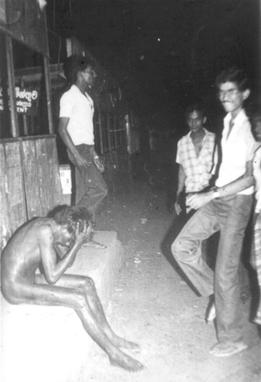
Black_July
Black July: Thirty-seven Tamil political prisoners at the Welikada high security prison in Colombo are massacred by the fellow Sinhalese prisoners.
1983 anti-Tamil riots in Sri Lanka
Black July was an anti-Tamil pogrom that occurred in Sri Lanka during July 1983. The pogrom was premeditated, and was finally triggered by a deadly ambush on a Sri Lankan Army patrol by the Liberation Tigers of Tamil Eelam (LTTE) on 23 July 1983, which killed 13 soldiers. Although initially orchestrated by members of the ruling UNP, the pogrom soon escalated into mass violence with significant public participation.
1983
Salyut_7
Salyut 7 cosmonaut Svetlana Savitskaya becomes the first woman to perform a space walk.
Soviet space station (1982–1991)
Salyut 7, also known as DOS-6, was a space station in low Earth orbit from April 1982 to February 1991. It was first crewed in May 1982 with two crew via Soyuz T-5, and last visited in June 1986, by Soyuz T-15. Various crew and modules were used over its lifetime, including 12 crewed and 15 uncrewed launches in total. Supporting spacecraft included the Soyuz T, Progress, and TKS spacecraft.
1984
Lebanon
Israel launches a massive attack against Lebanon in what the Israelis call Operation Accountability, and the Lebanese call the Seven-Day War.
Country in West Asia
Lebanon, officially the Lebanese Republic, is a country in the Levant region of West Asia. Situated at the crossroads of the Mediterranean Basin and the Arabian Peninsula, it is bordered by Syria to the north and east, Israel to the south, and the Mediterranean Sea to the west; Cyprus lies a short distance from the coastline. Lebanon has a population of more than five million and an area of 10,452 square kilometres (4,036 sq mi). Beirut is the country's capital and largest city.
1993
The Saint James Church massacre occurs in Kenilworth, Cape Town, South Africa.
1993 mass killing by militants in Kenilworth, Cape Town, South Africa
The Saint James Church massacre was a massacre perpetrated on St James Church of England in South Africa in Kenilworth, Cape Town, South Africa, on 25 July 1993 by four members of the Azanian People's Liberation Army (APLA). Eleven members of the congregation were killed and 58 wounded. In 1998 the attackers were granted amnesty for their acts by the Truth and Reconciliation Commission.
1993
Jordan
Israel and Jordan sign the Washington Declaration, that formally ends the state of war that had existed between the nations since 1948.
Country in West Asia
Jordan, officially the Hashemite Kingdom of Jordan, is a country in the Southern Levant region of West Asia. Jordan is bordered by Syria to the north, Iraq to the east, Saudi Arabia to the south, and both Israel and Palestine to the west. The Jordan River, flowing into the Dead Sea, is located along the country's western border within the Jordan Rift Valley. Jordan has a small coastline along the Red Sea in its southwest, separated by the Gulf of Aqaba from Egypt. Amman is the country's capital and largest city, as well as the most populous city in the Levant.
1994
1995_France_bombings
A gas bottle explodes in Saint Michel station of line B of the RER (Paris regional train network).
Eight are killed and 80 wounded.
A series of attacks targeted public transport systems in Paris and Lyon, as well as a school in Villeurbanne, in 1995. They were carried out by the Armed Islamic Group of Algeria (GIA), who sought to expand the Algerian Civil War to France. The attacks killed eight people, all during the first attack on 25 July. The attack also injured 190 people. The assassination of Abdelbaki Sahraoui, a co-founder of the Islamic Salvation Front (FIS), was a prelude to the extension of the Islamists' terrorist campaign in France.
1995
1996_Burundian_coup_d'état
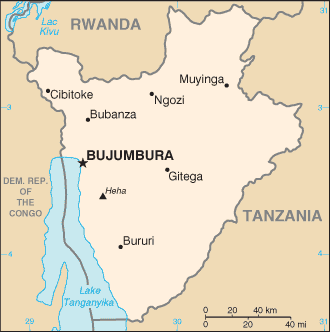
In a military coup in Burundi, Pierre Buyoya deposes Sylvestre Ntibantunganya.
Military coup in Burundi
The 1996 Burundian coup d'état was a military coup d'état that took place in Burundi on 25 July 1996. In the midst of the Burundi Civil War, former president Pierre Buyoya deposed Hutu President Sylvestre Ntibantunganya. According to Amnesty International, in the weeks following the coup, more than 6,000 people were killed in the country. This was Buyoya's second successful coup, having overthrown Jean-Baptiste Bagaza in 1987.
1996
Concorde
Concorde Air France Flight 4590 crashes outside of Paris shortly after taking off at Charles de Gaulle Airport, killing 113 people.
British–French supersonic airliner
Concorde is a retired Anglo-French supersonic airliner jointly developed and manufactured by Sud Aviation and the British Aircraft Corporation (BAC). Studies began in 1954 and a UK–France treaty followed in 1962, as the programme cost was estimated at £70 million . Construction of six prototypes began in February 1965, with the first flight from Toulouse on 2 March 1969. The market forecast was 350 aircraft, with manufacturers receiving up to 100 options from major airlines. On 9 October 1975, it received its French certificate of airworthiness, and was certified by the UK CAA on 5 December.
2000
Phoolan_Devi
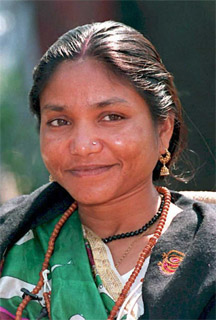
Phoolan Devi, a serving Member of Parliament, was assassinated by shooting in New Delhi, India.
Indian bandit and politician (1963–2001)
Phoolan Devi, popularly known as the Bandit Queen, was an Indian dacoit (bandit) who became a politician, serving as a member of parliament until her assassination. She was a woman of the Mallah subcaste who grew up in poverty in a village in the state of Uttar Pradesh, where her family was on the losing side of a land dispute which caused them many problems. After being married off at the age of eleven and being sexually abused by various people, she joined a gang of dacoits. Her gang robbed higher-caste villages and held up trains and vehicles. When she punished her rapists and evaded capture by the authorities, she became a heroine to the Other Backward Classes who saw her as a Robin Hood figure. Phoolan Devi was charged in absentia for the 1981 Behmai massacre, in which twenty Thakur men were killed, allegedly on her command. After this event, the Chief Minister of Uttar Pradesh resigned, and calls to apprehend her were amplified. She surrendered two years later in a carefully negotiated settlement and spent eleven years in Gwalior prison, awaiting trial.
2001
Pratibha_Patil
Pratibha Patil is sworn in as India's first female president.
President of India from 2007 to 2012
Pratibha Devisingh Patil, also known as Pratibha Patil Shekhawat, is an Indian stateswoman and lawyer who served as the president of India from 2007 to 2012. She was the first woman to become the president of India. A member of the Indian National Congress, she also served as the Governor of Rajasthan from 2004 to 2007, and was a member of the Lok Sabha from 1991 to 1996.
2007
WikiLeaks
WikiLeaks publishes classified documents about the War in Afghanistan, one of the largest leaks in U.S.
military history.
WikiLeaks is a non-profit media organisation and publisher of leaked documents. It is funded by donations and media partnerships. It has published classified documents and other media provided by anonymous sources. It was founded in 2006 by Julian Assange. Kristinn Hrafnsson is its editor-in-chief. Its website states that it has released more than ten million documents and associated analyses. WikiLeaks' most recent publication of original documents was in 2019, and its most recent publication was in 2021. From November 2022, numerous documents on the organisation's website became inaccessible. In 2023, Assange said that WikiLeaks was no longer able to publish due to his imprisonment and the effect that US government surveillance and WikiLeaks' funding restrictions were having on potential whistleblowers.
2010
2018_Suwayda_attacks
As-Suwayda attacks: Coordinated attacks occur in Syria.
ISIL attacks on Syrian Druze villages
The 2018 Suwayda attacks were a string of suicide bombings and mass shooting incidents in Suwayda, Syria on 25 July 2018. At least 258 people were killed and 180 wounded. The attacks were carried out by the Islamic State and largely targeted Syria's Druze minority. A 17-year old Druze girl was beheaded.
2018
2019_European_heatwaves
National extreme heat records set this day in the UK, Belgium, The Netherlands and Germany during the July 2019 European heat wave.
In late June and late July 2019 there were two temporally distinct European heat waves, which set all-time high temperature records in Belgium, France, Germany, Luxembourg, the Netherlands, and the United Kingdom.
2019

History runs on facts, and this project runs on coffee!

Your support is incredibly helpful and genuinely appreciated.

Support with a coffee ☕