June 18 in History

55 events 618 – 2023

June 18 spans 55 recorded events across recorded history, from 618 to 2023. Below is a curated digest of the most significant moments tied to this date.

By · Wikipedia

1837 — St

Joseph Mutiny: African soldiers in the 1st West India Regiment – led by former slave trader Daaga – launch a rebellion in the British colony of Trinidad in an attempt to escape to Africa.

More major events on June 18

The featured story and these ranked highlights form a quick summary. Every recorded event remains available in the chronology below.

  1. 2006 The first Kazakh space satellite, KazSat-1, is launched. Source
  2. 1812 The United States declaration of war upon the United Kingdom is signed by President James Madison, beginning the War of 1812. Source
  3. 1940 World War II: The "Finest Hour" speech is delivered by Winston Churchill. Source

Did you know

In 1837, St. Joseph Mutiny: African soldiers in the 1st West India Regiment – led by former slave trader Daaga – launch a rebellion in the British colony of Trinidad in an attempt to escape to Africa. This featured entry focuses on the immediate decision and its direct historical impact.

Did you know

The West India Regiments (WIR) were a group of line infantry regiments of the British Army raised and normally stationed in the British West Indies between 1795 and 1927. This helps explain why the event mattered beyond the initial announcement.

Did you know

In 1888 the two West India Regiments then in existence were reduced to a single regiment of two battalions. This clarifies the institutional and public response around the event.

Did you know

This regiment differed from similar forces raised in other parts of the British Empire in that it was a part of the British Army. This shows how the event shaped policy and public communication in the same period.

Did you know

In 1958 a new regiment was raised following the creation of the Federation of the West Indies with the establishment of three battalions, however, the regiment's existence was short-lived and it was disbanded in 1962 when its personnel were used to establish other military units in Jamaica and Trinidad and Tobago. This helps explain why the event mattered beyond the initial announcement.


Emperor_Gaozu_of_Tang
Li Yuan becomes Emperor Gaozu of Tang, initiating three centuries of Tang dynasty rule over China.
Founder of China's Tang Dynasty (618 - 626)
Emperor Gaozu of Tang, personal name Li Yuan, courtesy name Shude, Xianbei name Daye Yuan, was the founding emperor of the Tang dynasty of China, reigning from 618 to 626 CE. Under the Sui dynasty, Li Yuan was the governor in the area of modern-day Shanxi, and was based in Taiyuan.
618
Ali
Ali becomes Caliph of the Rashidun Caliphate.
Shia Imam (632–661) and Rashidun caliph (656–661)
Ali ibn Abi Talib was the fourth Rashidun caliph who ruled from 656 CE until his assassination in 661, as well as the first Shia Imam. He was the cousin and son-in-law of the Islamic prophet Muhammad. Born to Abu Talib ibn Abd al-Muttalib and Fatima bint Asad, Ali was raised in the household of his cousin Muhammad and was among the first to accept his teachings.
656
Siege_of_Constantinople_(860)
Byzantine–Rus' War: A fleet of about 200 Rus' vessels sails into the Bosphorus and starts pillaging the suburbs of the Byzantine capital Constantinople.
Battle during the Rus'-Byzantine Wars
The siege of Constantinople in 860 was the only major military expedition of the Rus' recorded in Byzantine and western European sources. The casus belli was the construction of the fortress Sarkel by Byzantine engineers, restricting the Rus' trade route along the Don River in favour of the Khazars. Accounts vary, with discrepancies between contemporary and later sources, and the outcome is unknown in detail.
860
Battle_of_Civitate
Battle of Civitate: Three thousand Norman horsemen of Count Humphrey rout the troops of Pope Leo IX.
1053 battle between the Normans and a coalition of Swabian, Italian, and Lombard forces
The Battle of Civitate was fought on 18 June 1053 in southern Italy, between the Normans, led by the Count of Apulia Humphrey of Hauteville, and a Swabian-Italian-Lombard army, organised by Pope Leo IX and led on the battlefield by Gerard, Duke of Lorraine, and Rudolf, Prince of Benevento. The Norman victory over the allied papal army marked the climax of a conflict between the Norman mercenaries who came to southern Italy in the eleventh century, the de Hauteville family, and the local Lombard princes. By 1059 the Normans would create an alliance with the papacy, which included a formal recognition by Pope Nicholas II of the Norman conquest in south Italy, investing Robert Guiscard as Duke of Apulia and Calabria, and Count of Sicily.
1053
Pope_Adrian_IV
Pope Adrian IV crowns Frederick Barbarossa as Holy Roman Emperor.
Head of the Catholic Church from 1154 to 1159
Pope Adrian IV was head of the Catholic Church and ruler of the Papal States from 4 December 1154 until his death in 1159. He is the only pope to have been born in England and the first pope from an English-speaking country.
1155
The treaty of Benevento between Pope Adrian IV and William I of Sicily is concluded.
1156 treaty between the Papacy and Normans
The Treaty of Benevento or Concordat of Benevento was an important treaty between the papacy of Adrian IV and the Norman Kingdom of Sicily. After years of turbulent relations, the popes finally settled down to a peace with the Hauteville kings.
1156
Parliament_of_Ireland
The Parliament of Ireland meets at Castledermot in County Kildare, the first definitively known meeting of this Irish legislature.
Former parliament of Ireland
The Parliament of Ireland was the legislature of the Lordship of Ireland, and later the Kingdom of Ireland, from 1297 until the end of 1800. It was modelled on the Parliament of England and from 1537 comprised two chambers: the House of Commons and the House of Lords. The Lords were members of the Irish peerage and bishops. The Commons was directly elected, albeit on a very restricted franchise. Parliaments met at various places in Leinster and Munster, but latterly always in Dublin: in Christ Church Cathedral, Dublin Castle, Chichester House (1661–1727), the Blue Coat School (1729–31), and finally a purpose-built Parliament House on College Green.
1264
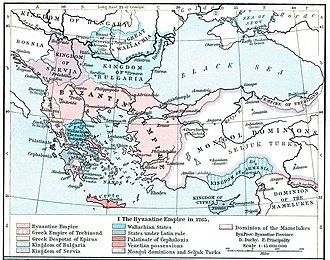
Byzantine–Venetian_treaty_of_1268
A draft Byzantine–Venetian treaty is concluded between Venetian envoys and Emperor Michael VIII Palaiologos, but is not ratified by Doge Reniero Zeno.
Temporary peace treaty
In 1268, the Byzantine Empire and the Republic of Venice agreed to temporarily end hostilities which had erupted after the Byzantine recovery of Constantinople by Emperor Michael VIII Palaiologos in 1261.
1265
Tokhtamysh–Timur_war
Tokhtamysh–Timur war: Battle of the Kondurcha River: Timur defeats Tokhtamysh of the Golden Horde in present-day southeast Russia.
1386–1395 war between Tokhtamysh and Timur
The Tokhtamysh–Timur war was fought from 1386 to 1395 between Tokhtamysh, the khan of the Golden Horde, and the warlord and conqueror Timur, founder of the Timurid Empire, in the areas of the Caucasus Mountains, Turkestan and Eastern Europe. The battle between Timur and Tokhtamysh played a key role in the decline of Mongol power over the Russian principalities.
1391
Charles_VII_of_France
Charles VII's army defeats an English army under John Talbot at the Battle of Patay during the Hundred Years' War.
The English lost 2,200 men, over half their army, crippling their efforts during this segment of the war.
Charles VII, called the Victorious or the Well-Served, was King of France from 1422 to his death in 1461. His reign saw the end of the Hundred Years' War and a de facto end of the English claims to the French throne.
1429
Charles_I_of_England
Charles I is crowned King of Scots at St Giles' Cathedral, Edinburgh.
King of England, Scotland and Ireland from 1625 to 1649
Charles I was King of England, Scotland, and Ireland from 27 March 1625 until his execution in 1649.
1633
Massachusetts_Bay_Colony
The charter of the Massachusetts Bay Colony is revoked via a scire facias writ issued by an English court.
1628-1691 English colony in North America
The Massachusetts Bay Colony (1628–1691), more formally the Colony of Massachusetts Bay, was an English settlement on the east coast of North America around Massachusetts Bay, one of the several colonies later reorganized as the Province of Massachusetts Bay. The lands of the settlement were in southern New England, with initial settlements on two natural harbors and surrounding land about 15.4 miles (24.8 km) apart—the areas around Salem and Boston, north of the previously established Plymouth Colony. The territory nominally administered by the Massachusetts Bay Colony covered much of central New England, including portions of Massachusetts, Maine, New Hampshire, and Connecticut.
1684
Battle_of_Kolín
Battle of Kolín between Prussian forces under Frederick the Great and an Austrian army under the command of Field Marshal Count Leopold Joseph von Daun in the Seven Years' War.
1757 battle of the Seven Years' War
The Battle of Kolín (Kolin) on 18 June 1757 saw 54,000 Austrians under Count von Daun defeat 34,000 Prussians under Frederick the Great during the Third Silesian War. Prussian attempts to turn the Austrian right flank turned into piecemeal frontal attacks and were defeated in five and a half hours of combat. The Prussians lost 13,733 men, the Austrians 8,100. Frederick gave up the Siege of Prague as well as his planned march on Vienna and retreated to Saxony.
1757
American_Revolutionary_War
American Revolutionary War: The British Army abandons Philadelphia.
1775–1783 conflict in North America
The American Revolutionary War, also known as the Revolutionary War or American War of Independence or simply the American Revolution, was the armed conflict that comprised the final eight years of the broader American Revolution, in which American Patriot forces organized as the Continental Army and commanded by George Washington defeated the British Army. The conflict was fought in North America, the Caribbean, and the Atlantic Ocean. The war's outcome seemed uncertain for most of the war, but Washington and the Continental Army's decisive victory in the Siege of Yorktown in 1781 led King George III and the Kingdom of Great Britain to negotiate an end to the war. In 1783, in the Treaty of Paris, the British monarchy acknowledged the independence of the Thirteen Colonies, leading to the establishment of the United States as an independent and sovereign nation.
1778
Action of 18 June 1799: A frigate squadron under Rear-admiral Jean-Baptiste Perrée is captured by the British fleet under Lord Keith.
1799 battle of the War of the Second Coalition
The action of 18 June 1799 was a naval engagement of the War of the Second Coalition fought off Toulon in the wake of the Mediterranean campaign of 1798. A frigate squadron under Counter-admiral Jean-Baptiste Perrée, returning to Toulon from Syria, met a 30-ship British fleet under Lord Keith. Three ships of the line and two frigates detached from the British squadron, and a 28-hour running battle ensued. When the British ships overhauled them, the French frigates and brigs had no choice but to surrender, given their opponents' overwhelming strength.
1799
Haitian_Revolution
Haitian Revolution: The Royal Navy led by Rear-Admiral John Thomas Duckworth commence the blockade of Saint-Domingue against French forces.
1791–1804 slave revolt in Hispanola
The Haitian Revolution, also known as the Haitian War of Independence, was a successful insurrection by enslaved Africans against French colonial rule in Saint-Domingue, now the sovereign state of Haiti. The revolution was one of the only known slave rebellions in human history that led to the founding of a state which was both free from slavery and ruled by former captives.
1803
United_States_declaration_of_war_on_the_United_Kingdom
The United States declaration of war upon the United Kingdom is signed by President James Madison, beginning the War of 1812.
1812 act passed by the 12th United States Congress
An Act Declaring War between the United Kingdom of Great Britain and Ireland and the Dependencies Thereof and the United States of America and Their Territories was passed by the 12th United States Congress on June 18, 1812, thereby beginning the War of 1812. It was signed by James Madison, the 4th president of the United States.
1812
Napoleonic_Wars
Napoleonic Wars: The Battle of Waterloo results in the defeat of Napoleon Bonaparte by the Duke of Wellington and Gebhard Leberecht von Blücher, forcing Napoleon to abdicate the throne of France for the second and last time.
1803–1815 series of wars led by Napoleon
The Napoleonic Wars (1803–15) were a global series of conflicts fought by a fluctuating array of European coalitions against the French First Republic (1803–04) under the First Consul followed by the First French Empire (1804–15) under the Emperor of the French, Napoleon. The wars originated in political forces arising from the French Revolution (1789–99) and French Revolutionary Wars (1792–1802) and produced a period of French domination over Continental Europe. The wars are categorised as seven conflicts, five named after the coalitions that fought Napoleon, plus two named for their respective theatres: the War of the Third Coalition, War of the Fourth Coalition, War of the Fifth Coalition, War of the Sixth Coalition, War of the Seventh Coalition, the Peninsular War, and the French invasion of Russia.
1815
Konstantinos_Kanaris
Konstantinos Kanaris blows up the Ottoman navy's flagship at Chios, killing the Kapudan Pasha Nasuhzade Ali Pasha.
Greek politician (c. 1790 – 1877)
Konstantinos Kanaris, also anglicised as Constantine Kanaris or Canaris, was a Greek statesman, an admiral, and a hero of the Greek War of Independence (1821–1829).
1822
Charles_Darwin
Charles Darwin receives a paper from Alfred Russel Wallace that includes nearly identical conclusions about evolution as Darwin's own, prompting Darwin to publish his theory.
English naturalist and biologist (1809–1882)
Charles Robert Darwin was an English naturalist, geologist, and biologist, widely known for his contributions to evolutionary biology. His proposition that all species of life have descended from a common ancestor is now generally accepted and considered a fundamental scientific concept. In a joint presentation with Alfred Russel Wallace, he introduced his scientific theory that this branching pattern of evolution resulted from a process he called natural selection, in which the struggle for existence has a similar effect to the artificial selection involved in selective breeding. Darwin has been described as one of the most influential figures in human history and was honoured by burial in Westminster Abbey.
1858
Aletschhorn
First ascent of Aletschhorn, second summit of the Bernese Alps.
Mountain in the Bernese Alps
The Aletschhorn is a mountain in the Alps in Switzerland, lying within the Jungfrau-Aletsch region, which has been designated a World Heritage Site by UNESCO. The mountain shares part of its name with the Aletsch Glacier lying at its foot.
1859
Susan_B._Anthony
Susan B.
Anthony is fined $100 for attempting to vote in the 1872 presidential election.
Susan B. Anthony was an American social reformer and women's rights activist who played a pivotal role in the women's suffrage movement. Born into a Quaker family committed to social equality, she collected anti-slavery petitions at the age of 17. In 1856, she became the New York state agent for the American Anti-Slavery Society.
1873
Reinsurance_Treaty
The Reinsurance Treaty between Germany and Russia is signed.
Late 19th-century German-Russian agreement
The Reinsurance Treaty was a diplomatic agreement between the German Empire and the Russian Empire that was in effect from 1887 to 1890. The existence of the agreement was not known to the general public, and as such, was only known to a handful of officials in Berlin and St. Petersburg. The treaty played a critical role in German Chancellor Otto von Bismarck's network of alliances and agreements, which aimed to keep the peace in Europe as well as maintaining Germany's economic, diplomatic and political dominance. It helped calm tensions between both Russia and Germany.
1887
Abdelaziz_of_Morocco
Sultan Abdelaziz of Morocco ratifies the agreement reached in the Algeciras Conference in a personal decree.
Sultan of Morocco from 1894 to 1908
Moulay Abd al-Aziz bin Hassan was sultan of Morocco from 9 June 1894 to 21 August 1908, as a ruler of the 'Alawi dynasty. He was proclaimed sultan at the age of sixteen after the death of his father Hassan I.
1906
Japanese_Brazilians
Japanese immigration to Brazil begins when 781 people arrive in Santos aboard the ship Kasato-Maru.
Ethnic group
Japanese Brazilians are Brazilian citizens who are nationals or naturals of Japanese ancestry or Japanese immigrants living in Brazil. Japanese immigration to Brazil peaked between 1908 and 1960, with the highest concentration between 1926 and 1935. In 2022, Japan's Ministry of Foreign Affairs stated that there were 2 million Japanese descendants in Brazil, making it the country with the largest population of Japanese origin outside Japan. However, in terms of Japanese citizens, Brazil ranked seventh in 2023, with 46,900 Japanese citizens. Most of the Japanese-descendant population in Brazil has been living in the country for three or more generations and most only hold Brazilian citizenship. Nikkei is the term used to refer to Japanese people and their descendants.
1908
University_of_the_Philippines
The University of the Philippines is established.
National University System of the Philippines
The University of the Philippines is a state public university system and the national university of the Philippines under Republic Act No. 9500. Established on June 18, 1908, by the American colonial government through Act No. 1870 of the First Philippine Legislature, it was founded as the country's premier institution of higher learning, and has a mandated role in national development through instruction, research, and public service. UP is widely considered as the Philippines' premier institute of higher learning.
1908
The_Troubles_in_Ulster_(1920–1922)
The Troubles in Ulster (1920–1922) begin with a week of sectarian violence in Derry.
Conflict in Northern Ireland
The Troubles in Ulster of the 1920s was a period of conflict in the Irish province of Ulster, from June 1920 until June 1922, during and after the Irish War of Independence and the partition of Ireland. In Ulster, it was mainly a communal conflict between unionists, who wanted to remain part of the United Kingdom, and nationalists, who backed Irish independence: the unionists were mainly Ulster Protestants and the nationalists were mainly Irish Catholics. During this period, more than 500 people were killed in Belfast alone, 500 interned and 23,000 people were made homeless in the city, while approximately 50,000 people fled the province due to intimidation. Most of the victims were Nationalists (73%) with civilians being far more likely to be killed compared to the military, police or paramilitaries. In Belfast where Catholics made up only a third of the population, the disproportionate number of Catholic casualties combined with sustained attacks upon Catholic civilians involving police or special constabulary forces, led to the troubles being known as the 'Belfast Pogrom(s)'.
1920
Aircraft_pilot
Aviator Amelia Earhart becomes the first woman to fly in an aircraft across the Atlantic Ocean (she is a passenger; Wilmer Stultz is the pilot and Lou Gordon the mechanic).
Person controlling an aircraft in flight
An aircraft pilot is an individual who controls an aircraft's flight by operating its directional controls. Other aircrew members, such as navigators and flight engineers, are also considered aviators because they assist in operating the aircraft’s navigation and engine systems. Aircrew members like drone operators, flight attendants, mechanics, and ground crew are not classified as aviators.
1928
Battle_of_Ballantyne_Pier
Police in Vancouver, British Columbia, Canada, clash with striking longshoremen, resulting in a total of 60 injuries and 24 arrests.
1935 labor conflict in Vancouver, Canada
The Battle of Ballantyne Pier occurred in Ballantyne Pier during a docker's strike in Vancouver, British Columbia, in June 1935.
1935
World_War_II
World War II: Appeal of 18 June by Charles de Gaulle.
Global conflict (1939–1945)
World War II, or the Second World War, was a global conflict between two coalitions: the Allies and the Axis powers. Nearly all of the world's countries participated, with many engaging in total war on an unprecedented scale. World War II was the deadliest conflict in history, causing the deaths of 60 to 75 million people, a majority of whom were civilians. Millions died as a result of massacres, starvation, disease, and genocides including the Holocaust. After the Allied victory, Germany, Austria, Japan, and Korea were occupied, and German and Japanese leaders were tried for war crimes.
1940
World War II: The "Finest Hour" speech is delivered by Winston Churchill.
1940 speech by Winston Churchill
"This was their finest hour" was a speech delivered by Winston Churchill to the House of Commons of the United Kingdom on 18 June 1940, just over a month after he took over as Prime Minister at the head of an all-party coalition government.
1940
William_Joyce
William Joyce ("Lord Haw-Haw") is charged with treason for his pro-German propaganda broadcasting during World War II.
American-born fascist and propaganda broadcaster (1906–1946)
William Brooke Joyce, nicknamed Lord Haw-Haw, was an American-born Nazi propaganda broadcaster during the Second World War. After moving from New York to Ireland and subsequently to England, Joyce became a member of Oswald Mosley's British Union of Fascists (BUF) from 1932, before finally moving to Germany at the outset of the war where he took Nazi German citizenship in 1940.
1945
Ram_Manohar_Lohia
Dr.
Ram Manohar Lohia, a Socialist, calls for a Direct Action Day against the Portuguese in Goa.
Ram Manohar Lohia was an Indian political activist of the Indian independence movement and a socialist politician. As a nationalist, he worked actively to protest against colonialism, raising awareness of the same. He founded multiple socialist political parties and later won elections to the Lok Sabha.
1946
Columbia_Records
Columbia Records introduces the long-playing record album in a public demonstration at the Waldorf-Astoria Hotel in New York City.
American record label
Columbia Records is an American record label owned by Sony Music Entertainment, a division of Sony Music Group, an American subsidiary of the Japanese conglomerate Sony Group Corporation. Founded on January 15, 1889, Columbia is the oldest surviving brand name in the recorded sound business, and the second major company to produce records after Edison Phonograph Company. It is one of Sony Music's four flagship record labels, along with Epic Records, former longtime rival RCA Records, and Arista Records. RCA and Arista were originally owned by BMG until Sony's acquisition at the end of their merger in 2008.
1948
Deutsche_Mark
Britain, France and the United States announce that on June 21, the Deutsche Mark will be introduced in western Germany and West Berlin.
Over the next six days, Communists increasingly restrict access to Berlin.[citation needed]
The Deutsche Mark, abbreviated "DM" or "D-Mark" ( ), was the official currency of West Germany from 1948 until 1990, and then unified Germany from 1990 until the adoption of the euro in 2002. In English, it was typically called the "Deutschmark". One Deutsche Mark was divided into 100 pfennigs.
1948
Egyptian_revolution_of_1952
The Egyptian revolution of 1952 ends with the overthrow of the Muhammad Ali dynasty and the declaration of the Republic of Egypt.
Military overthrow of King Farouk
On 23 July 1952, a revolution began in Egypt with the toppling of King Farouk in a coup d'état by the Free Officers Movement, a group of army officers led by Mohamed Naguib and Gamal Abdel Nasser. It ushered in a wave of revolutionary politics in the Arab world, contributing to the escalation of decolonization and the development of Third World solidarity during the Cold War.
1953
United_States_Air_Force
A United States Air Force C-124 crashes and burns near Tachikawa, Japan, killing 129.
Air service branch of the U.S. military
The United States Air Force (USAF) is the air service branch of the United States Armed Forces. It is a part of the United States Department of Defense (DoD) and is one of the six armed forces and one of the eight uniformed services of the United States. Tracing its origins to 1 August 1907, as a part of the United States Army Signal Corps, the Air Force was established by transfer of personnel from the Army Air Forces with the enactment of the National Security Act of 1947. It is the second youngest branch of the United States Armed Forces and the fourth in order of precedence. The United States Air Force articulates its core missions as air supremacy, global integrated intelligence, surveillance and reconnaissance, rapid global mobility, global strike, and command and control.
1953
Carlos_Castillo_Armas
Carlos Castillo Armas leads an invasion force across the Guatemalan border, setting in motion the 1954 Guatemalan coup d'état.
President of Guatemala from 1954 to 1957
Carlos Castillo Armas was a Guatemalan military officer and politician who was the 28th president of Guatemala, serving from 1954 to 1957 after taking power in a coup d'état. A member of the far-right National Liberation Movement (MLN) party, his authoritarian government was closely allied with the United States.
1954
Benjamin_Britten
Benjamin Britten's one-act opera Noye's Fludde premieres at the Aldeburgh Festival.
English composer and pianist (1913–1976)
Edward Benjamin Britten, Baron Britten was an English composer, conductor, and pianist. He was a central figure of 20th-century British music, with a range of works including opera, other vocal music, orchestral and chamber pieces. His best-known works include the opera Peter Grimes (1945), the War Requiem (1962) and the orchestral showpiece The Young Person's Guide to the Orchestra (1945).
1958
Vietnam_War
Vietnam War: The United States Air Force uses B-52 bombers to attack guerrilla fighters in South Vietnam.
1955–1975 war in Southeast Asia
The Vietnam War was an armed conflict in Vietnam, Laos, and Cambodia fought between North Vietnam and South Vietnam and their allies. North Vietnam was supported by the Soviet Union and China, while South Vietnam was supported by the United States and other anti-communist nations. The conflict was the second of the Indochina wars and a proxy war of the Cold War. The Vietnam War was one of the postcolonial wars of national liberation, a theater in the Cold War, and a civil war, with civil warfare a defining feature from the outset. Direct US military involvement escalated from 1965 until US forces were withdrawn in 1973. The fighting spilled into the Laotian and Cambodian civil wars, which ended with all three countries becoming communist in 1975.
1965
British_European_Airways_Flight_548
Staines air disaster: One hundred eighteen people are killed when a BEA H.S.
Trident crashes minutes after takeoff from London's Heathrow Airport.
British European Airways Flight 548 was a scheduled passenger flight from London Heathrow to Brussels that crashed near Staines, England, United Kingdom, shortly after take-off on 18 June 1972, killing all 118 people on board. The accident became known as the Staines air disaster. As of 2026, it remains the deadliest air accident to have occurred in the UK and was the deadliest air accident involving a Hawker Siddeley Trident. Initially, there were two survivors of the accident; a man, who was discovered in the remains of the aircraft cabin, and a young woman, but both later died of their injuries.
1972
Strategic_Arms_Limitation_Talks
SALT II is signed by the United States and the Soviet Union.
Two conferences between the United States and Soviet Union involving arms control
The Strategic Arms Limitation Talks (SALT) were two rounds of bilateral conferences and corresponding international treaties involving the United States and the Soviet Union. The Cold War superpowers dealt with arms control in two rounds of talks and agreements: SALT I and SALT II.
1979
Lockheed_F-117_Nighthawk
The Lockheed F-117 Nighthawk, the first operational aircraft initially designed around stealth technology, makes its first flight.
American stealth ground-attack aircraft
The Lockheed F-117 Nighthawk is a retired American single-seat, subsonic, twin-engined stealth attack aircraft developed by Lockheed's Skunk Works division and operated by the United States Air Force (USAF). It was the first operational aircraft to be designed with stealth technology.
1981
Roberto_Calvi
Italian banker Roberto Calvi's body is discovered hanging beneath Blackfriars Bridge in London, England.
Italian banker (1920–1982)
Roberto Calvi was an Italian banker, dubbed "God's Banker" by the press because of his close business dealings with the Holy See. He was a native of Milan and was chairman of Banco Ambrosiano, which collapsed in one of Italy's biggest political scandals.
1982
Space_Shuttle_program
Space Shuttle program: STS-7, astronaut Sally Ride becomes the first American woman in space.
1972–2011 United States human spaceflight program
The Space Shuttle program was the fourth human spaceflight program carried out by the U.S. National Aeronautics and Space Administration (NASA), which accomplished routine transportation for Earth-to-orbit crew and cargo from 1981 to 2011. Its official program name was carried over from the 1969 plan for the Space Transportation System (STS) of reusable spacecraft. Only the shuttle and supporting rockets were funded for development; a proposed nuclear lunar shuttle in the plan was canceled in 1972. It flew 135 missions and carried 355 astronauts from 16 countries, many on multiple trips.
1983
Mona_Mahmudnizhad
Mona Mahmudnizhad, together with nine other women of the Baháʼí Faith, is sentenced to death and hanged in Shiraz, Iran, over her religious beliefs.
Iranian Baháʼí executed for her religion in 1983
Mona Mahmudnizhad was an Iranian Baháʼí who, in 1983, together with nine other Baháʼí women, was sentenced to death and hanged in Shiraz, Iran, on the grounds of being a member of the Baháʼí Faith. The official charges ranged from "misleading children and youth" to being a "Zionist", as the Baháʼí World Centre is located in Israel.
1983
Battle_of_Orgreave
A major clash between about 5,000 police and a similar number of striking miners takes place at Orgreave, South Yorkshire, during the 1984–85 UK miners' strike.
1984 clash between police and striking miners in Rotherham, South Yorkshire, England
The Battle of Orgreave was a violent confrontation on 18 June 1984 between pickets and officers of the South Yorkshire Police (SYP) and other police forces, including the Metropolitan Police, at a British Steel Corporation (BSC) coking plant at Orgreave, in Rotherham, South Yorkshire, England. It was a pivotal event in the 1984–1985 UK miners' strike, and one of the most violent clashes in British industrial history.
1984
The_Troubles
The Troubles: Members of the Ulster Volunteer Force (UVF) attack a crowded pub with assault rifles in Loughinisland, Northern Ireland.
Six Catholic civilians are killed and five wounded. It was crowded with people watching the 1994 FIFA World Cup.
The Troubles were an ethno-nationalist conflict in Northern Ireland that lasted for about 30 years from the late 1960s to 1998. Also known internationally as the Northern Ireland conflict, it began in the late 1960s and is usually deemed to have ended with the Good Friday Agreement of 1998. Although the Troubles mostly took place in Northern Ireland, at times violence spilled over into parts of the Republic of Ireland, England, and mainland Europe.
1994
Propair_Flight_420
Propair Flight 420 crashes near Montréal–Mirabel International Airport in Quebec, Canada, killing 11.
1998 aviation accident in Canada
Propair Flight 420 (PRO420) was a domestic charter flight from Montreal, Quebec to Peterborough, Ontario. The flight was carried out by Propair, a charter airline based in Rouyn-Noranda, Quebec, using a Fairchild Swearingen Metroliner. On 18 June 1998, the aircraft suffered an in-flight fire shortly after take-off from Dorval and the crew elected to conduct an emergency landing at Montréal–Mirabel International Airport. The intense heat of the fire caused a structural failure in the left wing during the landing and the aircraft crashed, resulting in the deaths of all 11 passengers and crew on board.
1998
Kazakhstan
The first Kazakh space satellite, KazSat-1, is launched.
Country in Eastern Europe and Central Asia
Kazakhstan, officially the Republic of Kazakhstan, is a landlocked country situated primarily in Central Asia, with a portion of its territory extending into Eastern Europe. It borders Russia to the north and west, China to the east, Kyrgyzstan to the southeast, Uzbekistan to the south, and Turkmenistan to the southwest, and it has a coastline along the Caspian Sea. The capital is Astana and the country's largest city and principal cultural and economic center is Almaty, which served as the capital until 1997.
2006
Charleston_Sofa_Super_Store_fire
The Charleston Sofa Super Store fire kills nine firefighters in Charleston, South Carolina.
2007 firefighter casualty in South Carolina, US
The Charleston Sofa Super Store fire was a firefighting accident that occurred on the evening of June 18, 2007, in Charleston, South Carolina, resulting in the deaths of nine firefighters. It was the deadliest firefighter disaster in the US since the September 11 attacks. The fire, which started in the loading dock of the furniture store, rapidly spread to the main showroom and warehouse, leading to a catastrophic structural collapse. Despite initial firefighting efforts and rescue attempts, the poor water supply and lack of fire sprinkler systems contributed to the incident. The site was cleared after the fire, and a new fire station was constructed nearby.
2007
Lunar_Reconnaissance_Orbiter
The Lunar Reconnaissance Orbiter (LRO), a NASA robotic spacecraft is launched.
NASA robotic spacecraft orbiting the moon
The Lunar Reconnaissance Orbiter (LRO) is a NASA robotic spacecraft currently orbiting the Moon in an eccentric polar mapping orbit. Data collected by LRO have been described as essential for planning NASA's future human and robotic missions to the Moon. Its detailed mapping program is identifying safe landing sites, locating potential resources on the Moon, characterizing the radiation environment, and demonstrating new technologies.
2009
2018_Osaka_earthquake
An earthquake of magnitude 6.1 strikes northern Osaka.
5.6 Mw earthquake in Japan
On 18 June 2018, around 7:58:35 a.m. Japan Standard Time, an earthquake measuring 5.6 Mw on the moment magnitude scale struck in northern Osaka Prefecture, Japan. The earthquake's epicenter was near Takatsuki and occurred at a depth of approximately 10.3 kilometres (6.4 mi). The Japan Meteorological Agency reported a magnitude of 6.1 Mj and an intensity of 6 lower on the shindo scale.
2018
Titan_(submersible)
Titan, a submersible operated by OceanGate Expeditions, implodes in the North Atlantic Ocean while attempting to view the wreck of the Titanic, killing all five people on board, including OceanGate co-founder and CEO Stockton Rush.
Submersible that imploded in 2023
Titan, previously named Cyclops 2, was a submersible created and operated by the American underwater tourism company OceanGate. It was the first privately owned submersible with a claimed maximum depth of 4 kilometers, and the first completed crewed submersible with a hull constructed of titanium and carbon fiber composite materials.
2023

History runs on facts, and this project runs on coffee!

Your support is incredibly helpful and genuinely appreciated.

Support with a coffee ☕