March 23 in History

NASA launches Gemini 3, the United States' first two-man space flight (crew: Gus

1965 — NASA launches Gemini 3, the United States' first two-man space flight (crew: Gus Grissom and John Young)

March 23 spans 55 recorded events across recorded history, from 625 to 2026. Below is a curated digest of the most significant moments tied to this date.

By · Wikipedia

Historical Events 55 events 625 – 2026

More major events on March 23

The featured story and these ranked highlights form a quick summary. Every recorded event remains available in the chronology below.

  1. 1868 The University of California is founded in Oakland, California when the Organic Act is signed into law. Source
  2. 1862 American Civil War: The First Battle of Kernstown, Virginia, marks the start of Stonewall Jackson's Valley Campaign. Although a Confederate defeat, the engagement distracts Federal efforts to capture Richmond. Source
  3. 1848 The ship John Wickliffe arrives at Port Chalmers carrying the first Scottish settlers for Dunedin, New Zealand. Otago province is founded. Source

Did you know

In 1965, NASA launches Gemini 3, the United States' first two-man space flight (crew: Gus Grissom and John Young). This featured entry focuses on the immediate decision and its direct historical impact.
Did you know

John Watts Young was an American astronaut, naval officer and aviator, test pilot, and aeronautical engineer. This helps explain why the event mattered beyond the initial announcement.

Did you know

He became the ninth person to walk on the Moon as commander of the Apollo 16 mission in 1972. This clarifies the institutional and public response around the event.

Did you know

In 1965, NASA launches Gemini 3, the United States' first two-man space flight (crew: Gus Grissom and John Young) had consequences that extended beyond the first headline. The key context is the institutions involved, the policy shift, and how the public response evolved afterward.

Did you know

In 1965, NASA launches Gemini 3, the United States' first two-man space flight (crew: Gus Grissom and John Young) had consequences that extended beyond the first headline. The key context is the institutions involved, the policy shift, and how the public response evolved afterward.


Muhammad
The Muslim army under Muhammad suffers a defeat against the Quraysh in the battle of Uhud.
Founder of Islam (c. 570–632)
Muhammad was an Arab religious, military, and political leader, and the founder of Islam. According to Islam, he was the final prophet of God who was divinely inspired to preach and confirm the monotheistic teachings of Adam, Noah, Abraham, Moses, Jesus, and other prophets in Islam. He is believed by Muslims to be the Seal of the Prophets, and along with the Quran, his teachings and normative examples form the basis for Islamic religious belief.
625
Trần_dynasty
The Trần dynasty of Vietnam is deposed, after one hundred and seventy-five years of rule, by Hồ Quý Ly, a court official.
Imperial Vietnamese dynasty (1225–1400)
The Trần dynasty was a Vietnamese dynasty that ruled Đại Việt from 1225 to 1400. The dynasty was founded when emperor Trần Thái Tông ascended to the throne after his uncle Trần Thủ Độ orchestrated the overthrow of the Lý dynasty. The Trần dynasty defeated three Mongol invasions, most notably during the decisive Battle of Bạch Đằng River in 1288. During its final decades, several succession crises and invasions from Champa severely weakened the dynasty. In 1398, emperor Trần Thuận Tông was forced to cede the throne to his three-year-old son Thiếu Đế, who in turn was forced to abdicate in 1400 in favor of the minister Hồ Quý Ly.
1400
Waltham_Abbey_Church
Waltham Abbey is surrendered to King Henry VIII of England, the last religious community to be closed during the Dissolution of the Monasteries.
Parish church in Waltham Abbey, Essex, England
The Abbey Church of Waltham Holy Cross and St Lawrence, also known as Waltham Abbey or Waltham Abbey Church, is the parish church of the town of Waltham Abbey, Essex, England. It has been a place of worship since the 7th century. The present building dates mainly from the early 12th century and is an example of Norman architecture. To the east of the existing church are traces of an enormous eastward enlargement of the building, begun following the re-foundation of the abbey in 1177. In the Late Middle Ages, Waltham was one of the largest church buildings in England and a major site of pilgrimage; in 1540 it was the last religious community to be closed during the Dissolution of the Monasteries. It is still the parish church for the town, and is a grade I listed building.
1540
Peace_of_Longjumeau
The Peace of Longjumeau is signed, ending the second phase of the French Wars of Religion.
1568 treaty which ended the second war of the French Wars of Religion
The Peace of Longjumeau was signed on 23 March 1568 by Charles IX of France and Catherine de' Medici. The edict brought to an end the brief second war of the French Wars of Religion with terms that largely confirmed those of the prior edict of Amboise. Unlike the previous edict, it would not be sent to the Parlements to examine prior to its publication, due to what the crown had felt was obstructionism the last time. The edict would not last, however, as it was overturned later in the year by the Edict of Saint-Maur which outlawed Protestantism at the beginning of the third war of religion.
1568
American_Revolutionary_War
American Revolutionary War: Patrick Henry delivers his speech – "Give me liberty or give me death!" – at St.
John's Episcopal Church, Richmond, Virginia.
The American Revolutionary War, also known as the Revolutionary War or American War of Independence or simply the American Revolution, was the armed conflict that comprised the final eight years of the broader American Revolution, in which American Patriot forces organized as the Continental Army and commanded by George Washington defeated the British Army. The conflict was fought in North America, the Caribbean, and the Atlantic Ocean. The war's outcome seemed uncertain for most of the war, but Washington and the Continental Army's decisive victory in the Siege of Yorktown in 1781 led King George III and the Kingdom of Great Britain to negotiate an end to the war. In 1783, in the Treaty of Paris, the British monarchy acknowledged the independence of the Thirteen Colonies, leading to the establishment of the United States as an independent and sovereign nation.
1775
Tsar
Tsar Paul I of Russia is struck with a sword, then strangled, and finally trampled to death inside his bedroom at St.
Michael's Castle.
Tsar ( ) is a Slavic title derived from the Latin word caesar, which was intended to mean "emperor" in the European medieval sense of the term—a ruler with the same rank as a Roman emperor, holding it by the approval of another emperor or a supreme ecclesiastical official—but was usually considered by Western Europeans to be equivalent to "king".
1801
Louisiana_Purchase
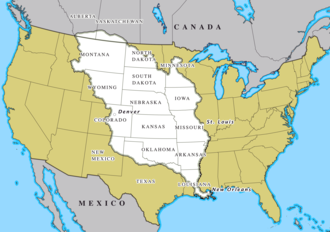
After traveling through the Louisiana Purchase and reaching the Pacific Ocean, explorers Lewis and Clark and their Corps of Discovery begin their arduous journey home.
1803 acquisition of region of Middle America land by the U.S. from France
The Louisiana Purchase was the acquisition of the territory of Louisiana by the United States from the French First Republic in 1803. This consisted of most of the land in the Mississippi River's drainage basin west of the river. In return for fifteen million dollars, or approximately eighteen dollars per square mile ($7/km2), the United States nominally acquired a total of 828,000 sq mi of land now in the Central United States. However, France only controlled a small fraction of this area, most of which was inhabited by Native Americans; effectively, for the majority of the area, the United States bought the preemptive right to obtain Indian lands by treaty or by conquest, to the exclusion of other colonial powers.
1806
Greek_War_of_Independence
Greek War of Independence: Battle and fall of city of Kalamata.
Greek rebellion against the Ottoman Empire (1821–1829)
The Greek War of Independence, also known as the Greek Revolution or the Greek Revolution of 1821, was a successful war of independence fought by Greek revolutionaries against the Ottoman Empire from 1821 to 1829. In 1826, the Greeks were assisted by the British Empire, the Kingdom of France, and the Russian Empire, while the Ottomans were aided by their vassals, especially by the Eyalet of Egypt. The war led to the formation of modern Greece, which in subsequent years would be expanded to its current size. The revolution is commemorated by Greeks in Greece and the Greek diaspora on 25 March, as Independence Day.
1821
1839_Ava_earthquake
A massive earthquake destroys the former capital Inwa of the Konbaung dynasty, present-day Myanmar.
Earthquake in British India
The 1839 Ava earthquake, also known as the Amarapura earthquake or Inwa earthquake, was a disastrous seismic event that struck present-day central Myanmar on March 23. This earthquake with an estimated moment magnitude as high as 8.3, was one of the largest in the country, since 1762. It was assigned a maximum of XI (Extreme) on the Modified Mercalli intensity scale, and was felt in Rangoon and Bhamo. Damage was enormous in Ava, resulting in the death of hundreds.
1839
John_Wickliffe_(ship)
The ship John Wickliffe arrives at Port Chalmers carrying the first Scottish settlers for Dunedin, New Zealand.
Otago province is founded.
The John Wickliffe was the first ship to arrive carrying Scottish settlers, including Otago settlement founder Captain William Cargill, in the city of Dunedin, New Zealand. The ship was named after the religious reformer, John Wycliffe.
1848
Elisha_Otis
Elisha Otis's first elevator is installed at 488 Broadway New York City.
19th-century American industrialist and inventor of the Otis Elevator
Elisha Graves Otis was an American industrialist and founder of the Otis Elevator Company. In 1853, he invented a safety device that prevents elevators from falling if the hoisting cable fails. On March 23, 1857, he installed the first safety elevator for passenger service in the store of E.V. Haughwout & Co. in New York City.
1857
American_Civil_War
American Civil War: The First Battle of Kernstown, Virginia, marks the start of Stonewall Jackson's Valley Campaign.
Although a Confederate defeat, the engagement distracts Federal efforts to capture Richmond.
The American Civil War was a civil war in the United States between the Union and the Confederacy, which was formed in 1861 by states that had seceded from the Union to preserve slavery in the United States. The South saw slavery as threatened because of the election of Abraham Lincoln and the growing abolitionist movement in the North. The war ended with Union victory, the dissolution of the Confederacy and the abolition of slavery, freeing four million African Americans.
1862
University_of_California
The University of California is founded in Oakland, California when the Organic Act is signed into law.
Public university system in California
The University of California (UC) is a public land-grant research university system in the U.S. state of California. Headquartered in Oakland, the system is composed of its ten campuses at Berkeley, Davis, Irvine, Los Angeles, Merced, Riverside, San Diego, San Francisco, Santa Barbara, and Santa Cruz, along with numerous research centers and academic centers abroad. The system is the state's land-grant university.
1868
War_of_the_Pacific
War of the Pacific: The Battle of Topáter, the first battle of the war, is fought between Chile and the joint forces of Bolivia and Peru.
Territorial conflict between Chile and allied Peru and Bolivia (1879–84)
The War of the Pacific, also known by multiple other names, was a war between Chile and a Bolivian–Peruvian alliance from 1879 to 1884. Fought over Chilean claims on coastal Bolivian territory in the Atacama Desert, the war ended with victory for Chile, which gained a significant amount of resource-rich territory from Peru and Bolivia. The war demonstrated Chile's military-technological superiority over its opponents at the time.
1879
Sino-French_War
Sino-French War: Chinese victory in the Battle of Phu Lam Tao near Hưng Hóa, northern Vietnam.
1884–1885 conflict between France and China
The Sino-French or Franco-Chinese War, also known as the Tonkin War, was a limited conflict fought from August 1884 to April 1885 between the French Third Republic and the Qing dynasty for influence in Vietnam. There was no declaration of war.
1885
English_Football_League
In England, The Football League, the world's oldest professional association football league, meets for the first time.
Association football league
The English Football League (EFL) is a league of professional football clubs from England and Wales. Founded in 1888 as the Football League, it is the oldest football league in the world, and was the top-level football league in England from its foundation until 1992, when the top 22 clubs split from it to form the Premier League. The Football League was rebranded as the "English Football League" (EFL) starting with the 2016–17 season.
1888
Ahmadiyya
The Ahmadiyya Muslim Community is established by Mirza Ghulam Ahmad in Qadian, British India.
Islamic messianic movement founded by Mirza Ghulam Ahmad
Ahmadiyya, officially the Ahmadiyya Muslim Jama'at is an Islamic messianic movement originating in British India in the late 19th century. It was founded by Mirza Ghulam Ahmad (1835–1908), who said he had been divinely appointed as both the promised Messiah and Mahdi expected by Muslims to appear towards the end times and bring about, by peaceful means, the final triumph of Islam; as well as to embody, in this capacity, the expected eschatological figure of other major religious traditions. Adherents of the Ahmadiyya—a term adopted expressly in reference to Muhammad's alternative name Ahmad—are known as Ahmadi Muslims or simply Ahmadis.
1889
Emilio_Aguinaldo
Emilio Aguinaldo, only President of the First Philippine Republic, is captured at Palanan, Isabela by the forces of American General Frederick Funston.
Filipino revolutionary leader (1869–1964)
Emilio Aguinaldo y Famy was a Filipino revolutionary, statesman, and military leader who was the first president of the Philippines from 1899 to 1901, and the first president of an Asian constitutional republic. He led the Philippine forces first against Spain in the Philippine Revolution (1896–1898), then in the Spanish–American War (1898), and finally against the United States during the Philippine–American War (1899–1901). He is regarded in the Philippines as having been the country's first president during the period of the First Philippine Republic, though he was not recognized as such outside of the revolutionary Philippines.
1901
Eleftherios_Venizelos
Eleftherios Venizelos calls for Crete's union with Greece, and begins what is to be known as the Theriso revolt.
Prime Minister of Greece (1910–20; 1928–33)
Eleftherios Kyriakou Venizelos was a Cretan Greek statesman and prominent leader of the Greek national liberation movement. As the leader of the Liberal Party, Venizelos served as prime minister of Greece for over 12 years, spanning eight terms from 1910 to 1933.
1905
Theodore_Roosevelt
Theodore Roosevelt leaves New York for a post-presidency safari in Africa.
The trip is sponsored by the Smithsonian Institution and National Geographic Society.
Theodore Roosevelt Jr. was the 26th president of the United States, serving from 1901 to 1909. Previously serving for six months as vice president under William McKinley, Roosevelt became president after McKinley's assassination in 1901. He was 42 years old upon his first inauguration, making him the youngest person to hold the office.
1909
1913_Easter_tornado_outbreak
A tornado outbreak kills more than 240 people in the central United States, while an ongoing flood in the Ohio River watershed was killing 650 people.
Severe windstorm in the United States
On March 23, 1913—Easter Sunday—a devastating tornado outbreak affected the northern Great Plains and sections of the Upper Midwest, lasting approximately 31⁄2 hours. It was the most violent tornado outbreak to affect the northern Great Plains on so early a date in the year—a record that still stands as of 2020. That day, four F4 tornadoes affected portions of eastern Nebraska and western Iowa, killing at least 168 people. The deadliest tornado of the day was a violent tornado, retroactively rated F4 on the present-day Fujita scale, that grew to 1⁄4 mile (440 yd) in width as it passed through northern Omaha, Nebraska, killing at least 94 people in the city proper and three in rural areas. Damage in Omaha reached at least F4, possibly even F5, intensity, though confirmation of F5 damage could not be determined from available evidence. The tornado is the 13th deadliest ever to affect the United States and the deadliest to hit the U.S. state of Nebraska as of 2024. No other violent tornado would affect Omaha for another 62 years. Outside the Great Plains, the outbreak of March 23 also produced two other F4 tornadoes, one each in Missouri and Indiana, including a devastating path more than 1⁄2 mi (880 yd) through southern Terre Haute, Indiana, killing 21 people and injuring 250. In all, tornadoes struck Nebraska, Iowa, Louisiana, Indiana, and Missouri, though only significant events were recorded and other, weaker tornadoes may have gone undetected.
1913
World_War_I
First World War: On the third day of the German Spring Offensive, the 10th Battalion of the Royal West Kent Regiment is annihilated with many of the men becoming prisoners of war.
Global conflict from 1914 to 1918
World War I, or the First World War, also known as the Great War, was a global conflict between two coalitions: the Allies and the Central Powers. Major theatres of war included Europe and the Middle East, and well as parts of Africa and the Asia-Pacific. One of the deadliest conflicts in history, World War I resulted in an estimated 15 to 22 million deaths, including in mass war crimes against civilians and genocides. The conflict saw important developments in weaponry, including the first large-scale use of machine guns, artillery, aircraft, chemical weapons, and tanks, and was a major factor in the deadly Spanish flu pandemic.
1918
Milan
In Milan, Italy, Benito Mussolini founds his Fascist political movement.
Second-largest city in Italy
Milan is the regional capital of Lombardy, in northern Italy, and the seat of the Metropolitan City of Milan. It is the second-most populous city in Italy after Rome, with a population of 1,362,863 in 2026. The city's wider metropolitan area is the largest in Italy, and the fourth-largest in the European Union, with an estimated population of 6.55 million. Milan is considered Italy's economic capital, and its metropolitan area accounts for about 20% of the country's GDP.
1919
Bhagat_Singh
Bhagat Singh, Shivaram Rajguru and Sukhdev Thapar are hanged for the killing of a deputy superintendent of police during the Indian independence movement.
Indian revolutionary (1907–1931)
Bhagat Singh was an Indian anti-colonial revolutionary who participated in the mistaken murder of a junior British police officer in December 1928 in what was intended to be retaliation for the death of an Indian nationalist. He later took part in a largely symbolic bombing of the Central Legislative Assembly in Delhi and a hunger strike in jail, which—on the back of sympathetic coverage in Indian-owned newspapers—turned him into a household name in the Punjab region, and, after his execution at age 23, a martyr and folk hero in Northern India. Borrowing ideas from Bolshevism and anarchism, the charismatic Bhagat Singh electrified a growing militancy in India in the 1930s and prompted urgent introspection within the Indian National Congress's nonviolent, and eventually successful, campaign for India's independence.
1931
Reichstag_(Weimar_Republic)
The Reichstag passes the Enabling Act of 1933, making Adolf Hitler dictator of Germany.
Legislative body of the Weimar Republic
The Reichstag of the Weimar Republic (1919–1933) was Germany's parliament. The Reichstag convened for the first time on 24 June 1920, taking over from the Weimar National Assembly, which had served as an interim parliament following the collapse of the German Empire in November 1918. Its counterpart, representing the states, was the Reichsrat.
1933
Constitution_of_the_Philippines
Signing of the Constitution of the Commonwealth of the Philippines.
Supreme law of the Philippines
The Constitution of the Philippines, also known as the 1987 Constitution is the supreme law of the Philippines. Its final draft was completed by the Constitutional Commission on October 12, 1986, and ratified by a nationwide plebiscite on February 2, 1987. The Constitution remains unamended to this day.
1935
Kingdom_of_Hungary_(1920–1946)
The Hungarian air force attacks the headquarters of the Slovak air force in Spišská Nová Ves, killing 13 people and beginning the Slovak–Hungarian War.
Monarchy under regency
The interwar Kingdom of Hungary, referred to retrospectively as the Regency, the Horthy era, the Horthy regime, and Horthyist Hungary, was the Hungarian state under a monarchy from 1920 to 1946 under the rule of Miklós Horthy for most of its existence, who officially represented the Hungarian monarchy after a period of revolutions and the counter-revolution as the Regent of Hungary. In reality there was no king, and attempts by King Charles IV to return to the throne shortly before his death were prevented by Horthy.
1939
Lahore_Resolution
The Lahore Resolution (Qarardad-e-Pakistan or Qarardad-e-Lahore) is put forward at the Annual General Convention of the All-India Muslim League.
Political statement adopted by the All-India Muslim League in Lahore (1940)
The Lahore Resolution, later called the Pakistan Resolution, was a formal political declaration, adopted by the All-India Muslim League on 23 March 1940, that served as the foundational basis for the Pakistan Movement. It was adopted during the League's three-day general session in Lahore, Punjab, from 22 to 24 March 1940, calling for "independent states" in the Muslim-majority regions of British India. The resolution was written and prepared by a nine-member subcommittee of the Muslim League; presented by A. K. Fazlul Huq, the Prime Minister of Bengal; and approved by the General Session of the Muslim League.
1940
Pakistan
Pakistan becomes the first Islamic republic in the world.
This date is now celebrated as Republic Day in Pakistan.
Pakistan, officially the Islamic Republic of Pakistan, is a country in South Asia. It is the fifth-most populous country, with a population of over 241.5 million, having the second-largest Muslim population as of 2023. Islamabad is the nation's capital, while Karachi is its largest city and financial centre. Pakistan is the 33rd-largest country by area. Bounded by the Arabian Sea on the south, the Gulf of Oman on the southwest, and the Sir Creek on the southeast, it shares land borders with India to the east; Afghanistan to the west; Iran to the southwest; and China to the northeast. It shares a maritime border with Oman in the Gulf of Oman, and is separated from Tajikistan in the northwest by Afghanistan's narrow Wakhan Corridor.
1956
David_Frost's_interviews_with_Richard_Nixon
The first of The Nixon Interviews (12 will be recorded over four weeks) is videotaped with British journalist David Frost interviewing former United States President Richard Nixon about the Watergate scandal and the Nixon tapes.
1977 interviews of Richard Nixon by David Frost
The Nixon interviews were a series of conversations between former American president Richard Nixon and British journalist David Frost, produced by John Birt. They were recorded and broadcast on television and radio in four programs in 1977. The interviews later became the central subject of Peter Morgan's play Frost/Nixon in 2006.
1977
United_Nations_Interim_Force_in_Lebanon
The first UNIFIL troops arrive in Lebanon for a peacekeeping mission along the Blue Line.
UN peacekeeping mission since 1978
The United Nations Interim Force in Lebanon, or UNIFIL is a United Nations peacekeeping mission established on 19 March 1978 by United Nations Security Council Resolutions 425 and 426, and resolution 1701 in 2006 to restore peace and security along the Israel-Lebanon border.
1978
Óscar_Romero
Archbishop Óscar Romero of El Salvador gives his famous speech appealing to men of the El Salvadoran armed forces to stop killing the Salvadorans.
Archbishop of San Salvador from 1977 to 1980
Óscar Arnulfo Romero y Galdámez was a prelate of the Catholic Church in El Salvador; he served as Auxiliary Bishop of the Archdiocese of San Salvador, the Titular Bishop of Tambeae, as Bishop of Santiago de María, and finally as the fourth Archbishop of San Salvador. As archbishop, Romero spoke out against social injustice and violence amid the escalating conflict between the military government and left-wing insurgents that led to the Salvadoran Civil War. In 1980, Romero was fatally shot by an assassin while celebrating Mass. Though no one was ever convicted for the crime, investigations by the UN-created Truth Commission for El Salvador concluded that Major Roberto D'Aubuisson, a death squad leader and later founder of the right-wing Nationalist Republican Alliance (ARENA) political party, had ordered the killing.
1980
Guatemala
Guatemala's government, headed by Fernando Romeo Lucas García, is overthrown in a military coup by right-wing General Efraín Ríos Montt.
Country in Central America
Guatemala, officially the Republic of Guatemala, is a country in northern Central America. It is bordered to the north and west by Mexico, to the northeast by Belize, to the east by Honduras, and to the southeast by El Salvador. It is bounded by the Pacific Ocean to the south and the Gulf of Honduras to the northeast.
1982
Strategic_Defense_Initiative
Strategic Defense Initiative: President Ronald Reagan makes his initial proposal to develop technology to intercept enemy missiles.
U.S. military defense program (1984–1993)
The Strategic Defense Initiative (SDI), nicknamed the Star Wars program, was a proposed missile defense system intended to protect the United States from attack by ballistic nuclear missiles. The program was announced in 1983 by President Ronald Reagan, a vocal critic of the doctrine of mutual assured destruction (MAD), which he described as a "suicide pact". Reagan called for a system that would end MAD and render nuclear weapons obsolete. Elements of the program reemerged in 2019 under the Space Development Agency (SDA).
1983
Angolan and Cuban forces defeat South Africa in the Battle of Cuito Cuanavale.
1987–88 battle of the Northern African Border War in southern Angola
The Battle of Cuito Cuanavale was fought intermittently between 14 August 1987 and 23 March 1988, south and east of Cuito Cuanavale, Angola, by the People's Armed Forces for the Liberation of Angola (FAPLA) and Cuba against South Africa and the National Union for the Total Independence of Angola (UNITA) during the Angolan Civil War and South African Border War. The battle was the largest engagement of the Angolan conflict and the biggest conventional battle on the African continent since World War II. UNITA and its South African allies defeated a major FAPLA offensive towards Mavinga, preserving UNITA's control of southern Angola. A subsequent counteroffensive was launched around the Tumpo River east of Cuito Cuanavale, and succeeded in ending FAPLA advances but failed to completely eliminate all remaining FAPLA positions.
1988
Revolutionary_United_Front
The Revolutionary United Front, with support from the special forces of Charles Taylor's National Patriotic Front of Liberia, invades Sierra Leone in an attempt to overthrow Joseph Saidu Momoh, sparking the 11-year Sierra Leone Civil War.
Rebel army and political party in Sierra Leone
The Revolutionary United Front (RUF) was a rebel group that fought a failed eleven-year war in Sierra Leone, beginning in 1991 and ending in 2002. It later transformed into a political party, which still exists today. The three most senior surviving leaders, Issa Sesay, Morris Kallon, and Augustine Gbao, were convicted in February 2009 of war crimes and crimes against humanity.
1991
Tijuana
At an election rally in Tijuana, Mexican presidential candidate Luis Donaldo Colosio is assassinated by Mario Aburto Martínez.
Largest city in Baja California, Mexico
Tijuana is the most populous city of the Mexican state of Baja California, located on the northwestern Pacific Coast of Mexico. It is the municipal seat of the Tijuana Municipality, the hub of the Tijuana metropolitan area and the most populous city in northern Mexico. Tijuana is just south of California and is adjacent to the Mexico–United States border which is part of the San Diego–Tijuana metro area.
1994
General_Dynamics_F-16_Fighting_Falcon
A United States Air Force (USAF) F-16 aircraft collides with a USAF C-130 at Pope Air Force Base and then crashes, killing 24 United States Army soldiers on the ground alongside destroying a Starlifter by accident.
This later became known as the Green Ramp disaster.
The General Dynamics F-16 Fighting Falcon is an American single-engine supersonic multirole fourth-generation fighter aircraft developed by General Dynamics and produced by multiple companies, including General Dynamics until 1993 and Lockheed Martin until 2017. Designed as an air superiority day fighter, it evolved into a successful all-weather multirole aircraft with over 4,600 built since 1976. Although the original versions are no longer in production, improved versions of the Lockheed Martin F-16V Viper family are being built and upgraded for export in a new production facility of Lockheed Martin. As of 2026, it is the world's most common fixed-wing aircraft in military service, with 2,102 from the F-16 family operational, comprising 15% of all active combat aircraft.
1994
Aeroflot_Flight_593
Aeroflot Flight 593 crashes into the Kuznetsk Alatau mountain, Kemerovo Oblast, Russia, killing 75.
1994 aviation accident in Russia
Aeroflot Flight 593 was a scheduled international passenger flight from Sheremetyevo International Airport, Moscow, Russia, to Kai Tak Airport in Hong Kong. On 23 March 1994, the aircraft operating the route, an Airbus A310 flown by Aeroflot, crashed into the Kuznetsk Alatau mountain range in Kemerovo Oblast, killing all 63 passengers and 12 crew members on board.
1994
Taiwan
Taiwan holds its first direct elections and chooses Lee Teng-hui as President.
Country in East Asia
Taiwan, officially the Republic of China (ROC), is a country in East Asia. The main island of Taiwan, also known as Formosa, lies between the East and South China Seas in the northwestern Pacific Ocean, with the People's Republic of China (PRC) to the northwest, Japan to the northeast, and the Philippines to the south. It has an area of 35,808 square kilometers, with mountain ranges dominating the eastern two-thirds and plains in the western third, where its highly urbanized population is concentrated. The combined territories under ROC control consist of 168 islands in total covering 36,193 square kilometers. The largest metropolitan area is formed by Taipei, New Taipei City, and Keelung. With around 23.9 million inhabitants, Taiwan is among the most densely populated countries.
1996
Paraguay
Gunmen assassinate Paraguay's Vice President Luis María Argaña.
Country in South America
Paraguay, officially the Republic of Paraguay, is a landlocked country located in the central region of South America. It borders Bolivia to the northwest and north, Brazil to the northeast and east, and Argentina to the southeast, south, and west. Paraguay has access to the Atlantic Ocean via the Paraná–Paraguay Waterway. The country is governed as a unitary presidential republic composed of a capital district and seventeen departments. Its capital and largest city is Asunción.
1999
Mir
The Russian Mir space station is disposed of, breaking up in the atmosphere before falling into the southern Pacific Ocean near Fiji.
Soviet/Russian space station (1986–2001)
Mir was a space station operated in low Earth orbit from 1986 to 2001, first by the Soviet Union and later by the Russian Federation. Mir was the first modular space station and was assembled in orbit from 1986 to 1996. At the time it was the largest artificial satellite in orbit, only being succeeded by the International Space Station (ISS) after Mir's deorbiting in 2001. The station served as a microgravity research laboratory in which crews conducted experiments in biology, human biology, physics, astronomy, meteorology, and spacecraft systems with a goal of developing technologies required for permanent occupation of space.
2001
Battle_of_Nasiriyah
Battle of Nasiriyah, first major conflict during the invasion of Iraq.
Battle during the 2003 U.S. invasion of Iraq
The Battle of Nasiriyah was fought between the US 2nd Marine Expeditionary Brigade and Iraqi forces from 23 March to 2 April 2003 during the US-led invasion of Iraq. On the night of 24–25 March, the bulk of the Marines of Regimental Combat Team 1 passed through the city over the bridges and attacked north towards Baghdad. Other elements remained in the city to fight its defenders, who put up stiff resistance and inflicted several dozen casualties on coalition forces, more than in most other battles during the invasion. Resistance ceased on 1 April.
2003
Rajiv_Gandhi_International_Airport
Official opening of Rajiv Gandhi International Airport in Hyderabad, India.
Airport serving Hyderabad, Telangana, India
Rajiv Gandhi International Airport is an international airport that serves Hyderabad, the capital of the Indian state of Telangana. It is located in Shamshabad, about 24 kilometres (15 mi) south of Hyderabad and it was opened on 23 March 2008 to replace Begumpet Airport, which was till then the sole civilian airport serving Hyderabad. It is owned and operated by GMR Hyderabad International Airport Limited (GHIAL), a public–private consortium. It was the first airport in India to launch domestic e-boarding facility in December 2015, followed with international e-boarding facility in October 2020, and ranked in AirHelp's list of top 10 airports in the world. The fourth-busiest airport in India by passenger traffic, it handled over 29 million passengers and over 167,660 tonnes of cargo between April 2024 and March 2025.
2008
FedEx_Express_Flight_80
FedEx Express Flight 80: A McDonnell Douglas MD-11 flying from Guangzhou, China crashes at Tokyo's Narita International Airport, killing both the captain and the co-pilot.
2009 aircraft accident in Japan
FedEx Express Flight 80 was a scheduled cargo flight from Guangzhou Baiyun International Airport, China, to Narita International Airport, Japan, operated by FedEx Express. At 06:48 JST (UTC+09:00) on 23 March 2009, the McDonnell Douglas MD-11 registered N526FE operating the flight crashed while attempting a landing on Runway 34L in gusty and highly variable weather conditions, including winds in excess of 40 knots (74 km/h). The aircraft became destabilized after the fatigued co-pilot's delayed start of the landing flare, subsequently exacerbated by his excessively large, nose-down inputs causing abrupt changes in the plane's pitch, increasing the speed and severity of repeated touchdowns during the bounced landing. This resulted in a structural failure of the landing gear and airframe, with the left wing detaching and power of the jet on the right wing thus causing the plane to roll. The plane came to a stop off of the runway, with the plane inverted and on fire. The captain and first officer, who were the only occupants, survived the initial crash. The airport's rescue crew got the pilots out of the aircraft and tried getting them to a hospital, but the crew succumbed to their injuries before they could receive medical attention.
2009
Affordable_Care_Act
The Affordable Care Act becomes law in the United States.
U.S. federal statute known as Obamacare
The Affordable Care Act (ACA), formally the Patient Protection and Affordable Care Act (PPACA) and informally known as Obamacare, is a landmark U.S. federal statute enacted by the 111th United States Congress and signed into law by President Barack Obama on March 23, 2010. Together with amendments made to it by the Health Care and Education Reconciliation Act of 2010, it represents the U.S. healthcare system's most significant regulatory overhaul and expansion of coverage since the enactment of Medicare and Medicaid in 1965. Most of the act remains in effect.
2010
World_Health_Organization
The World Health Organization (WHO) reports cases of Ebola in the forested rural region of southeastern Guinea, marking the beginning of the largest Ebola outbreak in history.
Specialized agency of the United Nations
The World Health Organization (WHO) is a specialized agency of the United Nations (UN) which coordinates responses to international public health issues and emergencies. It is headquartered in Geneva, Switzerland, and has six regional offices and 150 field offices worldwide. Only sovereign states are eligible to join, and it is the largest intergovernmental health organization at the international level.
2014
President_of_Peru
President of Peru Pedro Pablo Kuczynski resigns from the presidency amid a mass corruption scandal before certain impeachment by the opposition-majority Congress of Peru.
Head of state and government of Peru
The president of Peru, officially the constitutional president of the Republic of Peru, is the head of state and head of government of Peru. The president is the head of the executive branch and is the supreme head of the Armed Forces and National Police of Peru. The office of president corresponds to the highest magistracy in the country, making the president the highest-ranking public official in Peru. Due to broadly interpreted impeachment wording in the 1993 Constitution of Peru, the Congress of Peru can impeach the president without cause, effectively making the executive branch subject to the legislature.
2018
Kazakhstan
The Kazakh capital of Astana is renamed to Nur-Sultan.
Country in Eastern Europe and Central Asia
Kazakhstan, officially the Republic of Kazakhstan, is a landlocked country situated primarily in Central Asia, with a portion of its territory extending into Eastern Europe. It borders Russia to the north and west, China to the east, Kyrgyzstan to the southeast, Uzbekistan to the south, and Turkmenistan to the southwest, and it has a coastline along the Caspian Sea. The capital is Astana and the country's largest city and principal cultural and economic center is Almaty, which served as the capital until 1997.
2019
Battle_of_Baghuz_Fawqani
The US-backed Syrian Democratic Forces capture the town of Baghuz in Eastern Syria, declaring military victory over the Islamic State of Iraq and the Levant after four years of fighting, although the group maintains a scattered presence and sleeper cells across Syria and Iraq.
2019 battle of the Syrian Civil War
The Battle of Baghuz Fawqani was an offensive by the Syrian Democratic Forces (SDF), assisted by Combined Joint Task Force – Operation Inherent Resolve (CJTF-OIR) coalition airstrikes, artillery, and special forces personnel, that began on 9 February 2019 as part of the Deir ez-Zor campaign of the Syrian Civil War. The battle—which was composed of a series of ground assaults—took place in and around the Syrian town of Al-Baghuz Fawqani in the Middle Euphrates River Valley near the Iraq–Syria border, and was the territorial last stand of the Islamic State (IS) in eastern Syria.
2019
Prime_Minister_of_the_United_Kingdom
Prime Minister Boris Johnson puts the United Kingdom into its first national lockdown in response to COVID-19.
Head of government
The prime minister of the United Kingdom is the head of government of the United Kingdom. The prime minister advises the sovereign on the exercise of much of the royal prerogative, chairs the Cabinet, and selects its ministers. Modern prime ministers hold office by virtue of their ability to command the confidence of the House of Commons, so they are invariably members of Parliament.
2020
2021_Suez_Canal_obstruction
A container ship runs aground and obstructs the Suez Canal for six days.
Maritime incident caused by grounded vessel
The Suez Canal was blocked for six days from 23 to 29 March 2021 by the Ever Given, a container ship that had run aground in the canal. The 400-metre-long (1,300 ft), 224,000-ton, 20,000 TEU vessel was buffeted by strong winds on the morning of 23 March, and ended up wedged across the waterway with its bow and stern stuck on opposite canal banks, blocking all traffic until it could be freed. Egyptian authorities said that "technical or human errors" may have also been involved. The obstruction occurred south of the two-channel section of the canal, so other ships could not pass. The Suez Canal Authority (SCA) hired Royal Boskalis through its subsidiary Smit International to manage marine salvage operations. The blockage of one of the world's busiest trade routes slowed trade between Europe, Asia, and the Middle East, tying up goods worth an estimated US$9.6 billion per day. By 28 March, at least 369 ships were queuing to pass through the canal.
2021
Israel_Defense_Forces
Israel Defense Forces kill 15 aid workers in the Rafah paramedic massacre.
Combined military forces of Israel
The Israel Defense Forces, alternatively referred to by the Hebrew-language acronym Tzahal (צה״ל), is the national military of the State of Israel. It consists of three service branches: the Israeli Ground Forces, the Israeli Air Force, and the Israeli Navy. It is the sole military wing of the Israeli security apparatus. The IDF is headed by the chief of the general staff, who is subordinate to the defense minister.
2025
2026_Colombian_Air_Force_Lockheed_C-130_crash
An Aerospace Force Lockheed C-130 crashes during take-off in Puerto Leguízamo, Colombia, killing 69 people.
Aviation accident in Colombia
On 23 March 2026, a Colombian Aerospace Force Lockheed C-130 Hercules crashed into dense jungle while taking off from Caucayá Airport in Puerto Leguízamo en route to Tres de Mayo Airport in Puerto Asís, both located in Colombia's Putumayo department near the border with Peru and Ecuador. There were 126 people on board, of whom 69 were killed, and 57 survived with injuries. It is the second deadliest crash in the history of the Colombian Aerospace Force and is the deadliest aviation crash of 2026.
2026

History runs on facts, and this project runs on coffee!

Your support is incredibly helpful and genuinely appreciated.

Support with a coffee ☕