May 14 in History

Israel is declared to be an independent state and a provisional government is es

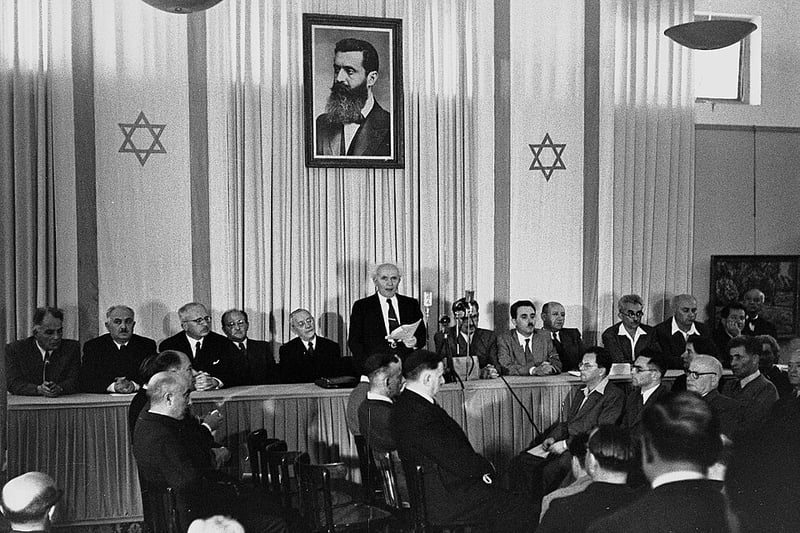
1948 — Israel is declared to be an independent state and a provisional government is established

Immediately after the declaration, Israel is attacked by the neighboring Arab states, triggering the 1948 Arab–Israeli War.

May 14 spans 52 recorded events across recorded history, from 1027 to 2022. Below is a curated digest of the most significant moments tied to this date.

By · Wikipedia

Historical Events 52 events 1027 – 2022

More major events on May 14

The featured story and these ranked highlights form a quick summary. Every recorded event remains available in the chronology below.

  1. 1961 Civil rights movement: A white mob twice attacks a Freedom Riders bus near Anniston, Alabama, before fire-bombing the bus and attacking the civil rights protesters who flee the burning vehicle. Source
  2. 2010 Space Shuttle Atlantis launches on the STS-132 mission to deliver the first shuttle-launched Russian ISS component — Rassvet. This was originally slated to be the final launch of Atlantis, before Congress approved STS-135. Source
  3. 1955 Cold War: Eight Communist bloc countries, including the Soviet Union, sign a mutual defense treaty called the Warsaw Pact. Source

Did you know

In 1948, Israel is declared to be an independent state and a provisional government is established. Immediately after the declaration, Israel is attacked by the neighboring Arab states, triggering the 1948 Arab–Israeli War. This featured entry focuses on the immediate decision and its direct historical impact.

Did you know

The Israeli Declaration of Independence, formally the Declaration of the Establishment of the State of Israel, was proclaimed at the Tel Aviv Museum on 14 May 1948, at the end of the civil war phase and beginning of the Arab–Israeli War of the 1948 Palestine war, by the Va'ad Leumi led by David Ben-Gurion, the executive head of the World Zionist Organization and chairman of the Jewish Agency for Palestine. This helps explain why the event mattered beyond the initial announcement.

Did you know

In 1948, Israel is declared to be an independent state and a provisional government is established. Immediately after the declaration, Israel is attacked by the neighboring Arab states, triggering the 1948 Arab–Israeli War had consequences that extended beyond the first headline. The key context is the institutions involved, the policy shift, and how the public response evolved afterward.

Did you know

In 1948, Israel is declared to be an independent state and a provisional government is established. Immediately after the declaration, Israel is attacked by the neighboring Arab states, triggering the 1948 Arab–Israeli War had consequences that extended beyond the first headline. The key context is the institutions involved, the policy shift, and how the public response evolved afterward.

Did you know

In 1948, Israel is declared to be an independent state and a provisional government is established. Immediately after the declaration, Israel is attacked by the neighboring Arab states, triggering the 1948 Arab–Israeli War had consequences that extended beyond the first headline. The key context is the institutions involved, the policy shift, and how the public response evolved afterward.


Robert_II_of_France
Robert II of France names his son Henry I as junior King of the Franks.
King of the Franks from 996 to 1031
Robert II, called the Pious or the Wise, was king of the Franks from 996 to 1031, the second from the Capetian dynasty. Crowned junior king in 987, he assisted his father on military matters. His solid education, provided by Gerbert of Aurillac in Reims, allowed him to deal with religious questions of which he quickly became the guarantor. Continuing the political work of his father after becoming sole ruler in 996, he managed to maintain the alliance with the Duchy of Normandy and the County of Anjou and thus was able to contain the ambitions of Count Odo II of Blois.
1027
Siege_of_Nicaea
The Siege of Nicaea begins during the First Crusade.
Part of the First Crusade (1097)
The siege of Nicaea was the first major battle of the First Crusade, taking place from 14 May to 19 June 1097. The city was under the control of the Seljuk Turks who opted to surrender to the Byzantines in fear of the Crusaders breaking into the city. The siege was followed by the Battle of Dorylaeum and the Siege of Antioch, all taking place in modern Turkey.
1097
Battle_of_Lewes
Battle of Lewes: Henry III of England is captured and forced to sign the Mise of Lewes, making Simon de Montfort the effective ruler of England.
1264 battle of the Second Barons' War
The Battle of Lewes was one of two main battles of the conflict known as the Second Barons' War. It took place at Lewes in Sussex, on 14 May 1264. It marked the high point of the career of Simon de Montfort, 6th Earl of Leicester, and made him the "uncrowned King of England". Henry III's forces left the safety of Lewes Castle and St. Pancras Priory to engage the barons in battle and were initially successful, with Henry's son Prince Edward routing part of the baronial army with a cavalry charge. However, Edward pursued his quarry off the battlefield and left Henry's men exposed. Henry was forced to launch an infantry attack up Offham Hill where he was defeated by the barons' men defending the summit. The royalists fled back to the castle and priory and the King was forced to sign the Mise of Lewes, ceding many of his powers to de Montfort.
1264
Ottoman_Empire
A large Ottoman force begins the siege of Albanian rebel forces in Krujë, that ultimately will fail.
Turkish Empire (c. 1299–1922)
The Ottoman Empire, historically also known as the Turkish Empire or Turkey, was a state that spanned much of Southeastern Europe, West Asia, and North Africa from the 14th century to the early 20th century, centred in modern-day Turkey. It also controlled parts of southeastern Central Europe between the early 16th and early 18th centuries.
1450
During the 1465 Moroccan revolution which overthrows the Marinid dynasty, the Jewish mellah is attacked by the population of Fez, though the extent of the massacre is debated.
Uprising and end of the Marinid dynasty
The 1465 Fez revolt was a popular uprising in the Marinid capital of Fez against Sultan Abd al-Haqq II, the final ruler of the Marinid dynasty, and his Jewish vizier, Harun ibn Batash.
1465
Battle_of_Agnadello
Battle of Agnadello: In northern Italy, French forces defeat the Republic of Venice.
1509 battle, League of Cambrai versus Venice
The Battle of Agnadello, also known as Vailà, was fought on 14 May 1509 between the army of King Louis XII of France and the Venetian rear-guard elements commanded by Bartolomeo d'Alviano. After a three hour struggle, and after Bartolomeo found himself abandoned by a part of his army, the Venetians were defeated with losses in excess of 4,000 men. Louis then occupied the rest of Lombardy.
1509
Jamestown
English colonists establish "James Fort", which would become Jamestown, Virginia, the earliest permanent English settlement in the Americas.
Town and fort established in the Virginia Colony
The Jamestown settlement in the Colony of Virginia was the first permanent English settlement in the Americas. It was located, in what later became James City County, on the northeast bank of the James River, about 2.5 mi (4 km) southwest of present-day Williamsburg. It was established by the Virginia Company of London as "James Fort" on May 4, 1607 O.S. (May 14, 1607 N.S.). It followed earlier, failed English colonization attempts, including the 1585 Roanoke Colony. A river island was selected to evade Spanish naval patrols; however, it was infested with mosquitoes, lacked potable water, and was used by the Paspahegh people. Despite supply missions, only 60 of the original 214 settlers survived the 1609–1610 winter known as Starving Time. In 1612, West Indies tobacco was successfully cultivated, leading to an economic boom for the colony and England.
1607
Protestant_Union
The Protestant Union, a coalition of Protestant German states, is founded to defend the rights, land and safety of each member against the Catholic Church and Catholic German states.
Alliance in the Holy Roman Empire (1608–21)
The Protestant Union, also known as the Evangelical Union, Union of Auhausen, German Union or the Protestant Action Party, was a coalition of Protestant German states. It was formed on 14 May 1608 by Frederick IV, Elector Palatine in order to defend the rights, land and safety of each member. It included both Calvinist and Lutheran states, and dissolved in 1621.
1608
Henry_IV_of_France
Henry IV of France is assassinated by Catholic zealot François Ravaillac, and Louis XIII ascends the throne.
King of France from 1589 to 1610
Henry IV, also known by the epithets Good King Henry or Henry the Great, was King of Navarre from 1572 and King of France from 1589 to 1610. He was the first monarch of France from the House of Bourbon, a cadet branch of the Capetian dynasty. He pragmatically balanced the interests of the Catholic and Protestant parties in France, as well as among the European states. He was assassinated in Paris in 1610 by a Catholic zealot, and was succeeded by his son Louis XIII.
1610
War_of_the_Austrian_Succession
War of the Austrian Succession: A British fleet under Admiral George Anson defeats the French at the First Battle of Cape Finisterre.
1740–1748 war between European powers
The War of the Austrian Succession, 1740 to 1748, was a conflict between the European great powers, fought primarily in Europe, the Atlantic Ocean and Mediterranean Sea. Related conflicts include King George's War, the War of Jenkins' Ear, the First Carnatic War, and the First and Second Silesian Wars.
1747
Edward_Jenner
Edward Jenner administers the first smallpox inoculation.
English physician (1749–1823)
Edward Jenner was an English physician and scientist who pioneered the concept of vaccines and created the smallpox vaccine, the world's first vaccine. The terms vaccine and vaccination are derived from Variolae vaccinae, the term devised by Jenner to denote cowpox. He used it in 1798 in the title of his Inquiry into the Variolae vaccinae known as the Cow Pox, in which he described the protective effect of cowpox against smallpox.
1796
6th_United_States_Congress
The 6th United States Congress recesses, and the process of moving the Federal government of the United States from Philadelphia to Washington, D.C., begins the following day.
Meeting of the U.S. federal legislature from 1799 to 1801
The 6th United States Congress was the 6th meeting of the legislative branch of the United States federal government, consisting of the Senate and the House of Representatives. It initially met at Congress Hall in Philadelphia, Pennsylvania and then was the first congress to meet in the new Capitol Building in Washington, D.C.. Its term was from March 4, 1799, to March 4, 1801, during the last two years of John Adams's presidency. It was the last Congress of the 18th century and the first to convene in the 19th. The apportionment of seats in House of Representatives was based on the 1790 United States census. Both chambers had a Federalist majority. This was the last Congress in which the Federalist Party controlled the presidency or either chamber of Congress.
1800
William_Clark
William Clark and 42 men depart from Camp Dubois to join Meriwether Lewis at St Charles, Missouri, marking the beginning of the Lewis and Clark Expedition's historic journey up the Missouri River.
American explorer and territorial governor (1770–1838)
William Clark was an American explorer, soldier, Indian agent, and territorial governor. A native of Virginia, he grew up in pre-statehood Kentucky before later settling in what became the state of Missouri.
1804
Paraguay
Paraguay: Pedro Juan Caballero, Fulgencio Yegros and José Gaspar Rodríguez de Francia start actions to depose the Spanish governor.
Country in South America
Paraguay, officially the Republic of Paraguay, is a landlocked country located in the central region of South America. It borders Bolivia to the northwest and north, Brazil to the northeast and east, and Argentina to the southeast, south, and west. Paraguay has access to the Atlantic Ocean via the Paraná–Paraguay Waterway, a system of navigable channels shared by five countries. The country is governed as a unitary presidential republic composed of a capital district and seventeen departments. Its capital and largest city is Asunción. It dates its independence from Spain to 1811.
1811
Battle_of_Stillman's_Run
The Battle of Stillman's Run, the first battle of the Black Hawk War, is fought.
1832, Black Hawk War, Illinois
The Battle of Stillman's Run, also known as the Battle of Sycamore Creek or the Battle of Old Man's Creek, occurred in Illinois on May 14, 1832. The battle was named for the panicked retreat by Major Isaiah Stillman and his detachment of 275 Illinois militia after being attacked by an unknown number of Sauk warriors of Black Hawk's British Band. The numbers of warriors has been estimated at as few as fifty but as many as two hundred participated in the attack. However, reports found in Whitney's Black Hawk War indicated that large numbers of Indians were on the move throughout the region, and it appeared that widespread frontier warfare was underway. The engagement was the first battle of the Black Hawk War (1832), which developed after Black Hawk crossed the Mississippi River from Iowa into Illinois with his band of Sauk and Meskwaki warriors along with women, children, and elders to try to resettle in Illinois. The militia had pursued a small group of Sauk scouts to the main British Band camp following a failed attempt by Black Hawk's emissaries to negotiate a truce.
1832
The Treaties of Velasco are signed in Velasco, Texas.
1836 documents which ended the Texas Revolution
The Treaties of Velasco were two documents, one private and the other public, signed in Fort Velasco on May 14, 1836 between General Antonio López de Santa Anna and the Republic of Texas in the aftermath of the Battle of San Jacinto on April 21, 1836. The fort was located in the former Velasco, Texas, now part of the present-day location of Surfside Beach. The signatories were Interim President David G. Burnet for Texas and Santa Anna for Mexico. Texas intended the agreements to conclude hostilities between the two armies and offer the first steps toward the official recognition of Texas's independence from Mexico.
1836
The_Illustrated_London_News
The first edition of The Illustrated London News, the world's first illustrated weekly news magazine, is published.
British illustrated news magazine (1842–2003)
The Illustrated London News, founded by Herbert Ingram and first published on Saturday 14 May 1842, was the world's first illustrated weekly news magazine. The magazine was published weekly for most of its existence, switched to a less frequent publication schedule in 1971, and eventually ceased publication in 2003. The company continues today as Illustrated London News Ltd, a publishing, content, and digital agency in London, which holds the publication and business archives of the magazine.
1842
Mindon_Min
Mindon Min is crowned as King of Burma in Mandalay, Burma.
King of Burma from 1853 to 1878
Mindon Min, born Maung Lwin, was the penultimate king of Burma (Myanmar) from 1853 to 1878. He was one of the most popular and revered kings of Burma because of his role in the Fifth Buddhist Council. Under his half brother King Pagan, the Second Anglo-Burmese War in 1852 ended with the annexation of Lower Burma by the British Empire. Mindon and his younger brother Kanaung overthrew their half brother King Pagan. He spent most of his reign trying to defend the upper part of his country from British encroachments, and to modernize his kingdom.
1857
American_Civil_War
American Civil War: During the Vicksburg campaign, Union forces drive Confederates under Joseph E.
Johnston out of Jackson, Mississippi in the Battle of Jackson.
The American Civil War was a civil war in the United States between the Union and the Confederacy, which was formed in 1861 by states that had seceded from the Union to preserve slavery in the United States. The South saw slavery as threatened because of the election of Abraham Lincoln and the growing abolitionist movement in the North. The war ended with Union victory, the dissolution of the Confederacy and the abolition of slavery, freeing four million African Americans.
1863
Boshin_War
Boshin War: The Battle of Utsunomiya Castle ends as former Tokugawa shogunate forces withdraw northward.
1868–1869 Japanese civil war
The Boshin War , sometimes known as the Japanese Revolution or Japanese Civil War, was a civil war in Japan fought from 1868 to 1869 between forces of the ruling Tokugawa shogunate and a coalition seeking to seize political power in the name of the Imperial Court.
1868
Rugby_football
The first game of rugby in New Zealand is played in Nelson between Nelson College and the Nelson Rugby Football Club.
Rugby union and rugby league team sports
Rugby football is a type of football, a team sport which developed in the nineteenth century in England, and which later split into the modern sports of rugby union and rugby league.
1870
Salem_witchcraft_trial_(1878)
The last witchcraft trial held in the United States begins in Salem, Massachusetts, after Lucretia Brown, an adherent of Christian Science, accused Daniel Spofford of attempting to harm her through his mental powers.
American civil case
The Salem witchcraft trial of 1878, also known as the Ipswich witchcraft trial and the second Salem witch trial, was an American civil case held in May 1878 in Salem, Massachusetts, in which Lucretia L. S. Brown, an adherent of the Christian Science religion, accused fellow Christian Scientist Daniel H. Spofford of attempting to harm her through his "mesmeric" mental powers. By 1918, it was considered the last witchcraft trial held in the United States. The case garnered significant attention for its startling claims and the fact that it took place in Salem, the scene of the 1692 Salem witch trials. The judge dismissed the case.
1878
The first group of 463 Indian indentured laborers arrives in Fiji aboard the Leonidas.
System of indentured servitude using Indian labourers to replace slavery (1800s to 1920s)
The Indian indenture system was a system of indentured servitude, by which more than 1.6 million workers from India were transported to labour in various overseas European colonies, beginning shortly after the abolition of slavery in the early 19th century. Although described by colonial authorities as "free" migration, many recruits were deceived, coerced, or kidnapped, leading historians such as Hugh Tinker to characterise the system as a "new form of slavery". The system began with the Atlas voyage to Mauritius in 1834, but early journeys were marked by mortality rates of over 17%, prompting British authorities to impose stricter shipping regulations. The system expanded after the abolition of slavery in the British Empire in 1833, in the French colonies in 1848, and in the Dutch Empire in 1863. British Indian indentureship lasted until the 1920s. This resulted in the development of a large Indian diaspora in the Caribbean, Natal, Réunion, Mauritius, and Fiji, as well as the growth of Indo-South African, Indo-Caribbean, Indo-Mauritian and Indo-Fijian populations. While many descendants celebrate their cultural resilience, historians emphasise the trauma and displacement caused by the indenture system.
1879
Exposition_Universelle_(1900)
Opening of World Amateur championship at the Paris Exposition Universelle, also known as Olympic Games.
World's Fair held in Paris, France
The Exposition Universelle of 1900, better known in English as the 1900 Paris Exposition, was a world's fair held in Paris, France, from 14 April to 12 November 1900, to celebrate the achievements of the past century and to accelerate development into the next. It was the sixth of ten major expositions held in the city between 1855 and 1937. It was held at the esplanade of Les Invalides, the Champ de Mars, the Trocadéro and at the banks of the Seine between them, with an additional section in the Bois de Vincennes, and it was visited by more than fifty million people. Many international congresses and other events were held within the framework of the exposition, including the 1900 Summer Olympics.
1900
William_Sulzer
Governor of New York William Sulzer approves the charter for the Rockefeller Foundation, which begins operations with a $100 million donation from John D.
Rockefeller.
William Sulzer, nicknamed Plain Bill, was an American lawyer and politician. He was the 39th governor of New York serving for 10 months in 1913, and a long-serving U.S. representative from the same state. Sulzer was the first, and to date only, New York governor to be impeached and the only governor to be convicted on articles of impeachment. He broke with his sponsors at Tammany Hall, and they produced convincing evidence that Sulzer had falsified his sworn statement of campaign expenditures.
1913
May_14_Revolt
The May 14 Revolt takes place in Lisbon, Portugal.
1915 revolt in Portugal
The May 14 Revolt (1915) was a politico-military uprising led by Álvaro de Castro and General Sá Cardoso which started in Lisbon, Portugal, with the objective of taking power from the dictatorship of General Pimenta de Castro during the Portuguese First Republic and returning the government to the principles of the 1911 Constitution.
1915
Cape Town Mayor, Sir Harry Hands, inaugurates the two-minute silence.
British colonial politician (1860–1948)
Sir Harry Hands was a British colonial politician, who served from 1915 to 1918 as mayor of Cape Town, South Africa. He is credited with instituting the first practice in the world of an official two-minute silence to honour loss of life in conflict, following the death of his eldest son Reginald Hands in World War I, at the suggestion of councillor Robert Rutherford Brydone.
1918
Mrs_Dalloway
Mrs Dalloway, one of Virginia Woolf's earliest and best-known novels, is published.
1925 novel by Virginia Woolf
Mrs Dalloway is a novel by Virginia Woolf published on 14 May 1925. It details a day in the life of Clarissa Dalloway, a wealthy woman in post-First World War London.
1925
Ådalen_shootings
Five unarmed civilians are killed in the Ådalen shootings, as the Swedish military is called in to deal with protesting workers.
1931 Swedish anti-labour massacre
The Ådalen shootings was a series of events in and around the sawmill district of Ådalen, Kramfors Municipality, Ångermanland, Sweden, in May 1931. During a protest on 14 May, five people were killed by Swedish Army troops called in as reinforcements by the police.
1931
Constitution_of_the_Philippines
The Constitution of the Philippines is ratified by a popular vote.
Supreme law of the Philippines
The Constitution of the Philippines, also known as the 1987 Constitution is the supreme law of the Philippines. Its final draft was completed by the Constitutional Commission on October 12, 1986, and ratified by a nationwide plebiscite on February 2, 1987. The Constitution remains unamended to this day.
1935
Lina_Medina
Lina Medina becomes the youngest confirmed mother in medical history at the age of five.
Youngest confirmed mother in history (born 1933)
Lina Marcela Medina de Jurado is a Peruvian woman who became the youngest confirmed mother in history when she gave birth to her son Gerardo on 14 May 1939 when she was five years, seven months, and 21 days of age. Based on the medical assessments of her pregnancy, she was four years old when she became pregnant, which was biologically possible due to precocious puberty.
1939
World_War_II
World War II: Rotterdam, Netherlands, is bombed by the Luftwaffe of Nazi Germany despite a ceasefire, killing about 900 people and destroying the historic city center.
Global conflict (1939–1945)
World War II, or the Second World War, was a global conflict between two coalitions: the Allies and the Axis powers. Nearly all of the world's countries participated, with many engaging in total war on an unprecedented scale. World War II was the deadliest conflict in history, causing the deaths of 60 to 75 million people, a majority of whom were civilians. Millions died as a result of massacres, starvation, disease, and genocides including the Holocaust. After the Allied victory, Germany, Austria, Japan, and Korea were occupied, and German and Japanese leaders were tried for war crimes.
1940
AHS_Centaur
World War II: A Japanese submarine sinks AHS Centaur off the coast of Queensland.
Australian hospital ship
AHS Centaur was a hospital ship which was attacked and sunk by a Japanese submarine off the coast of Queensland, Australia, on 14 May 1943. Of the 332 medical personnel and civilian crew aboard, 268 died, including 63 of the 65 army personnel.
1943
Talyllyn_Railway
Trains run on the Talyllyn Railway in Wales for the first time since preservation, making it the first railway in the world to be operated by volunteers.
Narrow-gauge railway in north Wales
The Talyllyn Railway is a narrow-gauge railway in Wales, which runs for 7+1⁄4 miles (12 km) from Tywyn on the Mid-Wales coast to Nant Gwernol near the village of Abergynolwyn. Opened in 1865 to carry slate from the quarries at Bryn Eglwys to Tywyn, it was the first narrow-gauge railway in Britain authorised by Act of Parliament to carry passengers using steam haulage. Despite severe underinvestment, the line remained open, and in 1951 it became the first railway in the world to be preserved as a heritage railway by volunteers.
1951
Milwaukee
Approximately 7,100 brewery workers in Milwaukee perform a walkout, marking the start of the 1953 Milwaukee brewery strike.
Largest city in Wisconsin, United States
Milwaukee is the most populous city in the U.S. state of Wisconsin. Located on the western shore of Lake Michigan, it had a population of 577,222 at the 2020 census, making it the 31st-most populous city in the United States and the fifth-most populous city in the Midwest. The Milwaukee metropolitan area has over 1.57 million residents and ranks as the 40th-largest metropolitan area in the nation. The city is the county seat of Milwaukee County.
1953
Cold_War
Cold War: Eight Communist bloc countries, including the Soviet Union, sign a mutual defense treaty called the Warsaw Pact.
1947–1991 geopolitical rivalry between US and USSR
The Cold War was a period of international geopolitical rivalry between the United States (US) and the Soviet Union (USSR) and their respective allies, the capitalist Western Bloc and communist Eastern Bloc. It began in the aftermath of the Second World War and ended with the dissolution of the Soviet Union in 1991. The term cold war is used because there was no direct fighting between the two superpowers, though each supported opposing sides in regional conflicts known as proxy wars. In addition to the struggle for ideological and economic influence and an arms race in both conventional and nuclear weapons, the Cold War was expressed through technological rivalries such as the Space Race, espionage, propaganda campaigns, embargoes, and sports diplomacy.
1955
Civil_rights_movement
Civil rights movement: A white mob twice attacks a Freedom Riders bus near Anniston, Alabama, before fire-bombing the bus and attacking the civil rights protesters who flee the burning vehicle.
1954–1968 U.S. social movement
The civil rights movement was a social movement in the United States from 1954 to 1968 which aimed to abolish legalized racial segregation, discrimination, and disenfranchisement in the country, which most commonly affected African Americans. The movement had origins in the Reconstruction era in the late 19th century, and modern roots in the 1940s and in Mohandas Gandhi's nonviolent movement in India. After years of nonviolent protests and civil disobedience campaigns, the civil rights movement achieved many of its legislative goals in the 1960s, during which it secured new protections in federal law for the civil rights of all Americans, including the Civil Rights Act of 1964, the Voting Rights Act of 1965, and the Civil Rights Act of 1968.
1961
Red_Army_Faction
Andreas Baader is freed from custody by Ulrike Meinhof, Gudrun Ensslin and others, a pivotal moment in the formation of the Red Army Faction.
West German far-left militant organisation (1970–1998)
The Red Army Faction, also known as the Baader–Meinhof Group or Baader–Meinhof Gang, was a West German far-left militant group founded in 1970, active until 1998, and formally designated a terrorist organisation by the West German government. The RAF described itself as a communist and anti-imperialist urban guerrilla group. It was engaged in armed resistance against what it considered a fascist state. Members of the RAF generally used the Marxist–Leninist term "faction" when they wrote in English. Early leadership included Andreas Baader, Ulrike Meinhof, Gudrun Ensslin, and Horst Mahler.
1970
Skylab
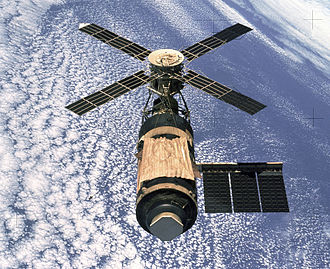
Skylab, the United States' first space station, is launched.
First space station launched and operated by NASA (1973–1979)
Skylab was the United States' first space station, launched by NASA, occupied for about 24 weeks between May 1973 and February 1974. It was operated by three trios of astronaut crews: Skylab 2, Skylab 3, and Skylab 4.
1973
Dan-Air
A Dan-Air Boeing 707 leased to IAS Cargo Airlines crashes on approach to Lusaka International Airport in Lusaka, Zambia, killing six people.
Airline of the United Kingdom (1953–1992)
Dan-Air was an airline based in the United Kingdom and a wholly owned subsidiary of London-based shipbroking firm Davies and Newman. It was started in 1953 with a single aircraft. Initially, it operated cargo and passenger charter flights from Southend (1953–1955) and Blackbushe airports (1955–1960) using a variety of piston-engined aircraft before moving to a new base at Gatwick Airport in 1960, followed by expansion into inclusive tour (IT) charter flights and all-year round scheduled services. The introduction of two de Havilland Comet series 4 jet aircraft in 1966 made Dan-Air the second British independent airline after British United Airways to begin sustained jet operations.
1977
Salvadoran_Civil_War
Salvadoran Civil War: The Sumpul River massacre occurs in Chalatenango, El Salvador.
1979–1992 conflict in El Salvador
The Salvadoran Civil War was a twelve-year civil war in El Salvador that was fought between the government of El Salvador that was backed by the United States, against the Farabundo Martí National Liberation Front (FMLN), a coalition of left-wing guerrilla groups that was backed by Cuba under Fidel Castro and the Soviet Union. A coup on 15 October 1979 followed by government killings of anti-coup protesters is widely seen as the start of the civil war. The war did not formally end until after the collapse of the Soviet Union, when, on 16 January 1992 the Chapultepec Peace Accords were signed in Mexico City.
1980
Timoci_Bavadra
Fijian Prime Minister Timoci Bavadra is ousted from power in a coup d'état led by Lieutenant colonel Sitiveni Rabuka.
Fijian medical doctor and politician (1934–1989)
Timoci Uluivuda Bavadra was a Fijian medical doctor who founded the Fiji Labour Party and served as the Prime Minister of Fiji for one month in 1987.
1987
Carrollton bus collision: A drunk driver traveling the wrong way on Interstate 71 near Carrollton, Kentucky, hits a converted school bus carrying a church youth group.
Twenty-seven die in the crash and ensuing fire.
The Carrollton bus collision occurred on May 14, 1988, on Interstate 71 in unincorporated Carroll County, Kentucky, United States. The collision involved a former school bus in use by a church youth group and a pickup truck driven by an alcohol-impaired driver. The head-on collision was the deadliest incident involving drunk driving and the third-deadliest bus crash in U.S. history.
1988
Constitutional_Court_of_Korea
The Constitutional Court of South Korea overturns the impeachment of President Roh Moo-hyun.
Highest constitutional court of South Korea
The Constitutional Court of Korea is a constitutional court of South Korea, seated in Jongno, Seoul. It is one of the two apex courts – along with the Supreme Court – in South Korea's judiciary that mainly exercises constitutional review. Composed of nine justices, the court has the power to nullify unconstitutional laws, remove impeached officials from office, dissolve antidemocratic political parties, oversee disputes on powers of public authorities, and handle constitutional complaints.
2004
Frederik_X
Crown Prince Frederik of Denmark and Mary Donaldson are married at Copenhagen Cathedral.
King of Denmark since 2024
Frederik X is King of Denmark, reigning since the abdication of his mother, Margrethe II, in January 2024.
2004
Rico_Linhas_Aéreas_Flight_4815
Rico Linhas Aéreas Flight 4815 crashes into the Amazon rainforest during approach to Eduardo Gomes International Airport in Manaus, Brazil, killing 33 people.
2004 aviation accident in Brazil
Rico Linhas Aéreas Flight 4815 was a domestic scheduled passenger flight from São Paulo de Olivença, via Tefé, to Manaus, the capital of Amazonas state, northwest Brazil. On 14 May 2004, the aircraft operating the flight, an Embraer EMB 120 Brasilia, crashed into the dense Amazon rainforest while on approach to Manaus. All 33 people on board were killed.
2004
2008_UEFA_Cup_final_riots
Battle of Piccadilly Gardens in Manchester city centre between Zenit supporters and Rangers supporters and the Greater Manchester Police; 39 policemen injured, one police dog injured and 39 arrested.
Football disorder in Manchester, England
Riots took place in Manchester, England, on the day of the 2008 UEFA Cup final between FC Zenit Saint Petersburg and Rangers FC. Serious disorder was allegedly sparked by the failure of a big screen erected in Piccadilly Gardens to transmit the match to thousands of Rangers fans who had travelled to the city without tickets. In addition to property damage, fifteen policemen were injured and ambulance crews attended 52 cases of assault. A Manchester City Council inquiry into the events estimated that over 200,000 Rangers fans visited Manchester for the match, with 39 fans arrested for a range of offences across the city, while 38 complaints were received about the conduct of Greater Manchester Police officers.
2008
Space_Shuttle_Atlantis
Space Shuttle Atlantis launches on the STS-132 mission to deliver the first shuttle-launched Russian ISS component — Rassvet.
This was originally slated to be the final launch of Atlantis, before Congress approved STS-135.
Space Shuttle Atlantis is a retired Space Shuttle orbiter vehicle which belongs to NASA, the spaceflight and space exploration agency of the United States. Atlantis was manufactured by the Rockwell International company in Southern California and was delivered to the Kennedy Space Center in Eastern Florida in April 1985. Atlantis is the fourth operational and the second-to-last Space Shuttle built. Its maiden flight was STS-51-J made from October 3 to 7, 1985.
2010
Agni_Air_Flight_CHT
Agni Air Flight CHT crashes in Nepal after a failed go-around, killing 15 people.
Passenger plane crash in Jomsom, Nepal
On 14 May 2012, a Dornier 228 passenger aircraft of Agni Air operating Flight CHT, crashed near Jomsom Airport, Nepal, killing 15 of the 21 people on board, including both pilots and Indian child actress Taruni Sachdev and her mother.
2012
Zhurong_(rover)
China successfully lands Zhurong, the country's first Mars rover.
Chinese rover on Mars
Zhurong is a Chinese rover on Mars, the country's first to land on another planet after it previously landed two rovers on the Moon. The rover is part of the Tianwen-1 mission to Mars conducted by the China National Space Administration (CNSA).
2021
2022_Buffalo_shooting
Ten people are killed in a mass shooting in Buffalo, New York.
Mass shooting in New York, U.S.
On May 14, 2022, a mass shooting occurred in Buffalo, New York, United States, at a Tops Friendly Markets supermarket in the East Side neighborhood. Ten people, all of whom were black, were murdered, and three people were injured. The shooter, 18-year-old Payton Gendron, livestreamed part of the attack on Twitch until the livestream was shut down by the service in under two minutes.
2022

History runs on facts, and this project runs on coffee!

Your support is incredibly helpful and genuinely appreciated.

Support with a coffee ☕