May 21 in History

Slavery in Colombia is abolished.

1851 — Slavery in Colombia is abolished

May 21 spans 75 recorded events across recorded history, from 293 to 2024. Below is a curated digest of the most significant moments tied to this date.

By · Wikipedia

Historical Events 75 events 293 – 2024

More major events on May 21

The featured story and these ranked highlights form a quick summary. Every recorded event remains available in the chronology below.

  1. 1911 President of Mexico Porfirio Díaz and the revolutionary Francisco Madero sign the Treaty of Ciudad Juárez to put an end to the fighting between the forces of both men, concluding the initial phase of the Mexican Revolution. Source
  2. 1809 The first day of the Battle of Aspern-Essling between the Austrian army led by Archduke Charles and the French army led by Napoleon I of France sees the French attack across the Danube held. Source
  3. 2001 French Taubira law is enacted, officially recognizing the Atlantic slave trade and slavery as crimes against humanity. Source

Did you know

In 1851, Slavery in Colombia is abolished. This featured entry focuses on the immediate decision and its direct historical impact.

Did you know

The practice of slavery in present-day Colombia dates back to the pre-Spanish era and persisted until its definitive abolition in 1851. This helps explain why the event mattered beyond the initial announcement.

Did you know

This practice involved the human trafficking of Indigenous individuals, initially among Indigenous groups such as the Chibchas, the Muzos, or the Panches, and later by European traders, particularly the Portuguese, who brought enslaved Africans, to the region. This clarifies the institutional and public response around the event.

Did you know

Subsequently, commercial elites of the early Republic of New Granada, what is present-day Colombia, also participated in this trade. This shows how the event shaped policy and public communication in the same period.

Did you know

In 1851, Slavery in Colombia is abolished had consequences that extended beyond the first headline. The key context is the institutions involved, the policy shift, and how the public response evolved afterward.


Diocletian
Roman Emperors Diocletian and Maximian appoint Galerius as Caesar to Diocletian, beginning the period of four rulers known as the Tetrarchy.
Roman emperor from 284 to 305
Diocletian, nicknamed Jovius, was Roman emperor from 284 until his abdication in 305. He was born Diocles to a family of low status in the Roman province of Dalmatia. As with other Illyrian soldiers of the period, Diocles rose through the ranks of the military early in his career, serving under Aurelian and Probus, and eventually becoming a cavalry commander for the army of Emperor Carus. After the deaths of Carus and his son Numerian on a campaign in Persia, Diocles was proclaimed emperor by the troops, taking the name "Diocletianus". The title was also claimed by Carus's surviving son, Carinus, but Diocletian defeated him in the Battle of the Margus.
293
Syracuse,_Sicily
Syracuse, Sicily, is captured by the Muslim Aghlabids after a nine-month siege.
City in Sicily, Italy
Syracuse is a city and municipality, capital of the free municipal consortium of the same name, located in the autonomous region of Sicily in Southern Italy. As of 2025, with a population of 115,636, it is the fourth most populous city in Sicily, following Palermo, Catania, and Messina.
878
Pope_John_VIII
Pope John VIII gives blessings to Branimir of Croatia and to the Croatian people, considered to be international recognition of the Croatian state.
Head of the Catholic Church from 872 to 882
Pope John VIII was the bishop of Rome and ruler of the Papal States from 14 December 872 to his death. He is often considered one of the most able popes of the 9th century.
879
Otto_III,_Holy_Roman_Emperor
Sixteen-year-old Otto III is crowned Holy Roman Emperor.
Holy Roman Emperor from 996 to 1002
Otto III was the Holy Roman emperor and King of Italy from 996 until his death in 1002. A member of the Ottonian dynasty, Otto III was the only son of Emperor Otto II and his wife Theophanu.
996
Michael_IX_Palaiologos
Coronation of Michael IX Palaiologos as Byzantine Emperor.
Byzantine emperor from 1294 to 1320
Michael IX Palaiologos or Palaeologus was Byzantine emperor together with his father, Andronikos II Palaiologos, from 1294 until his death. Andronikos II and Michael IX ruled as equal co-rulers, both using the title autokrator.
1294
John_VI_Kantakouzenos
Coronation of John VI Kantakouzenos as Byzantine Emperor by patriarch Isidore I of Constantinople at the Church of St.
Mary of Blachernae.
John VI Kantakouzenos or Cantacuzene was a Byzantine emperor and nobleman, statesman, and general. He served as grand domestic under Andronikos III Palaiologos and regent for John V Palaiologos before reigning as Byzantine emperor in his own right from 1347 to 1354. Deposed by his former ward, he was forced to retire to a monastery under the name Joasaph Christodoulos and spent the remainder of his life as a monk and historian. At age 91 at his death, he was the longest-lived of the Roman emperors. His two disastrous civil wars led to the loss of much of the remaining territory in the Balkans under Byzantine control to the Serbian and Bulgarian empires, but the most severe loss during his civil war was the loss of the Gallipoli peninsula to the Ottoman Turks, allowing the Ottomans to gain territory in Europe and setting the stage for the destruction of the Byzantine Empire a century later.
1347
Dušan's_Code
Dušan's Code, the constitution of the Serbian Empire, is enacted by Dušan the Mighty.
14th-century Serbian set of laws
Dušan's Code is a compilation of several legal systems that was enacted by Stefan Uroš IV Dušan of Serbia in 1349. It drew upon Roman law, Byzantine law, as well as elements of customary and canon law. It was used in the Serbian Empire and the succeeding Serbian Despotate. It is considered an early constitution, or close to it; an advanced set of laws which regulated all aspects of life such as family relations, property rights, contracts, and crimes.
1349
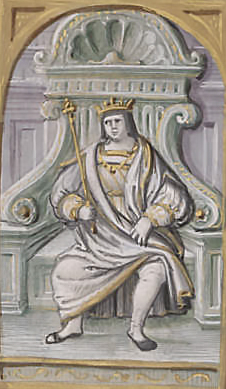
Henry_III_of_Castile
Henry III of Castile sends Ruy González de Clavijo as ambassador to Timur to discuss the possibility of an alliance between Timur and Castile against the Ottoman Empire.
King of Castile and León from 1390 to 1406
Henry III of Castile, called the Suffering due to his ill health, was the son of John I and Eleanor of Aragon. He succeeded his father as King of Castile in 1390.
1403
James_I_of_Scotland
Coronation of James I of Scotland at Scone.
King of Scots from 1406 to 1437
James I was King of Scots from 1406 to 1437. The youngest of three sons, he was born in Dunfermline Abbey to King Robert III and his wife Annabella Drummond. His older brother David, Duke of Rothesay died under suspicious circumstances while being detained by their uncle, Robert, Duke of Albany. His other brother, Robert, died young. Fears for James's safety grew through the winter of 1405/6 and plans were made to send him to France. In February 1406, James was forced to take refuge in the castle of the Bass Rock in the Firth of Forth after his escort was attacked by supporters of Archibald, 4th Earl of Douglas. He remained there until mid-March, when he boarded a vessel bound for France. On 22 March, English pirates captured the ship and delivered the prince to Henry IV of England. The ailing Robert III died on 4 April, and the 11-year-old James, now the uncrowned King of Scotland, would not regain his freedom for another eighteen years.
1424
Mary_I
Queen Mary I grants a royal charter to Derby School, as a grammar school for boys in Derby, England.
Queen of England and Ireland from 1553 to 1558
Mary I was Queen of England and Ireland from July 1553 and Queen of Spain as the wife of King Philip II from January 1556 until her death in 1558. She made vigorous attempts to reverse the English Reformation, which had begun during the reign of her father, King Henry VIII. Her attempt to restore to the Church the property confiscated in the previous two reigns was largely thwarted by Parliament but, during her five-year reign, more than 280 religious dissenters were burned at the stake, in what became known as the Marian persecutions, leading later commentators to label her "Bloody Mary".
1554
Concert_of_The_Hague_(1659)
In the Concert of The Hague, the Dutch Republic, the Commonwealth of England and the Kingdom of France set out their views on how the Second Northern War should end.
Treaty between England, France, and the Netherlands on the Second Northern War
The Concert of The Hague, signed on 21 May 1659, was an outline of the common stance of England, France and the Dutch Republic regarding the Second Northern War. The powers agreed that the Swedish Empire and Denmark–Norway should settle for a peace treaty based on the Treaty of Roskilde, including free navigation through The Sound and the Baltic Sea based on the Treaty of Elbing. The subsequent Dano-Swedish Peace of Copenhagen largely followed the terms dictated by the Concert of the Hague.
1659
Battle_of_Long_Sault
The Battle of Long Sault concludes after five days in which French colonial militia, with their Huron and Algonquin allies, are defeated by the Iroquois Confederacy.
1660 battle during the Beaver Wars
The Battle of Long Sault occurred over a five-day period in early May 1660 during the Beaver Wars. It was fought between French colonial militia, with their Wendat (Huron) and Algonquin allies, against the Haudenosaunee Confederacy (Iroquois).
1660
Szlachta
The nobility elect John Sobieski King of Poland and Grand Duke of Lithuania.
Noble class in the Kingdom of Poland and the Grand Duchy of Lithuania
The szlachta were the hereditary noble estate in the Kingdom of Poland, the Grand Duchy of Lithuania, and the Polish–Lithuanian Commonwealth. It was the dominating social class in the Kingdom of Poland and the Commonwealth, which was exercising political rights and power. Szlachta as a class differed substantially from the feudal nobility of Western Europe. The estate was officially abolished in 1921 by the March Constitution.
1674
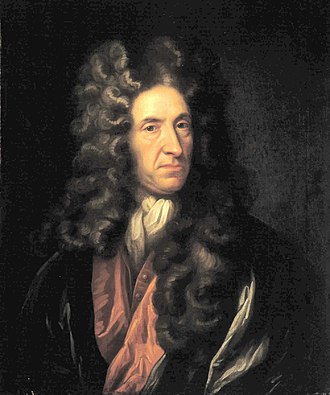
Daniel_Defoe
Daniel Defoe is imprisoned on charges of seditious libel.
English writer, merchant and spy (1660–1731)
Daniel Defoe was an English writer, journalist, merchant and spy. He is famous for his novels Robinson Crusoe (1719), Moll Flanders (1722) and Roxana: The Fortunate Mistress (1724). He has been seen as one of the earliest proponents of the English novel, and helped to popularise the form in Britain with others such as Aphra Behn and Samuel Richardson.
1703
Order_of_Saint_Alexander_Nevsky
The Order of St.
Alexander Nevsky is instituted in Russia by Empress Catherine I. It would later be discontinued and then reinstated by the Soviet government in 1942 as the Order of Alexander Nevsky.
The Imperial Order of Saint Alexander Nevsky was an order of chivalry of the Russian Empire first awarded on 1 June [O.S. 21 May] 1725 by Empress Catherine I of Russia.
1725
Mary_Campbell_(colonial_settler)
Ten-year-old Mary Campbell is abducted in Pennsylvania by Lenape during the French and Indian War.
She is returned six and a half years later.
Mary Campbell was an American colonial settler who was known for her abduction by Native Americans during the French and Indian War and being the first white child to travel to the Western Reserve. Born in 1747 or 1748, Campbell was taken captive by the Lenape tribe at the age of ten in 1758. It is believed that she lived with the Lenape, possibly under the care of their chief, Netawatwees, in locations near Cuyahoga Falls, Ohio, and Newcomerstown, eastern Ohio. Campbell's return to her family in Pennsylvania in 1764 was facilitated by British military pressure on the Native Americans. She was among a group of captives released to British forces and transported to Fort Pitt.
1758
Lava_dome
A lava dome collapses on Mount Unzen, near the city of Shimbara on the Japanese island of Kyūshū, creating a deadly tsunami that killed nearly 15,000 people.
Roughly circular protrusion from slowly extruded viscous volcanic lava
In volcanology, a lava dome is a circular, mound-shaped protrusion resulting from the slow extrusion of viscous lava from a volcano. Dome-building eruptions are common, particularly in convergent plate boundary settings. Around 6% of eruptions on Earth form lava domes. The geochemistry of lava domes can vary from basalt to rhyolite although the majority are of intermediate composition. The characteristic dome shape is attributed to high viscosity that prevents the lava from flowing very far. This high viscosity can be obtained in two ways: by high levels of silica in the magma, or by degassing of fluid magma. Since viscous basaltic and andesitic domes weather fast and easily break apart by further input of fluid lava, most of the preserved domes have high silica content and consist of rhyolite or dacite.
1792
Siege_of_Acre_(1799)
The end of the Siege of Acre (1799): Napoleon Bonaparte abandons his siege of the Ottoman city of Acre after two months.
This was the turning point of Bonaparte's Egyptian campaign and one of the first major defeats he suffered in his military career.
The siege of Acre of 1799 was an unsuccessful French siege of the Ottoman city of Acre and was the turning point of Napoleon's invasion of Egypt and Syria, along with the Battle of the Nile. It was Napoleon's third tactical defeat in his career, being defeated at the Second Battle of Bassano and the Battle of Caldiero three years previously during the Italian campaign, and his first major strategic defeat, along with the last time he was defeated in battle for 10 years. As a result of the failed siege, Napoleon retreated two months later and withdrew to Egypt.
1799
Battle_of_Aspern–Essling
The first day of the Battle of Aspern-Essling between the Austrian army led by Archduke Charles and the French army led by Napoleon I of France sees the French attack across the Danube held.
1809 battle during the War of the Fifth Coalition
In the Battle of Aspern–Essling, Napoleon crossed the Danube near Vienna, but the French and their allies were attacked and forced back across the river by the Austrians under Archduke Charles. It was the first time Napoleon had been personally defeated in a major battle, as well as his first battle defeat in 10 years since the siege of Acre, and his first battle defeat as head of state, although he did suffer a tactical defeat in the Battle of Caldiero and in the Second Battle of Bassano. Archduke Charles drove out the French but fell short of destroying their army. The French lost over 20,000 men, including one of Napoleon's ablest field commanders and closest friends, Marshal Jean Lannes.
1809
Lawrence,_Kansas
Lawrence, Kansas is captured and burned by pro-slavery forces.
City and county seat in Kansas, United States
Lawrence is a city in and the county seat of Douglas County, Kansas, United States, and the sixth-largest city in the state. It is in the northeastern sector of the state, astride Interstate 70, between the Kansas and Wakarusa rivers. As of the 2020 census, the population of the city was 94,934. The city is a college town with a significant student population, because it is home to both the University of Kansas (KU) and Haskell Indian Nations University (HINU).
1856
American_Civil_War
American Civil War: The Union Army succeeds in closing off the last escape route from Port Hudson, Louisiana, in preparation for the coming siege.
1861–1865 conflict in the United States
The American Civil War was a civil war in the United States between the Union and the Confederacy, which was formed in 1861 by states that had seceded from the Union to preserve slavery in the United States. The South saw slavery as threatened because of the election of Abraham Lincoln and the growing abolitionist movement in the North. The war ended with Union victory, the dissolution of the Confederacy and the abolition of slavery, freeing four million African Americans.
1863
Russo–Circassian_War
Russia declares an end to the Russo-Circassian War and many Circassians are forced into exile.
The day is designated the Circassian Day of Mourning.
The Russo-Circassian War, also known as the Russian invasion of Circassia, or termed by the Circassians as the Great War with the Tsar took place in the North Caucasus between July 1763 and June 1864. It began when the Russian Empire entered Circassia and occupied Mozdok, which prompted the Circassian people to organize a resistance movement to preserve their independence. Over the next century, the Imperial Russian Army expanded across the country until the last Circassian fighters were defeated in the Battle of Qbaada. It remains the longest war to have ever occurred in the Caucasus and in the history of Russia, as well as the longest and final war in the history of Circassia. Although it initially involved only Russia and Circassia, the conflict soon drew in a number of other Caucasian nations after they also became targets for Russian conquests, and it is consequently sometimes considered to be the western half of the Caucasian War.
1864
Battle_of_Spotsylvania_Court_House
American Civil War: The Battle of Spotsylvania Court House ends.
1864 battle of the American Civil War
The Battle of Spotsylvania Court House, sometimes more simply referred to as the Battle of Spotsylvania, was the second major battle in Lt. Gen. Ulysses S. Grant and Maj. Gen. George G. Meade's 1864 Overland Campaign of the American Civil War. Following the bloody but inconclusive Battle of the Wilderness, Grant's army disengaged from Confederate General Robert E. Lee's army and moved to the southeast, attempting to lure Lee into battle under more favorable conditions. Elements of Lee's army beat the Union army to the critical crossroads of the Spotsylvania Court House in Spotsylvania County, Virginia, and began entrenching. Fighting occurred on and off from May 8 through May 21, 1864, as Grant tried various schemes to break the Confederate line. In the end, the battle was tactically inconclusive, but both sides declared victory. The Confederacy declared victory because they were able to hold their defenses. The United States declared victory because the Federal offensive continued and Lee's army suffered losses that could not be replaced. With almost 32,000 casualties on both sides, Spotsylvania was the costliest battle of the campaign.
1864
Ionian_Islands
The Ionian Islands reunite with Greece.
Group of islands in Greece
The Ionian Islands are a group of islands in the Ionian Sea, west of mainland Greece. They are traditionally called the Heptanese, but the group includes many smaller islands in addition to the seven principal ones.
1864
Paris_Commune
French troops invade the Paris Commune and engage its residents in street fighting.
By the close of "Bloody Week", some 20,000 communards have been killed and 38,000 arrested.
The Paris Commune was a French revolutionary government that seized power in Paris on 18 March 1871 and controlled parts of the city until 28 May 1871. During the Franco-Prussian War of 1870–1871, the French National Guard had defended Paris, and working class radicalism grew among its soldiers. Following the establishment of the French Third Republic in September 1870 and the complete defeat of the French Army by the Germans by March 1871, soldiers of the National Guard seized control of the city on 18 March. The Communards killed two French Army generals and refused to accept the authority of the Third Republic; instead, the radicals set about establishing their own independent government.
1871
Rack_railway
Opening of the first rack railway in Europe, the Rigi Bahnen on Mount Rigi.
Steep-grade railway with a toothed rack rail
A rack railway is a steep grade railway with a toothed rack rail, usually between the running rails. The trains are fitted with one or more cog wheels or pinions that mesh with this rack rail. This allows the trains to operate on steep gradients of 100% or more, well above the 10% maximum for friction-based rail. The rack-and-pinion mechanism also provides more controlled braking and reduces the effects of snow or ice on the rails. Most rack railways are mountain railways, although a few are transit railways or tramways built to overcome a steep gradient in an urban environment. The first cog railway was the Middleton Railway between Middleton and Leeds in West Yorkshire, England, United Kingdom, where the first commercially successful steam locomotive, Salamanca, ran in 1812. This used a rack and pinion system designed and patented in 1811 by John Blenkinsop.
1871
War_of_the_Pacific
War of the Pacific: Two Chilean ships blocking the harbor of Iquique (then belonging to Peru) battle two Peruvian vessels in the Battle of Iquique.
Territorial conflict between Chile and allied Peru and Bolivia (1879–84)
The War of the Pacific, also known by multiple other names, was a war between Chile and a Bolivian–Peruvian alliance from 1879 to 1884. Fought over Chilean claims on coastal Bolivian territory in the Atacama Desert, the war ended with victory for Chile, which gained a significant amount of resource-rich territory from Peru and Bolivia. The war demonstrated Chile's military-technological superiority over its opponents at the time.
1879
American_Red_Cross
The American Red Cross is established by Clara Barton in Dansville, New York.
American humanitarian organization
The American National Red Cross, sometimes referred to as ANRC, is an American nonprofit humanitarian organization that provides emergency assistance, disaster relief, and disaster preparedness education in the United States. Clara Barton founded the organization in 1881 after initially learning of the Red Cross, founded 1863 in Geneva, Switzerland. It is the designated American affiliate of the International Federation of Red Cross and Red Crescent Societies and the International Red Cross and Red Crescent Movement.
1881
Manchester_Ship_Canal
The Manchester Ship Canal in the United Kingdom is officially opened by Queen Victoria, who later knights its designer Sir Edward Leader Williams.
UK canal linking Manchester to the coast
The Manchester Ship Canal is a 36-mile-long (58 km) inland waterway in North West England that links Manchester to the Irish Sea. Beginning in the Mersey estuary at Eastham, near Ellesmere Port in Cheshire, it generally follows the original routes of the rivers Mersey and Irwell through the historic counties of Cheshire and Lancashire before terminating to the east of Salford Quays near Pomona Docks and a junction with the Bridgewater Canal where it meets the Irwell. Several sets of locks lift vessels about 60 ft (18 m) to the canal's terminus in Manchester. Landmarks along its route include the Barton Swing Aqueduct – the world's only swing aqueduct – and Trafford Park, the world's first planned industrial estate and one of the largest in Europe.
1894
FIFA
The Fédération Internationale de Football Association (FIFA) is founded in Paris.
International governing body of association football
The Fédération Internationale de Football Association (FIFA) is an international self-regulatory governing body of association football, beach soccer, and futsal. It was founded on 21 May 1904 to oversee international competition among the national associations of Belgium, Denmark, France, Germany, the Netherlands, Spain, Sweden, and Switzerland. Headquartered in Zurich, Switzerland, its membership now comprises 211 national associations. These national associations must also be members of one of the six regional confederations: CAF (Africa), AFC (Asia), UEFA (Europe), CONCACAF, OFC (Oceania), and CONMEBOL.
1904
President_of_Mexico
President of Mexico Porfirio Díaz and the revolutionary Francisco Madero sign the Treaty of Ciudad Juárez to put an end to the fighting between the forces of both men, concluding the initial phase of the Mexican Revolution.
Head of state and government
The president of Mexico, officially the president of the United Mexican States, is the head of state and head of government of Mexico. Under the Constitution of Mexico, the president heads the executive branch of the federal government and is the commander in chief of the Mexican Armed Forces.
1911
Commonwealth_War_Graves_Commission
The Imperial War Graves Commission is established through royal charter to mark, record, and maintain the graves and places of commemoration of the British Empire's military forces.
Commonwealth organisation responsible for war graves
The Commonwealth War Graves Commission (CWGC) is an intergovernmental organisation of six independent member states whose principal function is to mark, record and maintain the graves and places of commemoration of Commonwealth of Nations military service members who died in the two world wars. The commission is also responsible for commemorating Commonwealth civilians who died as a result of enemy action during the Second World War. The commission was founded by Sir Fabian Ware and constituted through royal charter in 1917 as the Imperial War Graves Commission. The change to the present name took place in 1960.
1917
Great_Atlanta_fire_of_1917
The Great Atlanta fire of 1917 causes $5.5 million in damages, destroying some 300 acres including 2,000 homes, businesses and churches, displacing about 10,000 people but leading to only one fatality (due to heart attack).
1917 fire which destroyed large parts of downtown Atlanta, Georgia, USA
The Great Atlanta Fire of 1917 began just after noon on 21 May 1917 in the Old Fourth Ward of Atlanta, Georgia. It is unclear just how the fire started, but it was fueled by hot temperatures and strong winds which propelled the fire. The fire, which burned for nearly 10 hours, destroyed 300 acres (120 ha) and 1,900 structures displacing over 10,000 people. Damages were estimated at $5 million,.
1917
University_of_Chicago
University of Chicago students Richard Loeb and Nathan Leopold, Jr.
murder 14-year-old Bobby Franks in a "thrill killing".
The University of Chicago is a private research university in the Hyde Park community area of Chicago, Illinois, United States.
1924
Doktor_Faust
The opera Doktor Faust, unfinished when composer Ferruccio Busoni died, is premiered in Dresden.
Opera by Ferruccio Busoni
Doktor Faust is an opera by Ferruccio Busoni with a German libretto by the composer, based on the myth of Faust. Busoni worked on the opera, which he intended as his masterpiece, between 1916 and 1924, but it was still incomplete at the time of his death. His pupil Philipp Jarnach finished it. More recently, in 1982, Antony Beaumont completed the opera using sketches by Busoni that were previously thought to have been lost. Nancy Chamness published an analysis of the libretto to Doktor Faust and a comparison with Goethe's version.
1925
Charles_Lindbergh
Charles Lindbergh touches down at Le Bourget Field in Paris, completing the world's first solo nonstop flight across the Atlantic Ocean.
American aviator (1902–1974)
Charles Augustus Lindbergh was an American aviator, military officer, and author. On May 20–21, 1927, he made the first nonstop flight from New York to Paris, a distance of 3,600 miles (5,800 km), flying alone for over 33 hours. His aircraft, the Spirit of St. Louis, was built to compete for the $25,000 Orteig Prize for the first flight between the two cities. Although not the first transatlantic flight, it was the first solo crossing of the Atlantic and the longest at the time by nearly 2,000 miles (3,200 km), setting a new flight distance world record. The achievement garnered Lindbergh worldwide fame and stands as one of the most consequential flights in history, signalling a new era of air transportation between parts of the globe.
1927
Amelia_Earhart
Bad weather forces Amelia Earhart to land in a pasture in Derry, Northern Ireland, and she thereby becomes the first woman to fly solo across the Atlantic Ocean.
American aviation pioneer (1897–1937)
Amelia Mary Earhart was an American aviator and aviation pioneer who became one of the most celebrated figures of early flight.
1932
Oskaloosa,_Iowa
Oskaloosa, Iowa, becomes the first municipality in the United States to fingerprint all of its citizens.
City in the United States
Oskaloosa is a city in, and the county seat of, Mahaska County, Iowa. The population was 11,558 in the 2020 U.S. census. In the late nineteenth and early twentieth century, Oskaloosa was a national center of bituminous coal mining. Today, Oskaloosa is home to William Penn University, a private university, and Lake Keomah State Park which is located four miles east of the city.
1934
Sada_Abe
Sada Abe is arrested after wandering the streets of Tokyo for days with her dead lover's severed genitals in her handbag.
Her story soon becomes one of Japan's most notorious scandals.
Sada Abe was a Japanese geisha and prostitute who murdered her lover, Kichizō Ishida , via strangulation on May 18, 1936, before cutting off his penis and testicles and carrying them around with her in her kimono. The story became a national sensation in Japan, acquiring mythic overtones; it has also been interpreted by artists, philosophers, novelists and filmmakers. Abe was released after serving five years in prison and went on to write an autobiography.
1936
Drifting_ice_station
A Soviet station, North Pole-1, becomes the first scientific research settlement to operate on the drift ice of the Arctic Ocean.
Research stations built on the ice of the high latitudes of the Arctic Ocean
A drifting ice station is a temporary or semi-permanent facility built on an ice floe. During the Cold War the Soviet Union and the United States maintained a number of stations in the Arctic Ocean on floes such as Fletcher's Ice Island for research and espionage, the latter of which were often little more than quickly constructed shacks. Extracting personnel from these stations proved difficult and in the case of the United States, employed early versions of the Fulton surface-to-air recovery system.
1937
National_War_Memorial_(Canada)
The Canadian National War Memorial is unveiled by King George VI and Queen Elizabeth in Ottawa, Ontario, Canada.
Canadian war memorial
The National War Memorial, titled The Response, is a tall, granite memorial arch with accreted bronze sculptures in Ottawa, Ontario, designed by Vernon March and first dedicated by King George VI in 1939. Originally built to commemorate the Canadians who died in the First World War, it was in 1982 rededicated to also include those killed in the Second World War and Korean War and again in 2014 to add the dead from the Second Boer War and War in Afghanistan, as well as all Canadians killed in all conflicts past and future. It now serves as the pre-eminent war memorial of 76 cenotaphs in Canada. In 2000, the Tomb of the Unknown Soldier was added in front of the memorial and symbolizes the sacrifices made by all Canadians who have died or may yet die for their country.
1939
Louis_Slotin
Physicist Louis Slotin is fatally irradiated in a criticality incident during an experiment with the demon core at Los Alamos National Laboratory.
Canadian physicist and chemist (1910–1946)
Louis Alexander Slotin was a Canadian physicist and chemist who took part in the Manhattan Project. Born and raised in the North End of Winnipeg, Manitoba, Slotin earned both his Bachelor of Science and Master of Science degrees from the University of Manitoba, and his doctorate in physical chemistry at King's College London in 1936. Afterwards, he joined the University of Chicago as a research associate to help design a cyclotron.
1946
9th_Street_Art_Exhibition
The opening of the Ninth Street Show, otherwise known as the 9th Street Art Exhibition: A gathering of a number of notable artists, and the stepping-out of the post war New York avant-garde, collectively known as the New York School.
1951 art show in New York City, USA; debut of the abstract expressionist art movement
The 9th Street Art Exhibition of Paintings and Sculpture is the official title artist Franz Kline hand-lettered onto the poster he designed for the Ninth Street Show. Now considered historic, the artist-led exhibition marked the formal debut of Abstract Expressionism, and the first American art movement with international influence. The School of Paris, long the headquarters of the global art market, typically launched new movements, so there was both financial and cultural fall-out when all the excitement was suddenly emanating from New York. The postwar New York avant-garde, artists like Willem de Kooning and Jackson Pollock, would soon become "art stars," commanding large sums and international attention. The Ninth Street Show marked their "stepping-out," and that of nearly 75 other artists, including Harry Jackson, Helen Frankenthaler, Michael Goldberg, Joan Mitchell, Grace Hartigan, Robert De Niro Sr., John Ferren, Philip Guston, Elaine de Kooning, Louis Schanker, Lee Krasner, Franz Kline, Ad Reinhardt, Ludwig Sander, David Smith, Milton Resnick, Joop Sanders, Robert Motherwell, Barnett Newman, and many others who were then mostly unknown to an art establishment that ignored experimental art without a ready market.
1951
Civil_rights_movement
American civil rights movement: Alabama Governor John Malcolm Patterson declares martial law in an attempt to restore order after race riots break out.
1954–1968 U.S. social movement
The civil rights movement was a social movement in the United States from 1954 to 1968 which aimed to abolish legalized racial segregation, discrimination, and disenfranchisement in the country, which most commonly affected African Americans. The movement had origins in the Reconstruction era in the late 19th century, and modern roots in the 1940s and in Mohandas Gandhi's nonviolent movement in India. After years of nonviolent protests and civil disobedience campaigns, the civil rights movement achieved many of its legislative goals in the 1960s, during which it secured new protections in federal law for the civil rights of all Americans, including the Civil Rights Act of 1964, the Voting Rights Act of 1965, and the Civil Rights Act of 1968.
1961
Ulster_Volunteer_Force
The Ulster Volunteer Force declares war on the Irish Republican Army in Northern Ireland.
Ulster loyalist paramilitary group
The Ulster Volunteer Force (UVF) is an Ulster loyalist paramilitary group based in Northern Ireland. Formed in 1965, it first emerged in 1966. Its first leader was Gusty Spence, a former British Army soldier from Northern Ireland. The group undertook an armed campaign of almost thirty years during The Troubles. It declared a ceasefire in 1994 and officially ended its campaign in 2007, although some of its members have continued to engage in violence and criminal activities. The group is a proscribed organisation and is on the terrorist organisation list of the United Kingdom.
1966
Rosario
Civil unrest in Rosario, Argentina, known as Rosariazo, following the death of a 15-year-old student.
City in Santa Fe Province, Argentina
Rosario, officially the Autonomous City of Rosario, is a city in central Argentina, in the south of the province of Santa Fe. Located 300 km (186 mi) northwest of Buenos Aires on the west bank of the Paraná River, it is the country's third-most populous city after Buenos Aires and Córdoba. With a growing and important metropolitan area, Greater Rosario has an estimated population of 1,750,000 as of 2020. One of its main attractions includes the neoclassical, Art Nouveau, and Art Deco architecture that has been preserved in hundreds of residences, houses and public buildings. The city is also famous for being the birthplace of revolutionary Marxist Che Guevara and footballer Lionel Messi.
1969
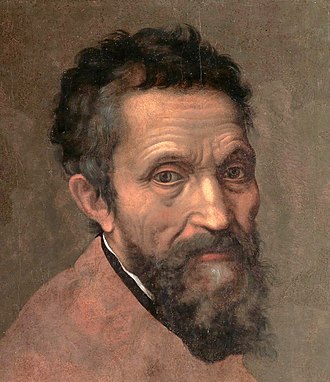
Michelangelo
Michelangelo's Pietà in St.
Peter's Basilica in Rome is damaged by a vandal, the mentally disturbed Hungarian geologist Laszlo Toth.
Michelangelo di Lodovico Buonarroti Simoni, known mononymously as Michelangelo, was an Italian sculptor, painter, architect, and poet of the High Renaissance. He was born in the Republic of Florence but was mostly active in Rome from his 30s onwards. His work was inspired by models from classical antiquity and had a lasting influence on Western art. Michelangelo's creative abilities and mastery in a range of artistic arenas define him as an archetypal Renaissance man, along with his rival and elder contemporary, Leonardo da Vinci. Given the sheer volume of surviving correspondence, sketches, and reminiscences, Michelangelo is one of the best-documented artists of the 16th century. He was lauded by contemporary biographers as the most accomplished artist of his era.
1972
Twenty-nine people are killed in the Yuba City bus disaster in Martinez, California.
Deadly school bus crash in Martinez, California
The Yuba City bus disaster occurred on May 21, 1976, in Martinez, California, United States. A chartered school bus transporting 52 passengers came off an elevated off ramp, left the roadway, and landed on its roof. There were 53 people on the bus, passengers and a driver. Twenty nine people died; 28 students and an adult adviser were killed in the crash.
1976
White_Night_riots
White Night riots in San Francisco following the manslaughter conviction of Dan White for the assassinations of George Moscone and Harvey Milk.
1979 riots in San Francisco, California, US
The White Night riots were a series of violent events sparked by an announcement of a lenient sentencing of Dan White for the assassinations of George Moscone, the mayor of San Francisco, and of Harvey Milk, a member of the city's Board of Supervisors who was one of the first openly gay elected officials in the United States. The events took place on the night of May 21, 1979, in San Francisco. Earlier that day White had been convicted of voluntary manslaughter, the lightest possible conviction for his actions. The lesser conviction outraged the city's gay community, setting off the most violent reaction by gay Americans since the 1969 Stonewall riots in New York City.
1979
The Italian government releases the membership list of Propaganda Due, an illegal pseudo-Masonic lodge that was implicated in numerous Italian crimes and mysteries.
Italian masonic lodge banned in 1982
Propaganda Due was a Masonic lodge, founded in 1877, within the tradition of Continental Freemasonry and under the authority of Grand Orient of Italy. Its Masonic charter was withdrawn in 1976, and it was transformed by Licio Gelli into an international, illegal, clandestine, anti-communist, anti-Soviet, anti-Marxist, and radical right criminal organization and secret society operating in contravention of Article 18 of the Constitution of Italy that banned all such secret associations. Gelli continued to operate the unaffiliated lodge from 1976 to 1984. P2 was implicated in numerous Italian crimes and mysteries, including the collapse of the Holy See-affiliated Banco Ambrosiano, the contract killings of journalist Carmine Pecorelli and mobbed-up banker Roberto Calvi, and political corruption cases within the nationwide mani pulite bribery scandal. P2 came to light through the investigations into the collapse of Michele Sindona's financial empire.
1981
Transamerica Corporation agrees to sell United Artists to Metro-Goldwyn-Mayer for $380 million after the box office failure of the 1980 film Heaven's Gate.
American private holding company
Transamerica Corporation is an American holding company for various life insurance companies and investment firms operating primarily in the United States, offering life and supplemental health insurance, investments, and retirement services. The company is located in Baltimore, Maryland, with its subsidiary Transamerica Life Company headquartered in Cedar Rapids, Iowa; It has back offices Denver, Colorado; Harrison, New York; Toronto, Ontario; Philadelphia, Pennsylvania; and Knoxville, Tennessee. Additional affiliated offices are located throughout the United States. In 1999, it became an independent subsidiary of multinational company Aegon.
1981
Falklands_War
Falklands War: A British amphibious assault during Operation Sutton leads to the Battle of San Carlos.
1982 undeclared Argentina–United Kingdom war
The Falklands War was a ten-week undeclared war between Argentina and the United Kingdom in 1982 over two British Overseas Territories in the South Atlantic: the Falkland Islands and its territorial dependency, South Georgia and the South Sandwich Islands. The conflict began on 2 April 1982, when Argentina invaded and occupied the Falkland Islands, followed by the invasion of South Georgia the next day. On 5 April the British government dispatched a naval task force to engage the Argentine Navy and Air Force before making an amphibious assault on the islands. The conflict lasted 74 days and ended with an Argentine surrender on 14 June, returning the islands to British control. In total, 649 Argentine military personnel, 255 British military personnel, and 3 Falkland Islanders were killed during the hostilities.
1982
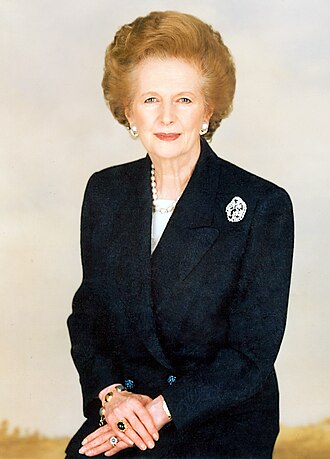
Margaret_Thatcher
Margaret Thatcher holds her controversial Sermon on the Mound before the General Assembly of the Church of Scotland.
Prime Minister of the United Kingdom from 1979 to 1990
Margaret Hilda Thatcher, Baroness Thatcher was a British stateswoman who served as Prime Minister of the United Kingdom from 1979 to 1990 and Leader of the Conservative Party from 1975 to 1990. She was the longest-serving British prime minister of the 20th century and the first woman to hold the office. As prime minister, she implemented policies that came to be known as Thatcherism. A Soviet journalist dubbed her the "Iron Lady", a nickname that became associated with her uncompromising politics and leadership style.
1988
Prime_Minister_of_India
Former Indian Prime Minister Rajiv Gandhi is assassinated by a female suicide bomber near Madras.
Head of government of the Republic of India
The prime minister of India is the head of government of the Republic of India. Executive authority is vested in the prime minister and his chosen Council of Ministers, despite the President of India being the nominal head of the executive. The prime minister has to be a member of one of the houses of bicameral Parliament of India, alongside heading the respective house. The prime minister and the cabinet are at all times responsible to the Lok Sabha, the lower house of the parliament.
1991
Mengistu_Haile_Mariam
Mengistu Haile Mariam, president of the People's Democratic Republic of Ethiopia, flees Ethiopia, effectively bringing the Ethiopian Civil War to an end.
Leader of Ethiopia from 1977 to 1991
Mengistu Haile Mariam is an Ethiopian communist revolutionary, military officer, and former statesman who served as the head of state of Ethiopia from 1977 to 1991. He was General Secretary of the Workers' Party of Ethiopia from 1984 to 1991, chairman of the Derg—the Marxist–Leninist military junta that ruled Ethiopia—from 1977 to 1987, and president of the People's Democratic Republic of Ethiopia (PDRE) from 1987 to 1991.
1991
Johnny_Carson
After 30 seasons Johnny Carson hosts his penultimate episode and last featuring guests (Robin Williams and Bette Midler) of The Tonight Show.
American comedian and television host (1925–2005)
John William Carson was an American television host, comedian, and writer. He was best known as the host of The Tonight Show Starring Johnny Carson, the third installment of The Tonight Show, which aired on NBC from 1962 to 1992.
1992
The Democratic Republic of Yemen unsuccessfully attempts to secede from the Republic of Yemen; a war breaks out.
1994 breakaway state in South Yemen
The Democratic Republic of Yemen, was a short-lived state that fought against the mainland Yemen in the 1994 Yemeni Civil War. It was declared in May 1994 and covered all of the former South Yemen.
1994
MV_Bukoba
The ferry MV Bukoba sinks in Tanzanian waters on Lake Victoria, killing nearly 1,000.
Lake Victoria ferry that sank off Mwanza
MV Bukoba was a Lake Victoria ferry that carried passengers and cargo along Tanzania's Lake Victoria between the Tanzanian ports of Bukoba and Mwanza City. It also served the regular line between Port Bell, Uganda, and Mwanza, Tanzania, across Lake Victoria. MV Bukoba was built in about 1979 and had capacity for 850 tons of cargo and 430 passengers.
1996
Trappists
The seven Trappist monks of Tibhirine who were abducted on March 27 are killed under uncertain circumstances.
Roman Catholic religious order
The Trappists, officially known as the Order of Cistercians of the Strict Observance and originally named the Order of Reformed Cistercians of Our Lady of La Trappe, are a Catholic religious order of cloistered monastics that branched off from the Cistercians. They follow the Rule of Saint Benedict and have communities of both monks and nuns that are known as Trappists and Trappistines, respectively. They are named after La Trappe Abbey, the monastery from which the movement and religious order originated. The movement began with the reforms that Abbot Armand Jean le Bouthillier de Rancé introduced in 1664, later leading to the creation of Trappist congregations, and eventually the formal constitution as a separate religious order in 1892.
1996
Miami
In Miami, five abortion clinics are attacked by a butyric acid attacker.
City in Florida, United States
Miami is a coastal city in the southeast portion of the U.S. state of Florida. It is the second-most populous city proper in Florida, with a population of 442,241 at the 2020 census. The Miami metropolitan area in South Florida has an estimated 6.39 million residents, ranking as the fifth-largest metropolitan area in the Southeast and eighth-largest metropolitan area in the United States. Miami has the third-largest skyline in the U.S. with over 300 high-rises, 70 of which exceed 492 ft (150 m). It is the county seat of Miami-Dade County.
1998
Suharto
President Suharto of Indonesia resigns following the killing of students from Trisakti University earlier that week by security forces and growing mass protests in Jakarta against his ongoing corrupt rule.
President of Indonesia from 1967 to 1998
Suharto was an Indonesian general and politician who served as the second and longest-serving president of Indonesia from 1967 to 1998.
1998
2000_Executive_Airlines_British_Aerospace_Jetstream_crash
Nineteen people are killed in a plane crash in Wilkes-Barre, Pennsylvania.
Plane crash in Pennsylvania, United States
On May 21, 2000, a British Aerospace BAe-3101 Jetstream 3101 operated by East Coast Aviation Services crashed into mountainous terrain in Bear Creek Township, Wilkes-Barre, Pennsylvania. The plane was carrying 17 professional gamblers returning home from Caesar's Palace Casino in Atlantic City, New Jersey, along with 2 crew members. It was chartered by Caesar's Palace. All 19 passengers and crew on board were killed on impact. This accident, alongside the accident of Aerocaribe Flight 7831 were the accidents with the most fatalities involving the Jetstream 3101 airliner.
2000
Christiane_Taubira
French Taubira law is enacted, officially recognizing the Atlantic slave trade and slavery as crimes against humanity.
French politician (born 1952)
Christiane Marie Taubira is a French politician who served as Minister of Justice of France in the governments of Prime Ministers Jean-Marc Ayrault and Manuel Valls under President François Hollande from 2012 until 2016. She was a member of the National Assembly of France for French Guiana from 1993 to 2012 and member of the European Parliament from 1994 to 1999.
2001
2003_Boumerdès_earthquake
The 6.8 Mw Boumerdès earthquake shakes northern Algeria with a maximum Mercalli intensity of X (Extreme).
More than 2,200 people were killed and a moderate tsunami sank boats at the Balearic Islands.
The 2003 Boumerdès earthquake occurred on May 21 at 19:44:21 local time in northern Algeria. The shock had a moment magnitude of 6.8 and a maximum Mercalli intensity of X (Extreme). The epicentre of the earthquake was located near the town of Thénia in Boumerdès Province, approximately 60 km east of the capital Algiers. The quake was the strongest to hit Algeria in more than twenty years – since 1980, when a magnitude 7.1 earthquake resulted in at least 2,633 deaths.
2003
Roller_coaster
The tallest roller coaster in the world, Kingda Ka opens at Six Flags Great Adventure in Jackson Township, New Jersey.
Rail-based amusement park ride
A roller coaster is a type of amusement ride employing a form of elevated railroad track that carries passengers on a train through tight turns, steep slopes, and other elements. Roller coasters are usually designed to produce a thrilling experience, though some roller coasters aim to provide a more gentle experience. Trains consist of open cars connected in a single line, and tracks are typically built and designed as a complete circuit in which trains depart from and return to the same loading station. The rides are typically found in amusement parks around the world but can also be located in shopping malls and zoos. The Roller Coaster DataBase records over 6,000 extant roller coasters as of January 2026.
2005
Republic_of_Montenegro_(1992–2006)
The Republic of Montenegro holds a referendum proposing independence from the State Union of Serbia and Montenegro; 55% of Montenegrins vote for independence.
Federal unit of Yugoslavia/Serbia & Montenegro between 1992 and 2006
The Republic of Montenegro was a constituent federated state of the Federal Republic of Yugoslavia and then Serbia and Montenegro between 1992 and 2006. The declaration of independence of Montenegro in 2006 ended the ex-Yugoslav state. After the collapse of the Socialist Federal Republic of Yugoslavia (SFRY), the remaining republics of Montenegro and Serbia agreed to the formation of the Federal Republic of Yugoslavia (FRY) which officially abandoned communism and endorsed liberal institutions. Montenegro was a constituent republic of the FRY and its successor state until June 2006 when Montenegro declared independence from Serbia and Montenegro following the 2006 Montenegrin independence referendum.
2006
JAXA
JAXA, the Japan Aerospace Exploration Agency, launches the solar-sail spacecraft IKAROS aboard an H-IIA rocket.
The vessel would make a Venus flyby late in the year.
The Japan Aerospace Exploration Agency (JAXA) is the operator of the Japanese space program and Japan's national aeronautics research agency. It was formed in 2003 through the merger of the Institute of Space and Astronautical Science, the National Aerospace Laboratory of Japan, and the National Space Development Agency of Japan.
2010
Radio broadcaster Harold Camping predicted that the world would end on this date.
American Christian radio broadcaster and evangelist (1921–2013)
Harold Egbert Camping was an American Christian radio broadcaster and evangelist. Beginning in 1958, he served as president of Family Radio, a California-based radio station group that, at its peak, broadcast to more than 150 markets in the United States. In October 2011, he retired from active broadcasting following a stroke, but still maintained a role at Family Radio until his death. Camping was notorious for issuing a succession of failed predictions of dates for the End Times, which temporarily gained him a global following and millions of dollars of donations.
2011
A bus accident near Himara, Albania kills 13 people and injures 21 others.
2012 motor vehicle incident in Albania
The Qafa e Vishës bus accident occurred on 21 May 2012, at Qafa e Vishës near Himarë, Albania, when a bus plunged 80 metres (260 ft) off a cliff. Most of the victims were students of Aleksandër Xhuvani University of Elbasan. The driver is also believed to have been killed. The students were travelling from Elbasan to Sarandë.
2012
2012_Unity_Day_parade_rehearsal_bombing
A suicide bombing kills more than 120 people in Sanaa, Yemen.
2012 suicide bombing in Yemen
On 21 May 2012, a suicide bomber detonated an explosive belt among groups of Yemeni soldiers rehearsing for the annual Unity Day military parade in Sanaa, Yemen. An 18-year-old soldier recruited as a suicide bomber entered al-Sabeen Square in uniform and joined his Central Security Organization brigade midway through the rehearsal. As the soldiers were passing by the parade view stand, the bomber detonated his explosive belt. The attack, which unsuccessfully attempted to target Yemen's Defense Minister Mohammed Nasser Ahmed, killed at least 96 soldiers and wounded 222, making it one of the worst in Yemen's history. The bombing was claimed by al-Qaeda in the Arabian Peninsula affiliate Ansar al-Sharia.
2012
2014_Taipei_Metro_attack
Random killings occur on the Bannan Line of the Taipei MRT, killing four and injuring 24.
Fatal stabbing spree in Taiwan
On 21 May 2014, a Taiwanese man carried out a stabbing spree targeting random civilians on a Taipei Metro C321 train near Jiangzicui Station, resulting in four deaths and 24 injuries. It was the first fatal attack on the city's subway system since operations began in 1996. The attacker, 21-year-old Cheng Chieh, was arrested after the attack. He was sentenced to death, in addition to 144 years in prison, and was executed on 10 May 2016.
2014
Ringling_Bros._and_Barnum_&_Bailey_Circus
Ringling Bros.
and Barnum & Bailey Circus perform their final show at Nassau Veterans Memorial Coliseum.
The Ringling Bros. and Barnum & Bailey Circus, or simply Ringling, is an American traveling circus company billed as The Greatest Show on Earth. It and its predecessors have run shows from 1871, with a hiatus from 2017 to 2023. The circus started in 1919 when the Barnum & Bailey's Greatest Show on Earth, a circus created by P. T. Barnum and James Anthony Bailey, was merged with the Ringling Bros. World's Greatest Shows. The Ringling brothers purchased Barnum & Bailey Ltd. in 1907 following Bailey's death in 1906, but ran the circuses separately until they were merged in 1919.
2017
Greenfield_tornado
The Greenfield tornado kills five and injures 35 across rural Iowa, United States.
Wind speeds in excess of 480 kilometres per hour (300 mph) are estimated from measurements for the third time in history.
On the afternoon of May 21, 2024, a violent and destructive EF4 tornado tracked across southwestern Iowa, United States, devastating the city of Greenfield. The tornado, known most commonly as the Greenfield tornado, destroyed many buildings and wind turbines across its path that stretched through Page, Taylor, Adams, and Adair counties, while also causing more than $31 million in property damage, killing five people and injuring 35 more. The tornado reached peak intensity within Greenfield, where National Weather Service surveyors denoted maximum wind speeds estimated at 185 mph (298 km/h), or EF4 on the Enhanced Fujita scale. However, estimated winds of 309–318 mph (497–512 km/h) were briefly determined from inside the tornado by a Doppler on Wheels portable radar unit, one of only three times that wind speeds exceeding 300 miles per hour (480 km/h) have been determined in a tornado from radar observations.
2024
2024_Taichung_MRT_attack
A stabbing spree on the Green line of the Taichung MRT injures four people, including the perpetrator.
Stabbing spree in Taiwan
On 21 May 2024, a Taiwanese man carried out a stabbing spree directed at passengers on a Taichung MRT train, near Taichung City Hall station. Three people, including the attacker, were injured. The attack occurred exactly ten years after the 2014 Taipei Metro attack.
2024

History runs on facts, and this project runs on coffee!

Your support is incredibly helpful and genuinely appreciated.

Support with a coffee ☕