November 16 in History

In the first open election in more than a decade, voters in Pakistan elect popul

1988 — In the first open election in more than a decade, voters in Pakistan elect populist candidate Benazir Bhutto to be Prime Minister of Pakistan

November 16 spans 51 recorded events across recorded history, from 951 to 2022. Below is a curated digest of the most significant moments tied to this date.

By · Wikipedia

Historical Events 51 events 951 – 2022

More major events on November 16

The featured story and these ranked highlights form a quick summary. Every recorded event remains available in the chronology below.

  1. 2022 Artemis Program: NASA launches Artemis 1 on the first flight of the Space Launch System, the start of the program's future missions to the moon. Source
  2. 1965 Venera program: The Soviet Union launches the Venera 3 space probe toward Venus, which will be the first spacecraft to reach the surface of another planet. Source
  3. 1973 U.S. president Richard Nixon signs the Trans-Alaska Pipeline Authorization Act into law, authorizing the construction of the Alaska Pipeline. Source

Did you know

In 1988, In the first open election in more than a decade, voters in Pakistan elect populist candidate Benazir Bhutto to be Prime Minister of Pakistan. This featured entry focuses on the immediate decision and its direct historical impact.

Did you know

The prime minister of Pakistan is the head of government of the Islamic Republic of Pakistan. This helps explain why the event mattered beyond the initial announcement.

Did you know

Executive authority is vested in the prime minister-led and appointed cabinet, with the president of Pakistan serving as the nominal head of executive and state. This clarifies the institutional and public response around the event.

Did you know

The prime minister is often the leader of the party or the coalition with a majority in the lower house of the federal parliament, the National Assembly, where he serves as leader of the House. This shows how the event shaped policy and public communication in the same period.

Did you know

Prime minister holds office by virtue of their ability to command the confidence of the National Assembly. This helps explain why the event mattered beyond the initial announcement.


Li_Jing_(Southern_Tang)
Emperor Li Jing sends a Southern Tang expeditionary force of 10,000 men under Bian Hao to conquer Chu.
Li Jing removes the ruling family to his own capital in Nanjing, ending the Chu Kingdom.
Li Jing, originally Xu Jingtong (徐景通), briefly Xu Jing (徐璟) in 937–939, courtesy name Boyu (伯玉), also known by his temple name as the Emperor Yuanzong of Southern Tang (南唐元宗), also known in historiography as the Middle Lord of Southern Tang (南唐中主), was the second and penultimate monarch of China's Southern Tang dynasty during the Five Dynasties and Ten Kingdoms period. He reigned his state from 943 until his death.
951
Lord_Edward's_crusade
While travelling during the Ninth Crusade, Prince Edward becomes King of England upon Henry III of England's death, but he will not return to England for nearly two years to assume the throne.
European crusade to the Holy Land, 1271–1272
Lord Edward's Crusade, sometimes called the Ninth Crusade, was a military expedition to the Holy Land under the command of Edward Longshanks, later king of England, in 1271–1272. In practice an extension of the Eighth Crusade, it was the last of the Crusades to reach the Holy Land before the fall of Acre in 1291, which brought an end to the permanent crusader presence there.
1272
Auto-da-fé
An auto-da-fé, held in the Brasero de la Dehesa outside of Ávila, concludes the case of the Holy Child of La Guardia with the public execution of several Jewish and converso suspects.
Public penance imposed during the Inquisition
An auto-da-fé was a ritualized or public penance carried out between the 15th and 19th centuries in condemnation of heretics, apostates, and minorities such as Jews and Muslims. It was imposed by the Spanish, Portuguese, or Mexican Inquisition as punishment and enforced by civil authorities. Its most extreme form was death by burning.
1491
Francisco_Pizarro
Francisco Pizarro and his men capture Inca Emperor Atahualpa at the Battle of Cajamarca.
Spanish conquistador (1478–1541)
Francisco Pizarro was a Spanish conquistador, best known for his expeditions that led to the Spanish conquest of the Inca Empire.
1532
Gustavus_Adolphus
King Gustavus Adolphus of Sweden was killed at the Battle of Lützen during the Thirty Years' War.
King of Sweden from 1611 to 1632
Gustavus Adolphus, also known as Gustav II Adolf or Gustav II Adolph, was King of Sweden from 1611 to 1632. He is credited with the rise of Sweden as a great European power. During his reign, Sweden became one of the primary military forces in Europe during the Thirty Years' War, helping to determine the political and religious balance of power in Europe. He was formally and posthumously given the name Gustavus Adolphus the Great by the Riksdag of the Estates in 1634.
1632
American_Revolutionary_War
American Revolutionary War: British and Hessian units capture Fort Washington from the Patriots.
1775–1783 conflict in North America
The American Revolutionary War, also known as the Revolutionary War or American War of Independence or simply the American Revolution, was the armed conflict that comprised the final eight years of the broader American Revolution, in which American Patriot forces organized as the Continental Army and commanded by George Washington defeated the British Army. The conflict was fought in North America, the Caribbean, and the Atlantic Ocean. The war's outcome seemed uncertain for most of the war, but Washington and the Continental Army's decisive victory in the Siege of Yorktown in 1781 led King George III and the Kingdom of Great Britain to negotiate an end to the war. In 1783, in the Treaty of Paris, the British monarchy acknowledged the independence of the Thirteen Colonies, leading to the establishment of the United States as an independent and sovereign nation.
1776
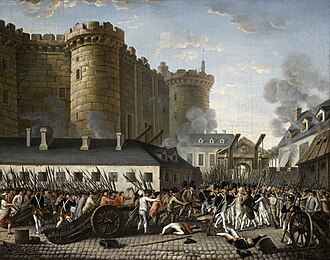
French_Revolution
French Revolution: Ninety dissident Roman Catholic priests are executed by drowning at Nantes.
1789–1799 sociopolitical change in France
The French Revolution was a period of political and societal change in France that began with the Estates General of 1789 and ended with the Coup of 18 Brumaire on 9 November 1799. Many of the revolution's ideas are considered fundamental principles of liberal democracy, and its values remain central to modern French political discourse. It was caused by a combination of social, political, and economic factors which the existing regime proved unable to manage.
1793
Frederick_William_III
The Prussian heir apparent, Frederick William, becomes King of Prussia as Frederick William III.
King of Prussia from 1797 to 1840
Frederick William III was King of Prussia from 16 November 1797 until his death in 1840. He was concurrently Elector of Brandenburg in the Holy Roman Empire until 6 August 1806, when the empire was dissolved.
1797
Napoleonic_Wars
Napoleonic Wars: Battle of Schöngrabern: Russian forces under Pyotr Bagration delay the pursuit by French troops under Joachim Murat.
1803–1815 series of wars led by Napoleon
The Napoleonic Wars (1803–15) were a global series of conflicts fought by a fluctuating array of European coalitions against the French First Republic (1803–04) under the First Consul followed by the First French Empire (1804–15) under the Emperor of the French, Napoleon. The wars originated in political forces arising from the French Revolution (1789–99) and French Revolutionary Wars (1792–1802) and produced a period of French domination over Continental Europe. The wars are categorised as seven conflicts, five named after the coalitions that fought Napoleon, plus two named for their respective theatres: the War of the Third Coalition, War of the Fourth Coalition, War of the Fifth Coalition, War of the Sixth Coalition, War of the Seventh Coalition, the Peninsular War, and the French invasion of Russia.
1805
American_frontier
American Old West: Missouri trader William Becknell arrives in Santa Fe, New Mexico, over a route that became known as the Santa Fe Trail.
Historical region of Western United States, c. 1607–1912
The American frontier encompasses the geography, history, folklore, and culture associated with the forward wave of American expansion in mainland North America that began with European colonial settlements in the early 17th century and ended with the admission of the last few contiguous western territories as states in 1912. This era of massive migration and settlement was particularly encouraged by President Thomas Jefferson following the Louisiana Purchase, giving rise to the expansionist attitude known as "manifest destiny" and historians' "Frontier Thesis". The legends, historical events, and folklore of the American frontier, known as the frontier myth, have embedded themselves into United States culture so much so that the Old West, and the Western genre of media specifically, has become one of the defining features of American national identity.
1822
Greek_War_of_Independence
Greek War of Independence: The London Protocol entails the creation of an autonomous Greek state under Ottoman suzerainty, encompassing the Morea and the Cyclades.
Greek rebellion against the Ottoman Empire (1821–1829)
The Greek War of Independence, also known as the Greek Revolution or the Greek Revolution of 1821, was a successful war of independence fought by Greek revolutionaries against the Ottoman Empire from 1821 to 1829. In 1826, the Greeks were assisted by the British Empire, the Kingdom of France, and the Russian Empire, while the Ottomans were aided by their vassals, especially by the Eyalet of Egypt. The war led to the formation of modern Greece, which in subsequent years would be expanded to its current size. The revolution is commemorated by Greeks in Greece and the Greek diaspora on 25 March, as Independence Day.
1828
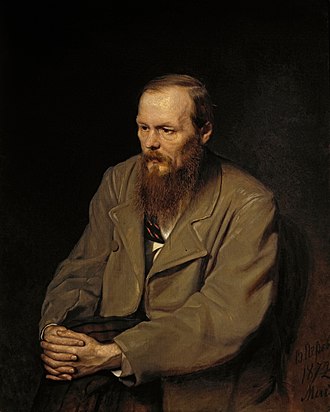
Fyodor_Dostoevsky
A Russian court sentences writer Fyodor Dostoyevsky to death for anti-government activities linked to a radical intellectual group; his sentence is later commuted to hard labor.
Russian novelist (1821–1881)
Fyodor Mikhailovich Dostoevsky was a Russian philosopher, novelist, short story writer, essayist and journalist. He is regarded as one of the greatest novelists in both Russian and world literature, and many of his works are considered highly influential masterpieces. Dostoevsky's literary works explore the human condition in the troubled political, social and spiritual atmospheres of 19th century Russia, and engage with a variety of philosophical and religious themes. His most acclaimed novels include Crime and Punishment (1866), The Idiot (1869), Demons (1872), The Adolescent (1875) and The Brothers Karamazov (1880). His Notes from Underground, a novella published in 1864, is considered one of the first works of existentialist literature.
1849
David_Livingstone
David Livingstone becomes the first European to see the Victoria Falls in what is now Zambia-Zimbabwe.
British colonialist and missionary
David Livingstone was a Scottish doctor, Congregationalist, pioneer Christian missionary with the London Missionary Society, and an explorer in Africa. Livingstone was married to Mary Moffat Livingstone, from the prominent 18th-century Moffat missionary family. Livingstone came to have a mythic status as a Protestant missionary martyr, working-class "rags-to-riches" inspirational story, scientific investigator and explorer, imperial reformer, anti-slavery crusader, and advocate of British commercial and colonial expansion. As a result, he became one of the most popular British heroes of the late 19th-century Victorian era.
1855
Siege_of_Lucknow
Second relief of Lucknow: Twenty-four Victoria Crosses are awarded, the most in a single day.
Siege fought during the Indian Rebellion of 1857
The siege of Lucknow was the prolonged defence of the British Residency within the city of Lucknow from rebel sepoys during the Indian Rebellion of 1857. After two successive relief attempts had reached the city, the defenders and civilians were evacuated from the Residency, which was then abandoned.
1857
Fisgard_Lighthouse_National_Historic_Site
Fisgard Lighthouse, built in the Colony of Vancouver Island, shines its first light, becoming the first permanent lighthouse in present-day British Columbia
Lighthouse
Fisgard Lighthouse National Historic Site, on Fisgard Island at the mouth of Esquimalt Harbour in Colwood, British Columbia, is the site of Fisgard Lighthouse, the first lighthouse on the west coast of Canada.
1860
American_Civil_War
American Civil War: In the Battle of Campbell's Station, Confederate troops unsuccessfully attack Union forces which allows General Ambrose Burnside to secure Knoxville, Tennessee.
1861–1865 conflict in the United States
The American Civil War was a civil war in the United States between the Union and the Confederacy, which was formed in 1861 by states that had seceded from the Union to preserve slavery in the United States. The South saw slavery as threatened because of the election of Abraham Lincoln and the growing abolitionist movement in the North. The war ended with Union victory, the dissolution of the Confederacy and the abolition of slavery, freeing four million African Americans.
1863
National_Rifle_Association
The National Rifle Association of America receives its charter from New York State.
American gun rights advocacy group
The National Rifle Association of America (NRA) is a gun rights advocacy group based in the United States. Founded in 1871 to advance rifle marksmanship, the modern NRA has become a prominent gun rights lobbying organization while continuing to teach firearm safety and competency. The organization also publishes several magazines and sponsors competitive marksmanship events. The group claimed nearly 5 million members as of December 2018, though that figure has not been independently confirmed.
1871
Métis
Canadian rebel leader of the Métis and "Father of Manitoba" Louis Riel is executed for treason.
Mixed Indigenous ethnic group of Canada and the US
The Métis are a mixed-ancestry Indigenous people whose historical homelands include Canada's three Prairie Provinces extending into parts of Ontario, British Columbia, the Northwest Territories and the northwest United States. They have a shared history and culture, deriving from specific mixed European and Indigenous ancestry, which became distinct through ethnogenesis by the mid-18th century, during the early years of the North American fur trade.
1885
John_Ambrose_Fleming
English engineer John Ambrose Fleming receives a patent for the thermionic valve (vacuum tube).
English electrical engineer and physicist (1849–1945)
Sir John Ambrose Fleming was an English electrical engineer and physicist. He is known for inventing the vacuum tube radio transmitter—with which the first transatlantic radio transmission was made—and establishing the right-hand rule used in physics.
1904
Indian_Territory
Indian Territory and Oklahoma Territory join to form Oklahoma, which is admitted as the 46th U.S.
state.
Indian Territory and the Indian Territories are terms that generally described an evolving land area set aside by the United States government for the relocation of Native Americans who held original Indian title to their land as an independent nation. The concept of an Indian territory was an outcome of the U.S. federal government's 18th- and 19th-century policy of Indian removal. After the American Civil War (1861–1865), the policy of the U.S. government was one of assimilation.
1907
Federal_Reserve_Bank
The Federal Reserve Bank of the United States officially opens.
American central banking institution
A Federal Reserve Bank is a regional bank of the Federal Reserve System, the central banking system of the United States. There are twelve in total, one for each of the twelve Federal Reserve Districts that were created by the Federal Reserve Act of 1913. The banks are jointly responsible for implementing the monetary policy set forth by the Federal Open Market Committee, and are divided as follows:
1914
Qantas
Qantas, Australia's national airline, is founded as Queensland and Northern Territory Aerial Services Limited.
National airline of Australia
Qantas Airways Limited, doing business as QANTAS or Qantas, is the flag carrier of Australia, and the largest airline by fleet size, international flights, and international destinations in Oceania. A founding member of the Oneworld airline alliance, it is the only airline in the world that flies to all seven continents, with it operating flights to Africa, Antarctica, Asia, Europe, North America, and South America from its hubs in Sydney, Perth, Melbourne, and Brisbane. It also flies to over 60 domestic destinations across Australia.
1920
Soviet_Union
The United States and the Soviet Union establish formal diplomatic relations.
Country in Eurasia from 1922 to 1991
The Soviet Union, officially the Union of Soviet Socialist Republics (USSR), was a transcontinental country that spanned much of Eurasia from its formation in 1922 until its dissolution in 1991. It was the world's third-most populous country, the largest by area, and bordered twelve other countries. A diverse multinational state, it was organized as a federal union of national republics, with the largest and most populous being the Russian Soviet Federative Socialist Republic (SFSR). The world's flagship communist state, it was governed by the Communist Party under Marxism–Leninism, through soviet councils. The Soviet economy was also centrally planned. Its capital and largest city was Moscow.
1933
LSD
LSD is first synthesized by Albert Hofmann from ergotamine at the Sandoz Laboratories in Basel.
Psychedelic drug
Lysergic acid diethylamide, commonly known as LSD and by the nicknames acid and Lucy, is a semisynthetic psychedelic drug derived from ergot, known for its potent psychological effects.
1938
World_War_II
World War II: In response to the leveling of Coventry by the German Luftwaffe two days before, the Royal Air Force bombs Hamburg.
Global conflict (1939–1945)
World War II, or the Second World War, was a global conflict between two coalitions: the Allies and the Axis powers. Nearly all of the world's countries participated, with many engaging in total war on an unprecedented scale. World War II was the deadliest conflict in history, causing the deaths of 60 to 75 million people, a majority of whom were civilians. Millions died as a result of massacres, starvation, disease, and genocides including the Holocaust. After the Allied victory, Germany, Austria, Japan, and Korea were occupied, and German and Japanese leaders were tried for war crimes.
1940
The_Holocaust
The Holocaust: In occupied Poland, the Nazis close off the Warsaw Ghetto from the outside world.
Genocide of European Jews by Nazi Germany
The Holocaust, known in Hebrew as the Shoah, was the genocide of European Jews during World War II. From 1941 to 1945, Nazi Germany and its collaborators systematically murdered around six million Jews across German-occupied Europe, approximately two-thirds of Europe's Jewish population. The murders were committed primarily through mass shootings across Eastern Europe and poison gas chambers in extermination camps, chiefly Auschwitz-Birkenau, Treblinka, Belzec, Sobibor, Chełmno and Majdanek death camps in occupied Poland. Concurrent Nazi persecutions killed millions of other non-Jewish civilians and prisoners of war (POWs); the term Holocaust is sometimes used to include the murder and persecution of non-Jewish groups, such as the Romani and Soviet POWs.
1940
George_Metesky
New York City's "Mad Bomber" George Metesky places his first bomb at a Manhattan office building used by Consolidated Edison.
American electrician, mechanic, and bomber (1903–1994)
George Peter Metesky, better known as the Mad Bomber, was an American electrician and mechanic who terrorized New York City for 16 years in the 1940s and 1950s with explosives that he planted in theaters, terminals, libraries and offices. Bombs were left in phone booths, storage lockers and restrooms in public buildings, including Grand Central Terminal, Pennsylvania Station, Radio City Music Hall, the New York Public Library, the Port Authority Bus Terminal and the RCA Building, and in the New York City Subway. Metesky also bombed movie theaters, where he cut into seat upholstery and slipped his explosive devices inside.
1940
Battle_of_Hürtgen_Forest
World War II: In support of the Battle of Hürtgen Forest, the town of Düren is destroyed by Allied aircraft.
Series of battles during World War II
The Battle of Hürtgen Forest was a series of battles fought from 19 September to 16 December 1944, between American and German forces on the Western Front during World War II, in the Hürtgen Forest, a 140 km2 (54 mi2) area about 5 km (3.1 mi) east of the Belgian–German border. Lasting 88 days, it was the longest battle on German ground during World War II and it is the second longest single battle the U.S. Army has ever fought after the three-month-long Battle of Bataan.
1944
Jussi_Awards
The Jussi Awards, the Finnish film award ceremony, is held for the first time at Restaurant Adlon in Helsinki.
Finnish film industry awards
The Jussi Awards are Finland's premier film industry prizes, awarded annually to recognize the achievements of directors, actors, and writers.
1944
UNESCO
UNESCO is founded.
Specialized agency of the United Nations
The United Nations Educational, Scientific and Cultural Organization is a specialized agency of the United Nations (UN) with the aim of promoting world peace and security through international cooperation in education, arts, sciences and culture. It has 194 member states and 12 associate members, as well as partners in the non-governmental, intergovernmental and private sector. Headquartered in Paris, France, UNESCO has 53 regional field offices and 199 national commissions.
1945
National_Airlines_Flight_967
National Airlines Flight 967 explodes in mid-air over the Gulf of Mexico, killing all 42 aboard.
1959 aviation accident
National Airlines Flight 967, registration N4891C, was a Douglas DC-7B aircraft that disappeared over the Gulf of Mexico en route from Tampa, Florida, to New Orleans, Louisiana, on November 16, 1959. All 42 on board were presumed killed in the incident.
1959
Aeroflot_Flight_315_(1959)
Aeroflot Flight 315 crashes on approach to Lviv Airport, killing all 40 people on board.
Aviation accident
Aeroflot Flight 315 was a regularly scheduled passenger flight operated by Aeroflot from Vnukovo International Airport in Moscow to Lviv Airport in Lviv, Ukraine. On 16 November 1959, the Antonov An-10 operating this flight crashed short of the airport runway while on final approach. All 32 passengers and eight crew members were killed.
1959
Venera_program
Venera program: The Soviet Union launches the Venera 3 space probe toward Venus, which will be the first spacecraft to reach the surface of another planet.
Soviet program that explored Venus with multiple probes
The Venera program was a series of space probes developed by the Soviet Union between 1961 and 1984 to gather information about the planet Venus. A total of eighteen probes were sent, including two related Vega probes.
1965
The_Temptations
The Temptations release their Greatest Hits album, which goes on to be the Billboard Year-End R&B album of 1967.
American rhythm and blues group
The Temptations are an American vocal group formed in Detroit, Michigan, in 1961 as The Elgins, known for their string of successful singles and albums with Motown from the 1960s to the mid-1970s. The group's work with producer Norman Whitfield, beginning with the Top 10 hit single "Cloud Nine" in October 1968, pioneered psychedelic soul, and was significant in the evolution of R&B and soul music. The group members were known for their choreography, distinct harmonies, and dress style. Having sold tens of millions of albums, the Temptations are among the most successful groups in popular music.
1966
Aeroflot_Flight_2230
Aeroflot Flight 2230 crashes near Koltsovo Airport, killing 107.
1967 aviation accident in Russia
Aeroflot Flight 2230 was a Soviet domestic passenger flight from Yekaterinburg to Tashkent. On 16 November 1967, the Ilyushin Il-18 aircraft serving the flight crashed after takeoff, killing all 107 people aboard. At the time, it was the deadliest aviation accident in the Russian SFSR and the worst accident involving the Il-18.
1967
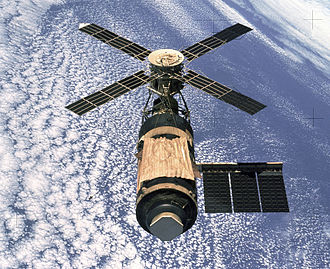
Skylab
Skylab program: NASA launches Skylab 4 with a crew of three astronauts from Cape Canaveral, Florida for an 84-day mission.
First space station launched and operated by NASA (1973–1979)
Skylab was the United States' first space station, launched by NASA, occupied for about 24 weeks between May 1973 and February 1974. It was operated by three trios of astronaut crews: Skylab 2, Skylab 3, and Skylab 4.
1973
Richard_Nixon
U.S.
president Richard Nixon signs the Trans-Alaska Pipeline Authorization Act into law, authorizing the construction of the Alaska Pipeline.
Richard Milhous Nixon was the 37th president of the United States, serving from 1969 until his resignation in 1974. A member of the Republican Party, he represented California in both houses of the United States Congress before serving as the 36th vice president under President Dwight D. Eisenhower from 1953 to 1961. His presidency saw the reduction of U.S. involvement in the Vietnam War, détente with the Soviet Union and China, the Apollo 11 Moon landing, and the establishment of the Environmental Protection Agency and Occupational Safety and Health Administration. Nixon's second term ended early when he became the only U.S. president to resign from office, as a result of the Watergate scandal.
1973
The Arecibo message is broadcast from Puerto Rico.
Radio message sent into space in 1974
The Arecibo message is an interstellar radio message carrying basic information about humanity and Earth that was sent to the globular cluster Messier 13 (M13) in 1974. It was meant as a demonstration of human technological achievement rather than a real attempt to enter into a conversation with extraterrestrials.
1974
Bucharest_Metro
The first line of Bucharest Metro (Line M1) is opened from Timpuri Noi to Semănătoarea in Bucharest, Romania.
Rapid transit system in Romania
The Bucharest Metro is an underground rapid transit system that serves Bucharest, the capital of Romania. It first opened for service on 16 November 1979. The network is run by Metrorex. One of two parts of the larger Bucharest public transport network, Metrorex had an annual ridership of 142,783,000 passengers during 2023, compared to over a billion annual passengers on Bucharest's STB transit system. In total, the Metrorex system is 80.1 kilometres (49.8 mi) long and has 64 stations.
1979
Aeroflot_Flight_3603
Aeroflot Flight 3603 crashes during landing at Norilsk Airport, killing 99.
1981 aviation accident
Aeroflot Flight 3603 was a Tupolev Tu-154 operating a scheduled domestic passenger flight from Krasnoyarsk to Noril'sk, both in the Soviet Union, that crashed while attempting to land on 17 November 1981. Of the 167 passengers and crew on board, 99 were killed in the accident.
1981
Supreme_Soviet
The Supreme Soviet of the Estonian Soviet Socialist Republic declares that Estonia is "sovereign" but stops short of declaring independence.
Legislatures of the constituent republics of the Soviet Union
The Supreme Soviet was the common name for the highest organs of state authority of the Soviet socialist republics (SSR) in the Union of Soviet Socialist Republics (USSR). These soviets were modeled after the Supreme Soviet of the USSR, established in 1938, and were nearly identical.
1988
1989_murders_of_Jesuits_in_El_Salvador
El Salvadoran army troops kill six Jesuit priests and two others at Jose Simeon Canas University.
Massacre of civilians by Salvadoran soldiers
During the Salvadoran Civil War, on 16 November 1989, Salvadoran Army soldiers killed six Jesuits and two women, the caretaker's wife and daughter, at their residence on the campus of Central American University in San Salvador, El Salvador. Polaroid photos of the Jesuits' bullet-riddled bodies were on display in the hallway outside the chapel, and a memorial rose garden was planted beside the chapel to commemorate the murders.
1989
Pop group Milli Vanilli are stripped of their Grammy Award because the duo did not sing at all on the Girl You Know It's True album.
Session musicians had provided all the vocals.
Pop music, or simply pop, is a genre of popular music that originated in its modern form during the mid-1950s in the United States and the United Kingdom. During the 1950s and 1960s, pop music encompassed rock and roll and the youth-oriented styles it influenced. Rock and pop music remained roughly synonymous until the late 1960s, after which pop became associated with music that was more commercial, ephemeral, and accessible.
1990
Hoxne_Hoard
The Hoxne Hoard is discovered by metal detectorist Eric Lawes in Hoxne, Suffolk.
Roman hoard found in England
The Hoxne Hoard is the largest hoard of late Roman silver and gold discovered in Britain, and the largest collection of gold and silver coins of the fourth and fifth centuries found anywhere within the former Roman Empire. It was found by Eric Lawes using a metal detector in the village of Hoxne in Suffolk, England, in 1992. The hoard consists of 14,865 Roman gold, silver, and bronze coins and approximately 200 items of silver tableware and gold jewellery. The objects are now in the British Museum in London, where the most important pieces and a selection of the rest are on permanent display. In 1993, the Treasure Valuation Committee valued the hoard at £1.75 million.
1992
China
After nearly 18 years of incarceration, China releases Wei Jingsheng, a pro-democracy dissident, from jail for medical reasons.
Country in East Asia
China, officially the People's Republic of China (PRC), is a country in East Asia. It is the world's second-most populous country after India, with a population exceeding 1.4 billion, across an area of 9.6 million square kilometers (3,700,000 sq mi), making it the third-largest country by area. It is divided into 33 province-level divisions, including two special administrative regions. Beijing is the capital, while Shanghai is the most populous city by urban area. Its geography features the vast Central Plain, major rivers such as the Yangtze and Yellow River, deserts, subtropical and temperate forests, plateaus, and mountain ranges such as the Himalayas.
1997
2002–2004_SARS_outbreak
The first cases of the 2002–2004 SARS outbreak are traced to Foshan, Guangdong Province, China.
Epidemic of severe acute respiratory syndrome originating in China
The 2002–2004 outbreak of SARS, caused by severe acute respiratory syndrome coronavirus, infected over 8,000 people from 30 countries and territories, and resulted in at least 774 deaths worldwide.
2002
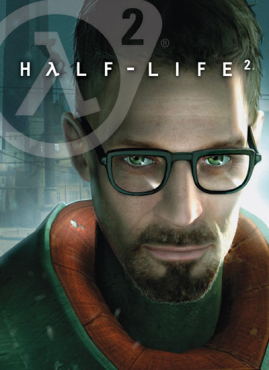
Half-Life_2
Half-Life 2 is released, a game winning 39 Game of the Year awards and being cited as one of the best games ever made.
2004 video game
Half-Life 2 is a 2004 first-person shooter (FPS) game developed and published by Valve Corporation. It was published for Windows on Valve's digital distribution service, Steam. Like the original Half-Life (1998), Half-Life 2 is played from a first-person perspective, combining combat, puzzles, and storytelling. It adds features such as vehicles and physics-based gameplay. The player controls Gordon Freeman, who joins a resistance effort to liberate Earth from the alien Combine empire.
2004
Australia_men's_national_soccer_team
Following a 31-year wait, Australia defeats Uruguay in a penalty shootout to qualify for the 2006 FIFA World Cup.
The Australia men's national soccer team represents Australia in international men's soccer. Officially nicknamed the Socceroos, the team is controlled by the governing body for soccer in Australia, Football Australia, which is affiliated with the Asian Football Confederation (AFC) and the regional ASEAN Football Federation (AFF).
2005
Space_Shuttle_program
Space Shuttle program: Space Shuttle Atlantis is launched on mission STS-129 to the International Space Station.
1972–2011 United States human spaceflight program
The Space Shuttle program was the fourth human spaceflight program carried out by the U.S. National Aeronautics and Space Administration (NASA), which accomplished routine transportation for Earth-to-orbit crew and cargo from 1981 to 2011. Its official program name was carried over from the 1969 plan for the Space Transportation System (STS) of reusable spacecraft. Only the shuttle and supporting rockets were funded for development; a proposed nuclear lunar shuttle in the plan was canceled in 1972. It flew 135 missions and carried 355 astronauts from 16 countries, many on multiple trips.
2009
Artemis_program
Artemis Program: NASA launches Artemis 1 on the first flight of the Space Launch System, the start of the program's future missions to the moon.
NASA-led lunar exploration program
The Artemis program is a Moon exploration program led by the United States' National Aeronautics and Space Administration (NASA), aimed at returning humans to the Moon for the first time since the Apollo program and building a permanent lunar base. It was formally established via Space Policy Directive-1 in 2017 by President Donald Trump.
2022

History runs on facts, and this project runs on coffee!

Your support is incredibly helpful and genuinely appreciated.

Support with a coffee ☕