October 6 in History

Eleftherios Venizelos is elected Prime Minister of Greece for the first of seven

1910 — Eleftherios Venizelos is elected Prime Minister of Greece for the first of seven times

October 6 spans 46 recorded events across recorded history, from 105 BC to 2025. Below is a curated digest of the most significant moments tied to this date.

By · Wikipedia

Historical Events 46 events 105 BC – 2025

More major events on October 6

The featured story and these ranked highlights form a quick summary. Every recorded event remains available in the chronology below.

  1. 1898 Phi Mu Alpha Sinfonia, the largest American music fraternity, is founded at the New England Conservatory of Music. Source
  2. 1884 The Naval War College of the United States is founded in Rhode Island. Source
  3. 1995 The first planet orbiting another sun, 51 Pegasi b, is discovered. Source

Did you know

In 1910, Eleftherios Venizelos is elected Prime Minister of Greece for the first of seven times. This featured entry focuses on the immediate decision and its direct historical impact.

Did you know

The prime minister of the Hellenic Republic, usually referred to as the prime minister of Greece, is the head of government of the Hellenic Republic and the leader of the Greek Cabinet. This helps explain why the event mattered beyond the initial announcement.

Did you know

In 1910, Eleftherios Venizelos is elected Prime Minister of Greece for the first of seven times had consequences that extended beyond the first headline. The key context is the institutions involved, the policy shift, and how the public response evolved afterward.

Did you know

In 1910, Eleftherios Venizelos is elected Prime Minister of Greece for the first of seven times had consequences that extended beyond the first headline. The key context is the institutions involved, the policy shift, and how the public response evolved afterward.

Did you know

In 1910, Eleftherios Venizelos is elected Prime Minister of Greece for the first of seven times had consequences that extended beyond the first headline. The key context is the institutions involved, the policy shift, and how the public response evolved afterward.


Cimbrian_War
Cimbrian War: Defeat at the Battle of Arausio of the Roman army of the mid-Republic
Conflict between Rome and Germanic & Celtic tribes (113–101 BCE)
The Cimbrian or Cimbric War was fought between the Roman Republic and the Germanic and Celtic tribes of the Cimbri and the Teutons, Ambrones and Tigurini, who migrated from the Jutland peninsula into Roman-controlled territory, and clashed with Rome and her allies. The Cimbrian War was the first time since the Second Punic War that Italia and Rome itself had been seriously threatened. It was the first of many confrontations with Germanic tribes in Roman history that would last for centuries.
-105
Third_Mithridatic_War
Third Mithridatic War: The military of the Roman Republic subdues Armenia.
War between Rome and Mithridates, 73–63 BC
The Third Mithridatic War, the last and longest of the three Mithridatic Wars, was fought between Mithridates VI of Pontus and the Roman Republic. Both sides were joined by a great number of allies, dragging the entire east of the Mediterranean and large parts of Asia into the war. The conflict ended in defeat for Mithridates; it ended the Pontic Kingdom and the Seleucid Empire, and also resulted in the Kingdom of Armenia becoming an allied client state of Rome.
-69
20s
Rebels decapitate Wang Mang, only Emperor of the Xin Dynasty, after his capital was sacked during a peasant rebellion.
Third decade of the first century AD
The 20s decade ran from January 1, AD 20, to December 31, AD 29.
23
AD_404
Byzantine Empress Eudoxia dies from the miscarriage of her seventh pregnancy.
Calendar year
Year 404 (CDIV) was a leap year starting on Friday of the Julian calendar. At the time, it was known as the Year of the Consulship of Honorius and Aristaenetus. The denomination 404 for this year has been used since the early medieval period, when the Anno Domini calendar era became the prevalent method in Europe for naming years.
404
Transition_from_Sui_to_Tang
Transition from Sui to Tang: Wang Shichong decisively defeats Li Mi at the Battle of Yanshi.
Period in Chinese history from 613 to 628 AD
The transition from Sui to Tang (613–628), or simply the Sui-Tang transition, was the period of Chinese history between the end of the Sui dynasty and the start of the Tang dynasty. The Sui dynasty's territories were carved into a handful of short-lived states by its officials, generals, and agrarian rebel leaders. A process of elimination and annexation followed that ultimately culminated in the consolidation of the Tang dynasty by the former Sui general Li Yuan. Near the end of the Sui, Li Yuan installed the puppet child emperor Yang You. Li later executed Yang and proclaimed himself Emperor Gaozu of the new Tang dynasty.
618
Hernando_de_Soto
Spain's DeSoto expedition takes over the Apalachee capital of Anhaica for their winter quarters.
Spanish explorer and conquistador (c.1479–1542)
Hernando de Soto was a Spanish explorer and conquistador, who was involved in expeditions in Nicaragua and the Yucatan Peninsula. He played an important role in Francisco Pizarro's conquest of the Inca Empire in Peru, but is best known for leading the first European expedition deep into the territory of the modern-day United States. He is the first European documented as having crossed the Mississippi River.
1539
Euridice_(Peri)
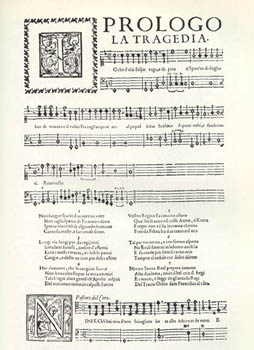
Euridice, the earliest surviving opera, receives its première performance, beginning the Baroque period.
Earliest surviving opera
Euridice is an opera by Jacopo Peri, with additional music by Giulio Caccini. It is the earliest surviving opera, Peri's earlier Dafne being lost. The libretto by Ottavio Rinuccini is based on books X and XI of Ovid's Metamorphoses which recount the story of the legendary musician Orpheus and his wife Euridice.
1600
Germantown,_Philadelphia
Immigrant families found Germantown, Pennsylvania in the first major immigration of German people to America.
Neighborhood of Philadelphia in Pennsylvania, United States
Germantown is an area in Northwest Philadelphia, Pennsylvania, United States. Founded by Palatine, Quaker, and Mennonite families in 1683 as an independent borough, it was absorbed into Philadelphia in 1854. The area, which is about six miles northwest from the city center, now consists of two neighborhoods: Germantown and East Germantown.
1683
Seven_Years'_War
Seven Years' War: The British capture Manila from Spain and occupy it.
Global war among European powers (1756–1763)
The Seven Years' War, 1756 to 1763, was a global war fought by numerous great powers, primarily in Europe, with significant subsidiary campaigns in North America and the Indian subcontinent. The primary warring states were Great Britain and Prussia fighting against France and Austria, with other countries joining these coalitions: Portugal, Spain, Sweden, and Russia, plus Saxony and many other minor states of the Holy Roman Empire. Related conflicts include the Third Silesian War, French and Indian War, Third Carnatic War, Anglo-Spanish War (1762–1763), and Spanish–Portuguese War.
1762
American_Revolutionary_War
American Revolutionary War: British forces capture Forts Clinton and Montgomery on the Hudson River.
1775–1783 conflict in North America
The American Revolutionary War, also known as the Revolutionary War or American War of Independence or simply the American Revolution, was the armed conflict that comprised the final eight years of the broader American Revolution, in which American Patriot forces organized as the Continental Army and commanded by George Washington defeated the British Army. The conflict was fought in North America, the Caribbean, and the Atlantic Ocean. The war's outcome seemed uncertain for most of the war, but Washington and the Continental Army's decisive victory in the Siege of Yorktown in 1781 led King George III and the Kingdom of Great Britain to negotiate an end to the war. In 1783, in the Treaty of Paris, the British monarchy acknowledged the independence of the Thirteen Colonies, leading to the establishment of the United States as an independent and sovereign nation.
1777
French_Revolution
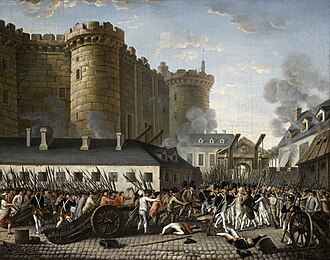
French Revolution: King Louis XVI is forced to change his residence from Versailles to the Tuileries Palace.
1789–1799 sociopolitical change in France
The French Revolution was a period of political and societal change in France that began with the Estates General of 1789 and ended with the Coup of 18 Brumaire on 9 November 1799. Many of the revolution's ideas are considered fundamental principles of liberal democracy, and its values remain central to modern French political discourse. It was caused by a combination of social, political, and economic factors which the existing regime proved unable to manage.
1789
Raahe
A large fire destroys a third of all the buildings in the town of Raahe in the Grand Duchy of Finland.
Town in North Ostrobothnia, Finland
Raahe is a town in Finland, located on the western coast of the country. Raahe is situated in the North Ostrobothnia region, along the Gulf of Bothnia. The population of Raahe is approximately 23,000, while the sub-region has a population of approximately 31,000. It is the 43rd most populous municipality in Finland.
1810
The_13_Martyrs_of_Arad
The execution of the 13 Martyrs of Arad after the Hungarian war of independence.
Hungarian generals executed in 1849
The Thirteen Martyrs of Arad were the thirteen Hungarian rebel generals who were executed by the Austrian Empire on 6 October 1849 in the city of Arad, then part of the Kingdom of Hungary, after the Hungarian Revolution (1848–1849). The execution was ordered by the Austrian general Julius Jacob von Haynau.
1849
Great_fire_of_Newcastle_and_Gateshead
In England the Great fire of Newcastle and Gateshead leads to 53 deaths and hundreds injured.
1854 series of fires and an explosion in Tyne and Wear, England
The great fire of Gateshead and Newcastle was a series of events starting on Friday 6 October 1854, in which a substantial amount of property in two North East England towns was destroyed in a series of fires and an explosion which killed 53 and injured hundreds. There is only one building still extant on the Newcastle Quayside which predated the fire.
1854
Naval_War_College
The Naval War College of the United States is founded in Rhode Island.
US staff college in Newport, Rhode Island
The Naval War College is the staff college and "Home of Thought" for the United States Navy at Naval Station Newport in Newport, Rhode Island. The NWC educates and develops leaders, supports defining the future Navy and associated roles and missions, supports combat readiness, and strengthens global maritime partnerships.
1884
Phi_Mu_Alpha_Sinfonia
Phi Mu Alpha Sinfonia, the largest American music fraternity, is founded at the New England Conservatory of Music.
American collegiate music fraternity
Phi Mu Alpha Sinfonia (ΦΜΑ) is an American collegiate social fraternity with an emphasis in music. It was founded as the Sinfonia Club at the New England Conservatory of Music on October 6, 1898, by Ossian Everett Mills.
1898
High_Court_of_Australia
The High Court of Australia sits for the first time.
The High Court of Australia is the apex court of the Australian legal system. It exercises original and appellate jurisdiction on matters specified in the Constitution of Australia and supplementary legislation.
1903
Bosnian_Crisis
The Bosnian crisis erupts when Austria-Hungary formally annexes Bosnia and Herzegovina.
Crisis triggered by Austria-Hungary's annexation of Bosnia and Herzegovina in 1908
The Bosnian Crisis, also known as the Annexation Crisis or the First Balkan Crisis, erupted on 5 October 1908 when Austria-Hungary announced the annexation of Bosnia and Herzegovina, territories formerly within the sovereignty of the Ottoman Empire but under Austro-Hungarian administration since 1878.
1908
World_War_I
World War I: Combined Austro-Hungarian and German Central Powers, reinforced by the recently joined Bulgaria launched a new offensive against Serbia under command of August von Mackensen.
Global conflict from 1914 to 1918
World War I, or the First World War, also known as the Great War, was a global conflict between two coalitions: the Allies and the Central Powers. Major theatres of war included Europe and the Middle East, and well as parts of Africa and the Asia-Pacific. One of the deadliest conflicts in history, World War I resulted in an estimated 15 to 22 million deaths, including in mass war crimes against civilians and genocides. The conflict saw important developments in weaponry, including the first large-scale use of machine guns, artillery, aircraft, chemical weapons, and tanks, and was a major factor in the deadly Spanish flu pandemic.
1915
Allies_of_World_War_I
World War I: Entente forces land in Thessaloniki, to open the Macedonian front against the Central Powers.
Military coalition in World War I
The Allies or the Entente was an international military coalition of countries led by the French Republic, the United Kingdom, the Russian Empire, the United States, the Kingdom of Italy, and the Empire of Japan against the Central Powers of the German Empire, Austria-Hungary, the Ottoman Empire, and the Tsardom of Bulgaria in World War I (1914–1918).
1915
Ukrainian_War_of_Independence
Ukrainian War of Independence: The Starobilsk agreement is signed by representatives of the Ukrainian Soviet Socialist Republic and the Makhnovshchina.
Eastern European military conflict (1917–1921)
The Ukrainian War of Independence, also referred to as the Ukrainian–Soviet War in Ukraine, lasted from March 1917 to November 1921 and was part of the wider Russian Civil War. It saw the establishment and development of an independent Ukrainian republic, most of which was absorbed into the Ukrainian Soviet Socialist Republic between 1919 and 1920. The Ukrainian Soviet Socialist Republic was one of the constituent republics of the Soviet Union between 1922 and 1991.
1920
Turkish_National_Movement
The Turkish National Movement enters Constantinople.
Revolutionary post-WWI political movement which founded the Republic of Turkey
The Turkish National Movement, also known as the Anatolian Movement, the Nationalist Movement, and the Kemalists, included political and military activities of the Turkish revolutionaries that resulted in the creation and shaping of the modern Republic of Turkey, as a consequence of the defeat of the Ottoman Empire in World War I and the subsequent occupation of Constantinople and partitioning of the Ottoman Empire by the Allies under the terms of the Armistice of Mudros. The Turkish revolutionaries rebelled against this partitioning and against the Treaty of Sèvres, signed in 1920 by the Ottoman government. Most revolutionaries were former members of the Committee of Union and Progress.
1923
The_Jazz_Singer
Opening of The Jazz Singer, the first prominent "talkie" movie.
1927 film by Alan Crosland
The Jazz Singer is a 1927 American part-talkie musical drama film directed by Alan Crosland and produced by Warner Bros. Pictures. It is the first feature-length motion picture with both synchronized recorded music and lip-synchronous singing and speech. Its release heralded the commercial ascendance of sound films and effectively marked the end of the silent film era with the Vitaphone sound-on-disc system, featuring six songs performed by Al Jolson. Based on the 1925 play of the same title by Samson Raphaelson, the plot was adapted from his short story "The Day of Atonement".
1927
Events_of_6_October
Revolution of 1934: The President of the autonomous government of Catalonia, Lluís Companys, proclaims the Catalan State with the support of the Worker's Alliance.
1934 general strike, armed insurgency, and declaration of a Catalan state
The events of 6 October were a general strike, armed insurgency and declaration of a Catalan State in Catalonia during the Revolution of 1934 on 6 October 1934.
1934
World_War_II
World War II: The Battle of Kock is the final combat of the September Campaign in Poland.
Global conflict (1939–1945)
World War II, or the Second World War, was a global conflict between two coalitions: the Allies and the Axis powers. Nearly all of the world's countries participated. World War II was the deadliest conflict in history, causing the death of 60 to 75 million people. Millions died as a result of massacres, starvation, disease, and genocides, including the Holocaust. After the Allied victory, Germany, Austria, Japan, and Korea were occupied, and German and Japanese leaders were tried for war crimes.
1939
Actions_along_the_Matanikau
World War II: American troops force the Japanese from their positions east of the Matanikau River during the Battle of Guadalcanal.
Battles during the Guadalcanal campaign in WWII
The Actions along the Matanikau—sometimes referred to as the Second and Third Battles of the Matanikau—were two separate but related engagements between the United States and Imperial Japanese naval and ground forces in the Pacific theater of World War II. The actions occurred around the Matanikau River on Guadalcanal Island in the southwestern Pacific during the Guadalcanal campaign. These particular engagements—the first taking place between 23 and 27 September, and the second between 6 and 9 October—were two of the largest and most significant of the Matanikau actions.
1942
World War II: Thirteen civilians are burnt alive by a paramilitary group in Crete during the Nazi occupation of Greece.
1943 atrocity by Nazi forces in Crete, Axis-occupied Greece
The Burnings of Kali Sykia is one of many atrocities perpetrated in Greece by Fritz Schubert and his people during the Nazi occupation of Greece in World War II. On October 6, 1943, 13 individuals were killed by being burned alive in the mountainous village of Kali Sykia, in Rethymno, Crete.
1943
1st_Czechoslovak_Army_Corps_in_the_Soviet_Union
World War II: Units of the 1st Czechoslovak Army Corps enter Czechoslovakia during the Battle of the Dukla Pass.
Military unit
The 1st Czechoslovak Army Corps, also known as Svoboda's Army, was a military formation of the Czechoslovak Army in exile fighting on the Eastern Front alongside the Soviet Red Army in World War II.
1944
Operation_Badr_(1973)
Egypt and Syria launch coordinated attacks against Israel, beginning the Yom Kippur War.
Egyptian military operation against Israel
Operation Badr, also known as Plan Badr, was an Egyptian military offensive and operation across the Suez Canal that destroyed the Bar-Lev Line, a chain of Israeli fortifications along the frontline of the Israeli-occupied Sinai Peninsula, on 6 October 1973. It was launched in conjunction with a Syrian military offensive against the Israeli-occupied Golan Heights, triggering the Yom Kippur War. During the War of Attrition, which preceded Operation Badr, both Egypt and Syria had been seeking to recover the territories that Israel had captured from them during the 1967 Arab–Israeli War.
1973
Cubana_de_Aviación_Flight_455
Cubana de Aviación Flight 455 is destroyed by two bombs, placed on board by an anti-Castro militant group.
1976 airliner bombing of a Cubana passenger flight
Cubana de Aviación Flight 455 was a domestic Cuban flight from Barbados to Jamaica that was brought down on 6 October 1976 by a terrorist bomb attack. All 73 people on board the Douglas DC-8 aircraft were killed after two time bombs went off and the plane crashed into the sea. The crash killed every member of the Cuban national fencing team.
1976
Hua_Guofeng
Premier Hua Guofeng arrests the Gang of Four, ending the Cultural Revolution in China.
Leader of China from 1976 to 1978
Hua Guofeng was a Chinese politician who served as chairman of the Chinese Communist Party and the premier of China. As the successor of Mao Zedong, Hua held the top offices of the government, party, and the military after the deaths of Mao and Premier Zhou Enlai, but was gradually forced out of power between December 1978 and June 1981, and subsequently retreated from the political limelight, though still remaining a member of the Central Committee until 2002.
1976
6_October_1976_massacre
Dozens are killed by Thai police and right-wing paramilitaries in the Thammasat University massacre; afterwards, the Seni Pramoj government is toppled in a military coup led by Sangad Chaloryu.
Killings of student protestors in Thailand
The 6 October 1976 massacre, also known as the 6 October event in Thailand, was a violent crackdown by Thai police and lynching by right-wing paramilitaries and bystanders against leftist protesters who had occupied Bangkok's Thammasat University and the adjacent Sanam Luang, on 6 October 1976. Prior to the massacre, thousands of leftists, including students, workers and others, had been holding ongoing demonstrations against the return of exiled former Prime Minister Thanom Kittikachorn to Thailand since mid-September. Official reports state that 46 were killed and 167 were wounded, while unofficial reports state that more than 100 demonstrators were killed. In the "Documentation of Oct 6" project, historian Thongchai Winichakul argued that the official death toll should be 45, since one demonstrator died in jail after the incident.
1976
Mikoyan_MiG-29
The first prototype of the Mikoyan MiG-29, designated 9-01, makes its maiden flight.
Soviet twin-engine jet fighter aircraft
The Mikoyan MiG-29 is a twin-engine fighter aircraft designed in the Soviet Union. Developed by the Mikoyan design bureau as an air superiority fighter during the 1970s, the MiG-29, along with the larger Sukhoi Su-27, was developed to counter U.S. fighters such as the McDonnell Douglas F-15 Eagle and the General Dynamics F-16 Fighting Falcon. The MiG-29 entered service with the Soviet Air Forces in 1983.
1977
Pope_John_Paul_II
Pope John Paul II becomes the first pontiff to visit the White House.
Head of the Catholic Church from 1978 to 2005
Pope John Paul II was the head of the Catholic Church and sovereign of Vatican City from 16 October 1978 until his death in 2005. He was the first non-Italian pope since Adrian VI in the 16th century, as well as the third-longest-serving pope in history, after St. Peter and Pius IX. In addition to this, he was an important philosopher and theologian of the 20th century.
1979
Anwar_Sadat
Egyptian President Anwar Sadat is murdered by Islamic extremists.
President of Egypt from 1970 to 1981
Muhammad Anwar el-Sadat was an Egyptian politician and military officer who served as the 3rd president of Egypt, from 15 October 1970 until his assassination in 1981. Sadat was a senior member of the Free Officers who overthrew King Farouk I in the Egyptian Revolution of 1952, and a close confidant of President Gamal Abdel Nasser, under whom he served as the vice president twice and whom he succeeded as president in 1970. He led Egypt in the October war of 1973. In 1978, Sadat and Menachem Begin, Prime Minister of Israel, signed a peace treaty in cooperation with United States President Jimmy Carter, for which they were recognized with the Nobel Peace Prize.
1981
NLM_CityHopper_Flight_431
NLM CityHopper Flight 431 crashes in Moerdijk after taking off from Rotterdam The Hague Airport in the Netherlands, killing all 17 people on board.
1981 aviation accident
NLM CityHopper Flight 431 was a flight by a Fokker F-28-4000, registration PH-CHI, that was operating an international scheduled Rotterdam–Eindhoven–Hamburg passenger service. On 6 October 1981, the aircraft encountered a tornado on the first leg, minutes after taking off from Rotterdam Airport, and crashed 15 miles (24 km) south-southeast of Rotterdam. All 17 occupants of the aircraft – 13 passengers and 4 crew members– died in the accident.
1981
Murder_of_Keith_Blakelock
Police constable Keith Blakelock is murdered as riots erupt in the Broadwater Farm suburb of London.
1985 murder in England
Keith Henry Blakelock QGM was a British police officer who served as a London Metropolitan Police constable. He was murdered on 6 October 1985 during the Broadwater Farm riot in Tottenham. The riot broke out after Cynthia Jarrett died of heart failure during a police search of her home, and took place against a backdrop of unrest in several English cities and a breakdown of relations between the police and some people in the black community.
1985
Fiji
Fiji becomes a republic.
Country in Oceania
Fiji, officially the Republic of Fiji, is an archipelagic country in Melanesia, part of Oceania in the South Pacific Ocean. It lies about 1,100 nautical miles north-northeast of New Zealand. Fiji consists of an archipelago of more than 330 islands—of which about 110 are permanently inhabited—and more than 500 islets, amounting to a total land area of about 18,300 square kilometres (7,100 sq mi). The most outlying island group is Ono-i-Lau. About 87% of the total population live on the two major islands, Viti Levu and Vanua Levu. About three-quarters of Fijians live on Viti Levu's coasts, either in the capital city of Suva, or in smaller urban centres such as Nadi or Lautoka. The interior of Viti Levu is sparsely inhabited because of its terrain.
1987
Space_Shuttle_Discovery
Space Shuttle Discovery is launched on STS-41, and deploys the Ulysses space probe to study the Sun's polar regions.
Space Shuttle orbiter (1984–2011)
Space Shuttle Discovery is a retired American Space Shuttle orbiter. The spaceplane was one of the orbiters from NASA's Space Shuttle program and the third of five fully operational orbiters to be built. Its first mission, STS-41-D, flew from August 30 to September 5, 1984. Over 27 years of service it launched and landed 39 times, aggregating more spaceflights than any other spacecraft as of December 2024. The Space Shuttle launch vehicle had three main components: the Space Shuttle orbiter, a single-use central fuel tank, and two reusable solid rocket boosters. Nearly 25,000 heat-resistant tiles cover the orbiter to protect it from high temperatures on re-entry.
1990
51_Pegasi_b
The first planet orbiting another sun, 51 Pegasi b, is discovered.
Exoplanet orbiting a main-sequence star
51 Pegasi b, officially named Dimidium, is an extrasolar planet approximately 50 light-years away in the Pegasus constellation. Dimidium was the first exoplanet to be discovered orbiting a main-sequence star, the Sun-like 51 Pegasi — a major astronomical discovery. It is the prototype for a class of planets called hot Jupiters.
1995
Jason_Lewis_(adventurer)
Jason Lewis completes the first human-powered circumnavigation of the Earth.
English author and sustainability advocate
Jason Lewis is an English author, explorer and sustainability campaigner credited with being the first person to circumnavigate the globe by human power. He is also the first person to cross North America on inline skates (1996), and the first to cross the Pacific Ocean by pedal power (2000). Together with Stevie Smith, Lewis completed the first crossing of the Atlantic Ocean from mainland Europe to North America by human power (1995).
2007
Instagram
Instagram, a mainstream photo-sharing application, is founded.
Social media platform owned by Meta
Instagram is an American photo and short-form video sharing social networking service owned by Meta Platforms. It allows users to upload media that can be edited with filters, be organized by hashtags, and be associated with a location via geographical tagging. Posts can be shared publicly or with preapproved followers. Users can browse other users' content by tags and locations, view trending content, like photos, and follow other users to add their content to a personal feed. A Meta-operated image-centric social media platform, it is available on iOS, Android, Windows, and the Web. Users can take photos and edit them using built-in filters and other tools, then share them on other social media platforms like Facebook. It supports 33 languages including English, Hindi, Spanish, French, Japanese, and Korean.
2010
United_States_Senate
The United States Senate confirms Brett Kavanaugh as a Supreme Court Associate Justice, ending a contentious confirmation process.
Upper house of the US Congress
The United States Senate is a chamber of the bicameral United States Congress; it is the upper house, and the U.S. House of Representatives is the lower house. Together, the Senate and House have the authority under Article One of the Constitution to make and pass or defeat federal legislation.
2018
Annie_Ernaux
Annie Ernaux is awarded the Nobel Prize in Literature.
French writer (born 1940)
Annie Thérèse Blanche Ernaux is a French writer who was awarded the 2022 Nobel Prize in Literature "for the courage and clinical acuity with which she uncovers the roots, estrangements, and collective restraints of personal memory". Her literary work, mostly autobiographical, maintains close links with sociology.
2022
2025_Alberta_teachers'_strike
The 2025 Alberta teachers' strike begins, leaving approximately 51,000 teachers off-work, impacting about 730,000 Albertan students.
Public education labour dispute
The 2025 Alberta teachers' strike was a public education teachers' strike and labour dispute that took place across Alberta, Canada, and affected the province's education system, resulting in a suspension of classes from October 6, 2025, to October 29, 2025. It was ended after the Notwithstanding Clause was invoked.
2025

History runs on facts, and this project runs on coffee!

Your support is incredibly helpful and genuinely appreciated.

Support with a coffee ☕