September 28 in History

American Revolution: Samuel Huntington is elected President of the Continental C

1779 — American Revolution: Samuel Huntington is elected President of the Continental Congress, succeeding John Jay

September 28 spans 58 recorded events across recorded history, from 48 BC to 2023. Below is a curated digest of the most significant moments tied to this date.

By · Wikipedia

Historical Events 58 events 48 BC – 2023

More major events on September 28

The featured story and these ranked highlights form a quick summary. Every recorded event remains available in the chronology below.

  1. 1871 The Brazilian Parliament passes a law that frees all children thereafter born to slaves, and all government-owned slaves. Source
  2. 1821 The Declaration of Independence of the Mexican Empire is drafted. It will be made public on 13 October. Source
  3. 2008 Falcon 1 becomes the first privately developed liquid-fuel ground-launched vehicle to put a payload into orbit by the RatSat mission. Source

Did you know

The American Revolution lasted from 1765 to 1789 and resulted in the creation of the United States.

Did you know

The Continental Army was established by the Second Continental Congress in 1775 with George Washington as its commander-in-chief.

Did you know

The Declaration of Independence was adopted by the Continental Congress on July 4, 1776, following the Lee Resolution on July 2nd.

Did you know

The Treaty of Paris, signed on September 3, 1783, formally ended the American Revolutionary War and acknowledged American sovereignty.

Did you know

The Constitution of the United States took effect in 1789, followed by the ratification of the Bill of Rights in 1791.


Pompey
Pompey disembarks at Pelusium upon arriving in Egypt, whereupon he is assassinated by order of King Ptolemy XIII.
Roman general and statesman (106–48 BC)
Gnaeus Pompeius Magnus, known in English as Pompey or Pompey the Great, was a Roman general and statesman who was prominent in the final decades of the Roman Republic. As a young man, he was a partisan and protégé of the dictator Sulla, after whose death he achieved significant military and political success.
-48
Pope_Pontian
Pope Pontian resigns.
He is exiled to the mines of Sardinia, along with Hippolytus of Rome.
Pope Pontian was the bishop of Rome from 21 July 230 to 28 September 235. In 235, during the persecution of Christians in the reign of the Emperor Maximinus Thrax, Pontian was arrested and sent to the island of Sardinia.
235
Constantius II defeats the usurper Magnentius.
Part of the Roman civil war of 350–353
The Battle of Mursa was fought on 28 September 351 between the eastern Roman armies led by the Emperor Constantius II and the western forces supporting the usurper Magnentius. It took place at Mursa, near the Via Militaris in the province of Pannonia. The battle, one of the bloodiest in Roman history, was a pyrrhic victory for Constantius.
351
AD_365
Roman usurper Procopius bribes two legions passing by Constantinople, and proclaims himself emperor.
Calendar year
Year 365 (CCCLXV) was a common year starting on Saturday of the Julian calendar. At the time, it was known in the West as the Year of the Consulship of Augustus and Valens. The denomination 365 for this year has been used since the early medieval period, when the Anno Domini calendar era became the prevalent method in Europe for naming years.
365
Wenceslaus_I,_Duke_of_Bohemia
Duke Wenceslaus I of Bohemia is murdered by a group of nobles led by his brother Boleslaus I, who succeeds him.
Duke of Bohemia from 921 to 935
Wenceslaus I, Wenceslas I or Václav the Good was the Prince (kníže) of Bohemia from 921 until his death, probably in 935. According to the legend, he was assassinated by his younger brother, Boleslaus the Cruel.
935
Boleslaus_II,_Duke_of_Bohemia
Boleslaus II, Duke of Bohemia, kills most members of the rival Slavník dynasty.
Duke of Bohemia from 972 to 999
Boleslaus II the Pious, a member of the Přemyslid dynasty, was Duke of Bohemia from 972 until his death in 999.
995
William_the_Conqueror
William the Conqueror lands in England, beginning the Norman conquest.
King of England from 1066 to 1087
William the Conqueror, sometimes called William the Bastard, was the first Norman king of England, reigning from 1066 until his death. A descendant of Rollo, he was Duke of Normandy from 1035 onward. By 1060, following a long struggle, his hold on Normandy was secure. In 1066, following the death of Edward the Confessor, William invaded England, leading a Franco-Norman army to victory over the Anglo-Saxon forces of Harold Godwinson at the Battle of Hastings. He suppressed subsequent English revolts in what has become known as the Norman Conquest. The rest of his life was marked by struggles to consolidate his hold over England and his continental lands, and by difficulties with his eldest son, Robert Curthose.
1066
Henry_I_of_England
King Henry I of England defeats his brother Robert Curthose at the Battle of Tinchebray.
King of England from 1100 to 1135
Henry I, also known as Henry Beauclerc, was King of England from 1100 to his death in 1135. He was the fourth son of William the Conqueror and was educated in Latin and the liberal arts. On William's death in 1087, Henry's elder brothers Robert Curthose and William Rufus inherited Normandy and England, respectively, thereby leaving Henry landless. He subsequently purchased the County of Cotentin in western Normandy from Robert, but his brothers deposed him in 1091. He gradually rebuilt his power base in the Cotentin and allied himself with William Rufus against Robert.
1106
Gertrude_of_Merania
Queen consort Gertrude of Merania is assassinated by a group of Hungarian lords.
Queen consort of Hungary
Gertrude of Merania was Queen of Hungary as the first wife of Andrew II from 1205 until her assassination. She was regent during her husband's absence.
1213
James_I_of_Aragon
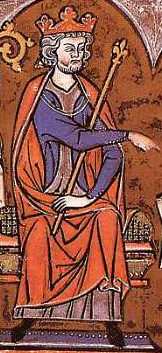
King James I of Aragon conquers Valencia from the Moors.
Shortly thereafter, he proclaims himself king of Valencia.
James I the Conqueror was King of Aragon, Count of Barcelona, and Lord of Montpellier from 1213 to 1276; King of Majorca from 1231 to 1276; and King of Valencia from 1238 to 1276. His long reign of 62 years is not only the longest of any Iberian monarch, but one of the longest monarchical reigns in history, ahead of Hirohito of Japan but remaining behind Elizabeth II of Britain, Queen Victoria of Britain, Ferdinand I of the Two Sicilies, Bhumibol Adulyadej of Thailand, and King Louis XIV of France.
1238
Battle_of_Mühldorf
Louis IV, Holy Roman Emperor, defeats Frederick I of Austria in the Battle of Mühldorf.
1322 battle between the duchies of Austria and Bavaria
The Battle of Mühldorf was fought near Mühldorf am Inn on September 28, 1322 between the Duchy of (Upper) Bavaria and the Archduchy of Austria. The Bavarians were led by German King Louis of Wittelsbach, while the Austrians were under the command of his cousin, Anti-king Frederick of Habsburg.
1322
Battle_of_Preveza
Ottoman–Venetian War: The Ottoman Navy scores a decisive victory over a Holy League fleet in the Battle of Preveza.
1538 battle of the Third Ottoman–Venetian War
The Battle of Preveza was a naval engagement that occurred on 28 September 1538 near Preveza in the Ionian Sea in northwest Greece, in the same area as the Battle of Actium in 31 BC. The battle was between an Ottoman fleet, led by Kapudan Pasha Hayreddin Barbarossa, and a Holy League of Venetian and Hispano-Imperial composition, led by Genoese admiral Andrea Doria. It was part of both the Ottoman–Habsburg wars and the Ottoman Venetian War of 1537-1547. It ended with the Holy League defeated by the Ottomans despite its enormous advantage in numbers and tonnage.
1538
Juan_Rodríguez_Cabrillo
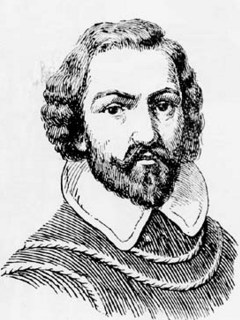
Juan Rodríguez Cabrillo of Portugal arrives at what is now San Diego, California.
He is the first European in California.
Juan Rodríguez Cabrillo was a Portuguese maritime explorer best known for investigations of the west coast of North America, undertaken on behalf of the Spanish Empire. He was the first European to explore present-day Alta California, navigating along the coast of California in 1542–1543 on his voyage from New Spain.
1542
Siege_of_Yorktown
American Revolution: French and American forces backed by a French fleet begin the siege of Yorktown.
1781 siege of the American Revolutionary War
The Siege of Yorktown, also known as the Battle of Yorktown and the surrender at Yorktown, took place in 1781 and was the final major land engagement of the American Revolutionary War. It was won decisively by the Continental Army, led by George Washington, with support from the Marquis de Lafayette and French Army troops, led by Comte de Rochambeau, and a French Navy force commanded by the Comte de Grasse, defeating the British Army commanded by British Lieutenant General Charles Cornwallis.
1781
History_of_the_United_States_Constitution
The Congress of the Confederation votes to send the newly written United States Constitution to the state legislatures for approval.
The United States Constitution has served as the supreme law of the United States since taking effect in 1789. The document was written at the 1787 Philadelphia Convention and was ratified through a series of state conventions held in 1787 and 1788. Since 1789, the Constitution has been amended twenty-seven times; particularly important amendments include the ten amendments of the United States Bill of Rights, the three Reconstruction Amendments, and the Nineteenth Amendment.
1787
Declaration_of_Independence_(Mexico)
The Declaration of Independence of the Mexican Empire is drafted.
It will be made public on 13 October.
The Declaration of Independence of the Mexican Empire is the document by which Mexico declared independence from the Spanish Empire. This founding document of the Mexican nation was drafted in the National Palace in Mexico City on 28 September 1821, by Juan José Espinosa de los Monteros, secretary of the Provisional Governmental Board.
1821
Oscar_I_of_Sweden
Oscar I of Sweden–Norway is crowned king of Sweden.
King of Sweden and Norway from 1844 to 1859
Oscar I was King of Sweden and Norway from 8 March 1844 until his death. He was the second monarch of the House of Bernadotte.
1844
History_of_Toronto
Toronto becomes the capital of Ontario, having also been the capital of Ontario's predecessors since 1796.
Toronto, Canada's largest city, was founded as the Town of York and capital of Upper Canada in 1793 after the Mississaugas sold the land to the British in the Toronto Purchase. For over 12,000 years, Indigenous People have lived in the Toronto area. The ancestors of the Huron-Wendat were the first known groups to establish agricultural villages in the area about 1,600 years ago.
1867
Battle_of_Alcolea_(1868)
The Battle of Alcolea causes Queen Isabella II of Spain to flee to France.
Part of the Glorious Revolution (Spain)
The Battle of Alcolea took place on 28 September 1868, over a bridge above Guadalquivir river in the town of Alcolea, Córdoba, Spain. In this battle, revolutionary forces led by General Francisco Serrano y Domínguez defeated Queen Isabella II of Spain's governmental forces commanded by general Manuel Pavía, forcing her to leave Spain and be exiled in France.
1868
Rio_Branco_Law
The Brazilian Parliament passes a law that frees all children thereafter born to slaves, and all government-owned slaves.
1871 Brazilian law intended to provide freedom to slaves
The Rio Branco law, also known as the Law of Free Birth, named after its champion, prime minister José Paranhos, Viscount of Rio Branco, was passed by the General Assembly of the Empire of Brazil on 28 September 1871. It was intended to grant freedom to all newborn children of slaves, and slaves of the state or crown. However, children of enslaved women in Brazil were obligated to serve their mother's owners until the age of 21, a condition that was often more or less that of slavery. The law did not define the exact legal status of enslaved women's wombs; this was negotiated by enslaved people afterwards, with women at the forefront.
1871
The General Conference on Weights and Measures (CGPM) defines the length of a metre.
International metrological authority
The General Conference on Weights and Measures is the supreme authority of the International Bureau of Weights and Measures (BIPM), the intergovernmental organization established in 1875 under the terms of the Metre Convention through which member states act together on matters related to measurement science and measurement standards. The CGPM is made up of delegates of the governments of the member states and observers from the Associates of the CGPM. It elects the International Committee for Weights and Measures as the supervisory board of the BIPM to direct and supervise it.
1889
The first night game for American football takes place in a contest between Wyoming Seminary and Mansfield State Normal.
First night-time American football game
The 1892 Wyoming Seminary vs. Mansfield Normal football game, played September 28, 1892, was the first-ever American football game played at night.
1892
Philippine–American_War
Philippine–American War: Filipino guerrillas kill more than forty American soldiers while losing 28 of their own.
Armed Philippine-American conflict (1899–1902)
The Philippine–American War, known alternatively as the Filipino–American War, Philippine Insurrection, or Tagalog Insurgency, emerged in early 1899 following the United States' annexation of the former Spanish colony of the Philippine Islands under the terms of the December 1898 Treaty of Paris following the Spanish–American War. Philippine nationalists had proclaimed independence in June 1898 and constituted the First Philippine Republic in January 1899. The United States did not recognize either event as legitimate, and tensions escalated until fighting commenced on February 4, 1899, in the Battle of Manila.
1901
Ulster_Covenant
The Ulster Covenant is signed by some 500,000 Ulster Unionists in opposition to the Third Irish Home Rule Bill.
1912 petition opposing Irish Home Rule
Ulster's Solemn League and Covenant, commonly known as the Ulster Covenant, was signed by nearly 500,000 people on and before 28 September 1912, in protest against the Third Home Rule Bill for Ireland introduced by the British Government in the same year.
1912
Frank_S._Scott
Corporal Frank S.
Scott of the United States Army becomes the first enlisted man to die in an airplane crash.
Frank S. Scott was a United States Army corporal who died during his second enlistment, aged 28, in an aircraft crash. As the first enlisted American to die in an aircraft incident, Scott was memorialized multiple times.
1912
World_War_I
World War I: The Fifth Battle of Ypres begins.
Global conflict from 1914 to 1918
World War I, or the First World War, also known as the Great War, was a global conflict between two coalitions: the Allies and the Central Powers. Major theatres of war included Europe and the Middle East, and well as parts of Africa and the Asia-Pacific. One of the deadliest conflicts in history, World War I resulted in an estimated 15 to 22 million deaths, including in mass war crimes against civilians and genocides. The conflict saw important developments in weaponry, including the first large-scale use of machine guns, artillery, aircraft, chemical weapons, and tanks, and was a major factor in the deadly Spanish flu pandemic.
1918
Omaha_race_riot_of_1919
Race riots begin in Omaha, Nebraska, United States.
Racial violence in Omaha, Nebraska, United States
The Omaha Race Riot occurred in Omaha, Nebraska, September 28–29, 1919. The race riot resulted in the lynching of Will Brown, a black civilian; the death of two white rioters; the injuries of many Omaha Police Department officers and civilians, including the attempted hanging of Mayor Edward Parsons Smith; and a public rampage by thousands of white rioters who set fire to the Douglas County Courthouse in downtown Omaha. It followed more than 20 race riots that occurred in major industrial cities and certain rural areas of the United States during the Red Summer of 1919.
1919
First_aerial_circumnavigation
The first aerial circumnavigation is completed by a team from the US Army.
1924 aviation feat by American officers
The first aerial circumnavigation of the world was completed in 1924 by four aviators from an eight-man team of the United States Army Air Service, the precursor of the United States Air Force. The 175-day journey from April to September covered over 26,345 miles (42,398 km). The team generally traveled east to west, around the northern Pacific Rim, through to South Asia and Europe and back to Seattle's Sand Point Airfield in the United States. Airmen Lowell H. Smith and Leslie P. Arnold, and Erik H. Nelson and John Harding Jr. made the trip in two single-engined open-cockpit Douglas World Cruisers (DWC) configured as floatplanes for most of the journey. Lead aircraft Chicago, and the New Orleans completed the expedition. Four more flyers in two additional DWC began the journey but their aircraft crashed or were forced down. All airmen survived. They were awarded the Distinguished Service Medal, and the flight won the Mackay Trophy aviation award for 1924.
1924
Alexander_Fleming
Alexander Fleming notices a bacteria-killing mold growing in his laboratory, discovering what later became known as penicillin.
Scottish physician and microbiologist (1881–1955)
Sir Alexander Fleming was a Scottish physician and microbiologist. He shared the 1945 Nobel Prize in Physiology or Medicine with Howard Florey and Ernst Chain "for the discovery of penicillin and its curative effect in various infectious diseases". This was the first antibiotic substance discovered. His discovery in 1928 of what was later named benzylpenicillin from the mould Penicillium rubens has been described as the "single greatest victory ever achieved over disease".
1928
World_War_II
World War II: Nazi Germany and the Soviet Union agree on a division of Poland.
Global conflict (1939–1945)
World War II, or the Second World War, was a global conflict between two coalitions: the Allies and the Axis powers. Nearly all of the world's countries participated, with many engaging in total war on an unprecedented scale. World War II was the deadliest conflict in history, causing the deaths of 60 to 75 million people, a majority of whom were civilians. Millions died as a result of massacres, starvation, disease, and genocides including the Holocaust. After the Allied victory, Germany, Austria, Japan, and Korea were occupied, and German and Japanese leaders were tried for war crimes.
1939
Siege_of_Warsaw_(1939)
World War II: The siege of Warsaw comes to an end.
Part of the German invasion of Poland
The Siege of Warsaw was fought between the Polish Warsaw Army garrisoned and entrenched in Warsaw and the invading German Army.
1939
Drama_uprising
World War II: The Drama uprising against the Bulgarian occupation in northern Greece begins.
1941 revolt against Bulgarian occupation in northeast Greece
The Drama uprising was an uprising of the population of the northern Greek city of Drama and the surrounding villages on 28–29 September 1941 against the Bulgarian occupation regime. The revolt lacked organization or military resources; the Bulgarian Army swiftly suppressed it, with massive reprisals. The revolt had guidance from the Communist Party of Greece (KKE).
1941
Ted_Williams
Ted Williams achieves a .406 batting average for the season, and becomes the last major league baseball player to bat .400 or better.
American baseball player (1918–2002)
Theodore Samuel Williams was an American professional baseball player and manager. He played his entire 19-year Major League Baseball (MLB) career, primarily as a left fielder, for the Boston Red Sox from 1939 to 1960; his career was interrupted by military service during World War II and the Korean War. Nicknamed "Teddy Ballgame", "the Kid", "the Splendid Splinter", and "the Thumper", Williams is widely regarded as one of the greatest hitters in baseball history, and is the last player to hit over .400 in a season.
1941
Klooga_concentration_camp
World War II: Soviet Army troops liberate Klooga concentration camp in Estonia.
Subcamp of the Vaivara concentration camp complex in German-occupied Estonia
Klooga concentration camp was a Nazi forced labor subcamp of the Vaivara concentration camp complex established in September 1943 in Harju County, during World War II, in German-occupied Estonia near the village of Klooga. The Vaivara camp complex was commanded by German officers Hans Aumeier, Otto Brennais and Franz von Bodmann and consisted of 20 field camps, some of which existed only for short periods.
1944
Color_television
CBS makes the first color televisions available for sale to the general public, but the product is discontinued less than a month later.
Television transmission technology
Color television or colour television is a television transmission technology that also includes color information for the picture, so the video image can be displayed in color on the television set. It improves on the monochrome or black-and-white television technology, which displays the image in shades of gray (grayscale). Television broadcasting stations and networks in most parts of the world transitioned from black-and-white to color broadcasting between the 1960s and the 1980s. The invention of color television standards was an important part of the history and technology of television.
1951
Fernando Rios, a Mexican tour guide in New Orleans, dies of injuries sustained in an incident of gay bashing.
1958 killing of a gay man in New Orleans
On September 28, 1958, Fernando Rios, a 26-year-old Mexican tour guide and gay man, died due to injuries sustained during an assault he experienced the previous night in New Orleans, Louisiana, United States. The assault was perpetrated by John Farrell, a 20-year-old student at Tulane University, who was accompanied by fellow students Alberto Calvo and David Drennan.
1958
1961_Syrian_coup_d'état
A military coup in Damascus effectively ends the United Arab Republic, the union between Egypt and Syria.
Military coup in splitting Syria from the UAR
The Syrian coup d'état of 1961 was an uprising by disgruntled Syrian Army officers on 28 September 1961, that resulted in the break-up of the United Arab Republic and the restoration of an independent Syrian Republic.
1961
Gamal_Abdel_Nasser
Egyptian President Gamal Abdel Nasser dies of a heart attack in Cairo.
President of Egypt from 1956 to 1970
Gamal Abdel Nasser Hussein was an Egyptian military officer and revolutionary who served as the second president of Egypt from 1954 until his death in 1970. Nasser led the Egyptian revolution of 1952 and introduced far-reaching land reforms the following year. Following a 1954 assassination attempt by a Muslim Brotherhood member, he cracked down on the organization, put President Mohamed Naguib under house arrest and assumed executive office. He was formally elected president in June 1956.
1970
ITT_Inc.
The ITT Building in New York City is bombed in protest at ITT's alleged involvement in the coup d'état in Chile.
American worldwide manufacturing company
ITT Inc., formerly ITT Corporation, is an American manufacturing company based in Stamford, Connecticut. The company produces specialty components for the aerospace, transportation, energy, and industrial markets. ITT's three business units are Industrial Process, Motion Technologies, and Connect and Control Technologies.
1973
Spaghetti_House_siege
The Spaghetti House siege, in which nine people are taken hostage, takes place in London.
1975 hostage situation in London, England
The Spaghetti House siege took place between 28 September and 3 October 1975. An attempted robbery of the Spaghetti House restaurant in Knightsbridge, London, went wrong and the police were quickly on the scene. The three robbers took the staff down into a storeroom and barricaded themselves in. They released all the hostages unharmed after six days. Two of the gunmen gave themselves up; the ringleader, Franklin Davies, shot himself in the stomach. All three were later imprisoned, as were two of their accomplices.
1975
Democratic_Progressive_Party
The Democratic Progressive Party becomes the first opposition party in Taiwan.
Taiwanese political party
The Democratic Progressive Party (DPP) is a Taiwanese nationalist political party in Taiwan. As the dominant party in the Pan-Green Coalition, one of the two main political camps in Taiwan, the DPP is currently the ruling party in Taiwan, leading a minority government that controls the presidency and the central government.
1986
Pakistan_International_Airlines_Flight_268
A Pakistan International Airlines flight crashes into a hill in Nepal, killing all 167 passengers and crew.
1992 aviation accident in Nepal
Pakistan International Airlines Flight 268 was an Airbus A300, registration AP-BCP, which crashed while approaching Kathmandu's Tribhuvan International Airport on 28 September 1992. All 167 people on board were killed. Flight 268 is the worst accident in the history of Pakistan International Airlines, and the worst ever to occur in Nepal.
1992
MS_Estonia
The cruise ferry MS Estonia sinks in the Baltic Sea, killing 852 people.
Car-passenger ferry sunk in the Baltic Sea in 1994
MS Estonia was a car-passenger ferry built in 1980 for the Finnish shipping company Rederi Ab Sally by Meyer Werft, in Papenburg, West Germany. She was deployed on ferry routes between Finland and Sweden by various companies until the end of January 1993, when she was sold to Nordström & Thulin for use on Estline's Tallinn–Stockholm route. The ship's sinking on 28 September 1994, in the Baltic Sea between Sweden, Finland and Estonia, was one of the deadliest peacetime maritime disasters of the 20th century, claiming 852 lives. An official inquiry found that failure of the locks on the bow visor allowed water to flood the car deck and quickly capsize the ship. The report also noted a lack of crew action. A 2023 investigation noted additional construction flaws in the bow visor.
1994
Bob_Denard
Bob Denard and a group of mercenaries take the islands of the Comoros in a coup.
French mercenary (1929–2007)
Robert Denard was a French mercenary. He served as the de facto military leader of the Comoros twice with him first serving from 13 May 1978 to 15 December 1989 and again briefly from 28 September to 5 October in 1995. Sometimes known under the aliases Gilbert Bourgeaud and Saïd Mustapha Mhadjou, he was known for having performed various jobs in support of Françafrique—France's sphere of influence in its former colonies in Africa—for Jacques Foccart, co-ordinator of President Charles de Gaulle's African policy.
1995
Yitzhak_Rabin
Israeli Prime Minister Yitzhak Rabin and PLO Chairman Yasser Arafat sign the Interim Agreement on the West Bank and the Gaza Strip.
Prime Minister of Israel (1974–1977; 1992–1995)
Yitzhak Rabin was an Israeli statesman and general who was the prime minister of Israel, having served from 1974 to 1977 and again from 1992 until his assassination in 1995. He was the first prime minister to have been born in the region of Palestine, at the time under British control.
1995
Second_Intifada
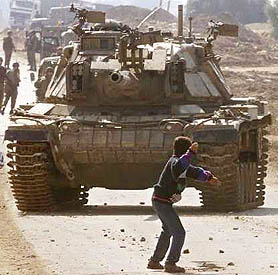
Al-Aqsa Intifada: Ariel Sharon visits Al-Aqsa Mosque known to Jews as the Temple Mount in Jerusalem.
2000–2005 Palestinian uprising against Israeli occupation
The Second Intifada, also known as the Al-Aqsa Intifada, was a major uprising by Palestinians against Israel and its occupation from 2000. Initially sparked by civilian protests in Jerusalem and areas within Israel proper, the uprising escalated into a prolonged period of heightened violence in Israel, the West Bank and the Gaza Strip. This violence, which included shootings, suicide bombings, and military operations, continued until the Sharm el-Sheikh Summit of 2005, which ended hostilities.
2000
Typhoon_Xangsane
Typhoon Xangsane passes over Manila after impacting parts of Southern Luzon and Eastern Visayas, becoming the strongest to affect the Philippine capital in 11 years.
Pacific typhoon in 2006
Typhoon Xangsane, known in the Philippines as Typhoon Milenyo, was a strong and deadly typhoon that affected the Philippines, and Indochina during the 2006 Pacific typhoon season.
2006
Falcon_1
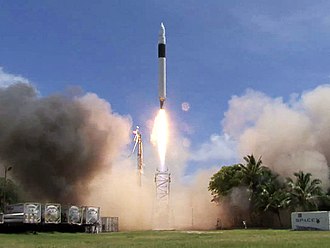
Falcon 1 becomes the first privately developed liquid-fuel ground-launched vehicle to put a payload into orbit by the RatSat mission.
Expendable launch system by SpaceX
Falcon 1 was a two-stage small-lift launch vehicle that was operated from 2006 to 2009 by SpaceX, an American aerospace manufacturer. On September 28, 2008, Falcon 1 became the first privately developed fully liquid-fueled launch vehicle to successfully reach orbit.
2008
2008_Singapore_Grand_Prix
The Singapore Grand Prix is held as Formula One's inaugural night race, with Fernando Alonso winning the event.
Almost a year later it was revealed that Alonso's team-mate Nelson Piquet Jr. had been ordered to crash his car to help bring out the safety car and give Alonso the advantage and win.
The 2008 Singapore Grand Prix, formally known as the 2008 Formula 1 SingTel Singapore Grand Prix, was a Formula One race held on 28 September 2008 at 20:00 SST at the newly built Marina Bay Street Circuit in Marina Bay, Singapore. It was the 15th race of the 2008 Formula One World Championship, the 800th Formula One World Championship race overall, and the first ever Formula One race held at night. This was also the first time Singapore hosted a Formula One race, as the last Singapore Grand Prix was a Formula Libre event in 1973.
2008
The military junta leading Guinea attacks a protest rally, killing or wounding 1,400 people.
Opposition rallies
The 2009 Guinean protests were an opposition rally in Conakry, Guinea on 28 September 2009, with about 50,000 participants demonstrating against the junta government that came to power after the 2008 Guinean coup d'état in December. The protest march was fueled by the indication of junta leader Captain Moussa Dadis Camara that he would break his pledge to not run in the next presidential vote, due in January 2010. The government had already banned any form of protests until 2 October. When the demonstrators gathered in a large stadium, the security forces opened fire on them. At least 157 demonstrators were killed, 1,253 were injured, and 30—including Cellou Dalein Diallo, the leader of the opposition Union of Democratic Forces of Guinea (UDFG)—were arrested and taken away in lorries.
2009
Battle_of_Kismayo_(2012)
Somali and African Union forces launch a coordinated assault on the Somali port of Kismayo to take back the city from al-Shabaab militants.
Part of the War in Somalia
The Battle of Kismayo was an offensive led by the Kenya Defence Forces, under the codename Operation Sledge Hammer, to seize the port city of Kismayo, Somalia, from Al-Shabaab from 28 September 2012. Members of the Raskamboni movement militia were part of the amphibious force.
2012
Sita_Air_Flight_601
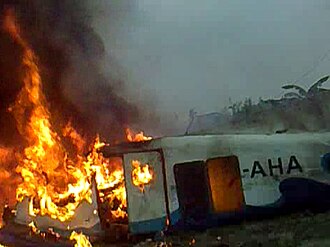
Sita Air Flight 601 crashes in Madhyapur Thimi, Nepal, killing all 19 passengers and crew.
2012 aviation accident
Sita Air Flight 601 (ST601/STA601) was a Nepalese domestic passenger flight, operated by Sita Air from Tribhuvan International Airport in Nepal's capital Kathmandu to Tenzing-Hillary Airport in Lukla. On 28 September 2012, the Dornier 228 serving the route crashed while attempting an emergency landing at Kathmandu shortly after takeoff, killing all 19 people on board.
2012
2014_Hong_Kong_protests
The 2014 Hong Kong protests begin in response to restrictive political reforms imposed by the NPC in Beijing.
Series of sit-in street protests
A series of sit-in street protests, often called the Umbrella Revolution and sometimes used interchangeably with Umbrella Movement, or Occupy Movement, occurred in Hong Kong from 26 September to 15 December 2014.
2014
The 2016 South Australian blackout occurs, lasting up to three days in some areas.
Power outage in South Australia
The South Australian blackout of 2016 was a widespread power outage in South Australia that occurred as a result of storm damage to electricity transmission infrastructure on 28 September 2016. The cascading failure of the electricity transmission network resulted in almost the entire state losing its electricity supply, affecting 850,000 SA customers. Kangaroo Island did not lose its supply, as the Kangaroo Island power station had been built to supply the island for the contingency of a failure in the power cable under the Backstairs Passage.
2016
2018_Sulawesi_earthquake_and_tsunami
The 7.5 Mw 2018 Sulawesi earthquake, which triggered a large tsunami, leaves 4,340 dead and 10,679 injured.
7 Mw earthquake and tsunami in Indonesia
On 28 September 2018, a shallow, large earthquake struck in the neck of the Minahasa Peninsula, Indonesia, with its epicentre located in the mountainous Donggala Regency, Central Sulawesi. The magnitude 7.5–7.6 quake was located 70 km (43 mi) away from the provincial capital Palu and was felt as far away as Samarinda on East Kalimantan and also in Tawau, Malaysia. This event was preceded by a sequence of foreshocks, the largest of which was a magnitude 6.1 tremor that occurred earlier that day.
2018
Hurricane_Ian
Hurricane Ian makes landfall in Cayo Costa State Park, Florida as a category four hurricane, killing 169 and doing $113 billion in damage, becoming Florida's costliest hurricane and the deadliest in 89 years.
Category 5 Atlantic hurricane in 2022
Hurricane Ian was a large and catastrophic tropical cyclone that became the third costliest weather disaster on record worldwide. It was also the deadliest hurricane to strike the state of Florida since the 1935 Labor Day hurricane, and the strongest hurricane to make landfall in Florida since Michael in 2018. Ian caused widespread damage across western Cuba, Florida, and the Carolinas. The ninth named storm, fourth hurricane, and second major hurricane of the 2022 Atlantic hurricane season, Ian was the first Category 5 hurricane in the Atlantic since Lorenzo in 2019.
2022
2023_Rotterdam_shootings
The 2023 Rotterdam shootings occurred, during which two people were killed in a shooting and arson incident at a residence in Delfshaven, Rotterdam.
Additionally, one person lost their life in a classroom at the Erasmus University Medical Center.
On 28 September 2023, two shootings occurred in Rotterdam, Netherlands. The first, in which two people were killed, was at a residence on Heiman Dullaertplein, followed by a second, in which one person was killed, in a classroom at the Erasmus University Medical Center. The perpetrator, identified as medical student Fouad Lakhlili was sentenced to life imprisonment in 2025.
2023

History runs on facts, and this project runs on coffee!

Your support is incredibly helpful and genuinely appreciated.

Support with a coffee ☕