September 3 in History

American Revolutionary War: The war ends with the signing of the Treaty of Paris

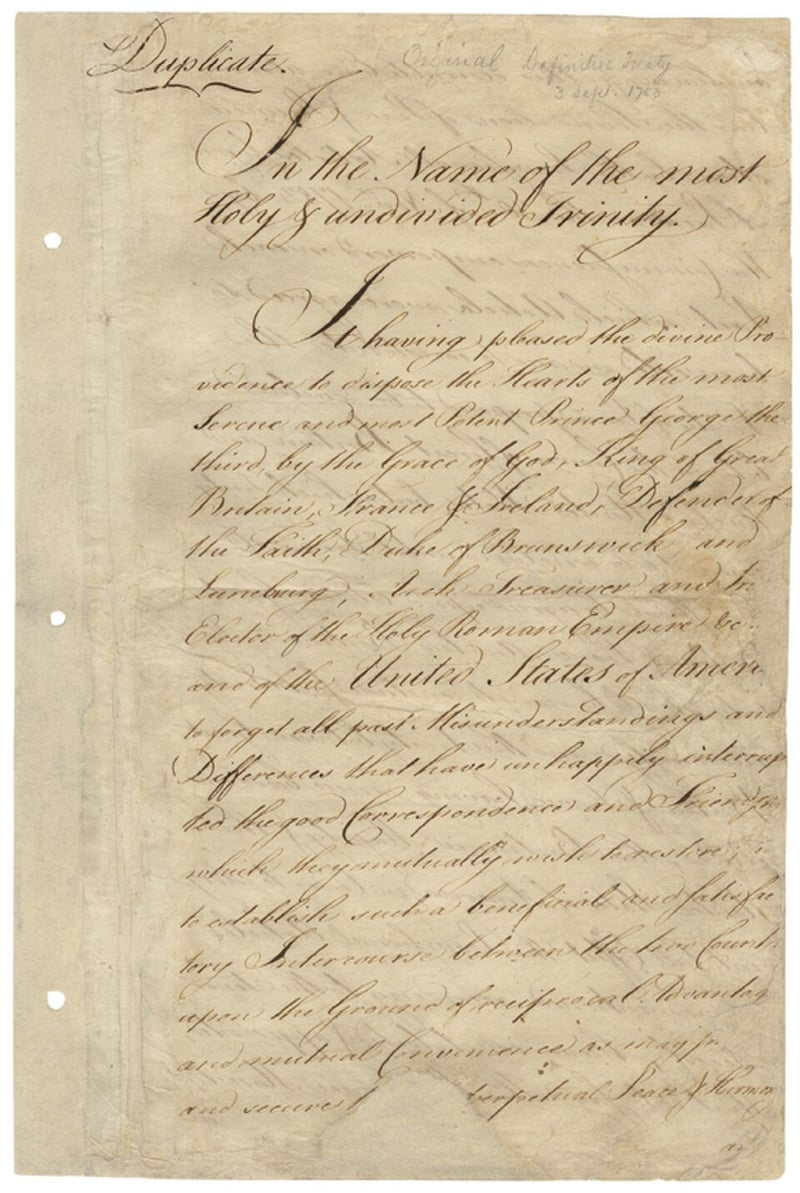
1783 — American Revolutionary War: The war ends with the signing of the Treaty of Paris by the United States and the Kingdom of Great Britain

September 3 spans 57 recorded events across recorded history, from 36 BC to 2017. Below is a curated digest of the most significant moments tied to this date.

By · Wikipedia

Historical Events 57 events 36 BC – 2017

More major events on September 3

The featured story and these ranked highlights form a quick summary. Every recorded event remains available in the chronology below.

  1. 1260 The Mamluks defeat the Mongols at the Battle of Ain Jalut in Palestine, marking their first decisive defeat and the point of maximum expansion of the Mongol Empire. Source
  2. 1954 The People's Liberation Army begins shelling the Republic of China-controlled islands of Quemoy, starting the First Taiwan Strait Crisis. Source
  3. 1777 American Revolutionary War: During the Battle of Cooch's Bridge, the Flag of the United States is flown in battle for the first time. Source

Did you know

In 1783, American Revolutionary War: The war ends with the signing of the Treaty of Paris by the United States and the Kingdom of Great Britain. This featured entry focuses on the immediate decision and its direct historical impact.
Did you know

The state was created by the 1706 Treaty of Union and ratified by the Acts of Union 1707, which united the Kingdom of England and the Kingdom of Scotland to form a single kingdom encompassing the whole island of Great Britain and its outlying islands, with the exception of the Isle of Man and the Channel Islands. This helps explain why the event mattered beyond the initial announcement.

Did you know

The unitary state was governed by a single parliament at the Palace of Westminster, but the distinct legal systems—English law and Scots law—remained in use, as did distinct educational systems and religious institutions, namely the Church of England and the Church of Scotland remaining as the national churches of England and Scotland respectively. This clarifies the institutional and public response around the event.

Did you know

In 1783, American Revolutionary War: The war ends with the signing of the Treaty of Paris by the United States and the Kingdom of Great Britain had consequences that extended beyond the first headline. The key context is the institutions involved, the policy shift, and how the public response evolved afterward.

Did you know

In 1783, American Revolutionary War: The war ends with the signing of the Treaty of Paris by the United States and the Kingdom of Great Britain had consequences that extended beyond the first headline. The key context is the institutions involved, the policy shift, and how the public response evolved afterward.


Battle_of_Naulochus
In the Battle of Naulochus, Marcus Vipsanius Agrippa, admiral of Octavian, defeats Sextus Pompey, son of Pompey, thus ending Pompeian resistance to the Second Triumvirate.
36 BC naval battle off Sicily
The naval Battle of Naulochus was fought on 3 September 36 BC between the fleets of Sextus Pompeius and Marcus Vipsanius Agrippa, off Naulochus, Sicily. The victory of Agrippa, admiral of Octavian, marked the end of the Pompeian resistance to the Second Triumvirate.
-36
San_Marino
San Marino, one of the smallest nations in the world and the world's oldest republic still in existence, is founded by Saint Marinus.
Microstate in Southern Europe
San Marino, officially the Republic of San Marino (RSM), is a landlocked country in Southern Europe, completely surrounded by Italy. Located on the northeastern slopes of the Apennine Mountains, it is the larger of two microstates within the Italian Peninsula, the other being Vatican City. San Marino is the fifth-smallest country in the world, with a land area of just over 61 square kilometres (24 sq mi) and a population of 34,042 as of 2025. Its capital, the City of San Marino, sits atop Monte Titano, while its largest settlement is Dogana, in the municipality of Serravalle.
301
Pope_Gregory_I
Consecration of Pope Gregory I (Gregory the Great).
64th Bishop of Rome; head of the Roman Catholic Church from AD 590 to 604
Pope Gregory I, commonly known as Saint Gregory the Great, was the 64th Bishop of Rome from 3 September 590 until his death on 12 March 604.
590
Wamba_(king)
King Wamba of the Visigoths puts down a revolt by Hilderic, governor of Nîmes (France) and rival for the throne.
King of the Visigoths from 672 to 680
Wamba was the king of the Visigoths from 672 to 680. During his reign, the Visigothic kingdom encompassed all of Hispania and part of southern Gaul known as Septimania.
673
Byzantine_Empire
Major Byzantine victory at the Battle of Lalakaon against an Arab raid.
Continuation of the Roman Empire (330–1453)
The Byzantine Empire, also known as the Eastern Roman Empire, was the continuation of the Roman Empire centred on Constantinople during late antiquity and the Middle Ages. Having survived the fall of the Western Roman Empire in the 5th century AD, it endured until the fall of Constantinople to the Ottoman Empire in 1453. The term 'Byzantine Empire' was coined only after its demise; its citizens used the term 'Roman Empire' and called themselves 'Romans'.
863
Richard_I_of_England
Richard I of England (a.k.a.
Richard "the Lionheart") is crowned at Westminster.
Richard I, known as Richard the Lionheart or Richard Cœur de Lion because of his reputation as a great military leader and warrior, was King of England from 1189 until his death in 1199. He also ruled as Duke of Normandy, Aquitaine, and Gascony; Lord of Cyprus; Count of Poitiers, Anjou, Maine, and Nantes; and was overlord of Brittany at various times during the same period. He was the third of five sons of Henry II of England and Eleanor of Aquitaine and was therefore not expected to become king, but his two elder brothers predeceased their father.
1189
Mamluk
The Mamluks defeat the Mongols at the Battle of Ain Jalut in Palestine, marking their first decisive defeat and the point of maximum expansion of the Mongol Empire.
Slave-soldiers and enslaved mercenaries in the Muslim world
Mamluk or mamaluk were non-Arab, ethnically diverse enslaved mercenaries, slave-soldiers, and freed slaves who were assigned high-ranking military and administrative duties in the Muslim world. They were purchased as military slaves, converted to Islam, and trained in martial and courtly skills. Upon completion of their training they were freed, but remained part of the ruling military caste, forming elite regiments and, in some periods and regions, rising to sovereign power.
1260
Charles_I_of_Hungary
At the congress of Visegrád Charles I of Hungary mediates a reconciliation between two neighboring monarchs, John of Bohemia and Casimir III of Poland.
King of Hungary and Croatia from 1308 to 1342
Charles I, also known as Charles Robert (Hungarian: Károly Róbert; Croatian: Karlo Robert; Slovak: Karol Róbert; Italian: Caroberto;, was King of Hungary and Croatia from 1308 to his death. He was a member of the Capetian House of Anjou and the only son of Charles Martel, Prince of Salerno. His father was the eldest son of Charles II of Naples and Mary of Hungary. Mary laid claim to Hungary after her brother, Ladislaus IV of Hungary, died in 1290, but the Hungarian prelates and lords elected her cousin, Andrew III, king. Instead of abandoning her claim to Hungary, she transferred it to her son, Charles Martel, and after his death in 1295, to her grandson, Charles. On the other hand, her husband, Charles II of Naples, made their third son, Robert, heir to the Kingdom of Naples, thus disinheriting Charles.
1335
The Treaty of Selymbria is concluded between the Ottoman Empire and the Republic of Venice.
1411 Venetian-Ottoman treaty
The Treaty of Selymbria was an agreement concluded on 3 September 1411 between the Republic of Venice and the Ottoman prince Musa Çelebi, ruler of the European portion of the Ottoman Empire (Rumelia), at Selymbria. The treaty largely repeated previous agreements between Venice and Ottoman rulers, and recognized the possessions of the Republic in Greece and Albania.
1411
Battle_of_Dunbar_(1650)
Victory over the royalists in the Battle of Dunbar opens the way to Edinburgh for the New Model Army in the Third English Civil War.
English invasion of Scotland
The Battle of Dunbar was fought between the English New Model Army, under Oliver Cromwell, and a Scottish army commanded by David Leslie on 3 September 1650 near Dunbar, Scotland. The battle resulted in a decisive victory for the English. It was the first major battle of the 1650 invasion of Scotland.
1650
Battle_of_Worcester
The Battle of Worcester is the last significant action in the Wars of the Three Kingdoms.
1651 final battle of the English Civil War
The Battle of Worcester took place on 3 September 1651 in and around the city of Worcester, England and was the last major battle of the 1642 to 1651 Wars of the Three Kingdoms. A Parliamentarian army of around 28,000 under Oliver Cromwell defeated a largely Scottish Royalist force of 16,000 led by Charles II of England and Scotland.
1651
Oliver_Cromwell
The death of Oliver Cromwell; Richard Cromwell becomes Lord Protector of England.
English military and political leader (1599–1658)
Oliver Cromwell was an English statesman, farmer and soldier, widely regarded as one of the most important figures in British history. He came to prominence during the Wars of the Three Kingdoms, initially as a senior commander in the Parliamentarian army and later as a politician. A leading advocate of the execution of Charles I in January 1649, which led to the establishment of the Commonwealth of England, Cromwell ruled as Lord Protector from December 1653 until his death in September 1658.
1658
Royal_Exchange,_London
The Royal Exchange burns down in the Great Fire of London.
Commercial building in London (built 1571, rebuilt 1844)
The Royal Exchange is a building in central London, originally founded in the 16th century by the merchant Sir Thomas Gresham on the suggestion of his factor Richard Clough to act as a centre of commerce for the City of London. The site was provided by the City of London Corporation and the Worshipful Company of Mercers, who still jointly own the freehold. The original foundation was ceremonially opened by Queen Elizabeth I who granted it its "royal" title. The current neoclassical building has a trapezoidal floor plan and is flanked by Cornhill and Threadneedle Street, which converge at Bank junction in the heart of the city. It lies in the Ward of Cornhill.
1666
American_Revolutionary_War
American Revolutionary War: During the Battle of Cooch's Bridge, the Flag of the United States is flown in battle for the first time.
1775–1783 conflict in North America
The American Revolutionary War, also known as the Revolutionary War or American War of Independence or simply the American Revolution, was the armed conflict that comprised the final eight years of the broader American Revolution, in which American Patriot forces organized as the Continental Army and commanded by George Washington defeated the British Army. The conflict was fought in North America, the Caribbean, and the Atlantic Ocean. The war's outcome seemed uncertain for most of the war, but Washington and the Continental Army's decisive victory in the Siege of Yorktown in 1781 led King George III and the Kingdom of Great Britain to negotiate an end to the war. In 1783, in the Treaty of Paris, the British monarchy acknowledged the independence of the Thirteen Colonies, leading to the establishment of the United States as an independent and sovereign nation.
1777
The week long battle of St.
George's Caye begins between Spain and Britain off the coast of Belize.
The Battle of St. George's Caye was a military engagement that lasted from 3 to 10 September 1798, off the coast of British Honduras. However, the name is typically reserved for the final battle that occurred on 10 September in which the Spanish were defeated. The events of 10 September 1798 marked the final Spanish attempt to take over the area. In Belize, the Battle of St. George's Caye is a national public and bank holiday.
1798
Pigeon_Roost_State_Historic_Site
Twenty-four settlers are killed in the Pigeon Roost Massacre in Indiana.
Site of an 1812 massacre of settlers by Native Americans in Indiana, United States
Pigeon Roost State Historic Site is located between Scottsburg and Henryville, Indiana, United States. A one-lane road off U.S. Route 31 takes the visitor to the site of a village where Native Americans massacred 24 settlers shortly after the War of 1812 began.
1812
Abolitionism_in_the_United_States
Future abolitionist Frederick Douglass escapes from slavery.
In the United States, abolitionism, the movement that sought to end chattel slavery in the country, was active from the colonial era until the American Civil War, the end of which brought about the abolition of American Chattel Slavery, except as punishment for a crime, through the Thirteenth Amendment to the United States Constitution.
1838
Otto_of_Greece
King Otto of Greece is forced to grant a constitution following an uprising in Athens.
King of Greece from 1832 to 1862
Otto was King of Greece from the establishment of the Kingdom of Greece on 7 May 1832, under the Convention of London, until he was deposed in October 1862.
1843
American_Indian_Wars
American Indian Wars: In Nebraska, 700 soldiers under United States General William S.
Harney avenge the Grattan massacre by attacking a Sioux village and killing 100 men, women and children.
The American Indian Wars, also known as the American Frontier Wars, and the Indian Wars, were initially fought by European colonial empires, the United States, and briefly the Confederate States of America and Republic of Texas against various American Indian tribes in North America. These conflicts occurred from the time of the earliest colonial settlements in the 17th century until the end of the 19th century. The various conflicts resulted from a wide variety of factors, the most common being the desire of settlers and governments for tribal lands. The European powers and their colonies enlisted allied Indian tribes to help them conduct warfare against each other's colonial settlements. After the American Revolution, many conflicts were local to specific states or regions and frequently involved disputes over land use; many involved retaliatory violence.
1855
American_Civil_War
American Civil War: Confederate General Leonidas Polk invades neutral Kentucky, prompting the state legislature to ask for Union assistance.
1861–1865 conflict in the United States
The American Civil War was a civil war in the United States between the Union and the Confederacy, which was formed in 1861 by states that had seceded from the Union to preserve slavery in the United States. The South saw slavery as threatened because of the election of Abraham Lincoln and the growing abolitionist movement in the North. The war ended with Union victory, the dissolution of the Confederacy and the abolition of slavery, freeing four million African Americans.
1861
Franco-Prussian_War
Franco-Prussian War: The Siege of Metz begins, resulting in a decisive Prussian victory on October 23.
War from 1870 to 1871
The Franco-Prussian War, occasionally known as the Franco-German War, and sometimes referred to in France as the War of 1870, was a conflict between France and the North German Confederation led by Prussia. Lasting from 19 July 1870 to 28 January 1871, the conflict was caused primarily by France's determination to reassert its dominant position in continental Europe, which appeared in question following the decisive Prussian victory over Austria in 1866.
1870
Polo
The first official game of polo is played in Argentina after being introduced by British ranchers.
Equestrian team sport
Polo is a stick and ball game that is played on horseback as a traditional field sport, and is one of the oldest known team sports in the world.
1875
Sinking_of_SS_Princess_Alice
Over 640 die when the crowded pleasure boat Princess Alice collides with the Bywell Castle in the River Thames.
1878 sinking on the River Thames
SS Princess Alice, formerly PS Bute, was a British passenger paddle steamer that sank on 3 September 1878 after a collision with the collier SS Bywell Castle on the River Thames. Between 600 and 700 people died, all from Princess Alice, the greatest loss of life of any British inland waterway shipping accident. No passenger list or headcount was made, so the exact figure of deaths has never been known.
1878
Siege_of_the_British_Residency_in_Kabul
Siege of the British Residency in Kabul: British envoy Sir Louis Cavagnari and 72 men of the Guides are massacred by Afghan troops while defending the British Residency in Kabul.
Their heroism and loyalty became famous and revered throughout the British Empire.
The siege of the British Residency in Kabul was a military engagement of the Second Anglo-Afghan War. The British resident, Sir Louis Cavagnari, and his escort were massacred after an 8-hour siege by mutinous Afghan troops inside their Residency in Kabul. This event triggered the second phase of the war, during which an Anglo-Indian army invaded Afghanistan and captured Kabul.
1879
John_Brallier
John Brallier becomes the first openly paid professional American football player, when he was paid US$10 by David Berry, to play for the Latrobe Athletic Association in a 12–0 win over the Jeanette Athletic Association.
American football player and coach (1876–1960)
John Kinport "Sal" Brallier was one of the first professional American football players. He was nationally acknowledged as the first openly paid professional football player when he was given $10 to play for the Latrobe Athletic Association for a game against the Jeanette Athletic Association in 1895.
1895
Fraser's_Million_Dollar_Pier
A fire that started on Fraser's Million Dollar Pier destroys six to eight square blocks of Ocean Park, California.
U.S. amusement park (1911–1912)
Fraser's Million Dollar Pier was a 20th-century amusement park in Ocean Park, California in the United States. The pier was located between Pier Avenue and Marine Street, in a community situated between Santa Monica and Venice in Los Angeles County. Developed by Alexander R. Fraser, a booster in Ocean Park who had formerly been business partners with Abbot Kinney of Venice, the pier opened to the public on June 17, 1911 and was destroyed September 3, 1912 in a catastrophic fire that spread into the adjacent neighborhood and destroyed six to eight square blocks.
1911
Wilhelm,_Prince_of_Albania
Wilhelm, Prince of Albania leaves the country after just six months due to opposition to his rule.
Prince of Albania (1876–1945)
Wilhelm, Prince of Albania was sovereign of the Principality of Albania from 7 March to 3 September 1914. His reign officially came to an end on 31 January 1925, when the country was declared an Albanian Republic.
1914
Albéric_Magnard
French composer Albéric Magnard is killed defending his estate against invading German soldiers.
French composer (1865–1914)
Lucien Denis Gabriel Albéric Magnard was a French composer, somewhat influenced by César Franck and Vincent d'Indy. Magnard became a national hero in 1914 when he refused to surrender his property to German invaders and died defending it.
1914
World_War_I
World War I: Start of the Battle of Grand Couronné, a German assault against French positions on high ground near the city of Nancy.
Global conflict from 1914 to 1918
World War I, or the First World War, also known as the Great War, was a global conflict between two coalitions: the Allies and the Central Powers. Major theatres of war included Europe and the Middle East, and well as parts of Africa and the Asia-Pacific. One of the deadliest conflicts in history, World War I resulted in an estimated 15 to 22 million deaths, including in mass war crimes against civilians and genocides. The conflict saw important developments in weaponry, including the first large-scale use of machine guns, artillery, aircraft, chemical weapons, and tanks, and was a major factor in the deadly Spanish flu pandemic.
1914
Leefe_Robinson
World War I: Leefe Robinson destroys the German airship Schütte-Lanz SL 11 over Cuffley, north of London; the first German airship to be shot down on British soil.
British WW1 fighter pilot (1895–1918)
William Leefe Robinson VC was the first British pilot to shoot down a German airship over Britain during the First World War. For this, he was awarded the Victoria Cross (VC), the highest award for gallantry in the face of the enemy that can be awarded to British and Commonwealth forces. He was the first person to be awarded the VC for action in the UK.
1916
USS_Shenandoah_(ZR-1)
USS Shenandoah, the United States' first American-built rigid airship, was destroyed in a squall line over Noble County, Ohio.
Fourteen of her 42-man crew perished, including her commander, Zachary Lansdowne.
USS Shenandoah was the first of four United States Navy rigid airships. It was constructed during 1922–1923 at Lakehurst Naval Air Station, and first flew in September 1923. It developed the U.S. Navy's experience with rigid airships and made the first crossing of North America by airship. On the 57th flight, Shenandoah was destroyed in a squall line over Ohio in September 1925.
1925
Yevgeniy_Abalakov
Yevgeniy Abalakov is the first man to reach the highest point in the Soviet Union, Communism Peak (now called Ismoil Somoni Peak and situated in Tajikistan) (7495 m).
Soviet mountaineer and sculptor (1907–1948)
Yevgeniy Mikhaylovich Abalakov was a Soviet mountaineer and sculptor.
1933
Malcolm_Campbell
Sir Malcolm Campbell reaches a speed of 304.331 miles per hour on the Bonneville Salt Flats in Utah, becoming the first person to drive an automobile over 300 mph.
British racing driver and speed record holder (1885–1948)
Major Sir Malcolm Campbell was a British racing motorist and motoring journalist. He gained the world speed record on land and on water at various times, using vehicles called Blue Bird, including a 1921 Grand Prix Sunbeam. His son, Donald Campbell, carried on the family tradition by holding both land speed and water speed records.
1935
World_War_II
World War II: France, the United Kingdom, New Zealand and Australia declare war on Germany after the invasion of Poland, forming the Allied nations.
The Viceroy of India also declares war, but without consulting the provincial legislatures.
World War II, or the Second World War, was a global conflict between two coalitions: the Allies and the Axis powers. Nearly all of the world's countries participated, with many engaging in total war on an unprecedented scale. World War II was the deadliest conflict in history, causing the deaths of 60 to 75 million people, a majority of whom were civilians. Millions died as a result of massacres, starvation, disease, and genocides including the Holocaust. After the Allied victory, Germany, Austria, Japan, and Korea were occupied, and German and Japanese leaders were tried for war crimes.
1939
Blockade_of_Germany_(1939–1945)
World War II: The United Kingdom and France begin a naval blockade of Germany that lasts until the end of the war.
This also marks the beginning of the Battle of the Atlantic.
The Blockade of Germany (1939–1945), also known as the Economic War, involved operations carried out during World War II by the British Empire and by France in order to restrict the supplies of minerals, fuel, metals, food and textiles needed by Nazi Germany – and later by Fascist Italy – in order to sustain their war efforts. The economic war consisted mainly of a naval blockade, which formed part of the wider Battle of the Atlantic, but also included the bombing of economically important targets and the preclusive buying of war materials from neutral countries in order to prevent their sale to the Axis powers.The first period, from the beginning of European hostilities in September 1939 to the end of the "Phoney War", saw both the Allies and the Axis powers intercepting neutral merchant ships to seize deliveries en route to their respective enemies. Naval blockade at this time proved less than effective because the Axis could get crucial materials from the Soviet Union until June 1941, while Berlin used harbours in Spain to import war materials into Germany. The second period began after the rapid Axis occupation of the majority of the European landmass in 1940–1941, resulting in Axis control of major centres of industry and agriculture. The third period started in December 1941 after the attack on Pearl Harbor by the Imperial Japanese Navy Air Service brought the U.S. officially into the European war. The final period came after the tide of war finally turned against the Axis after heavy military defeats up to and after D-Day in June 1944, which led to gradual Axis withdrawals from the occupied territories in the face of the overwhelming Allied military offensives.
1939
The_Holocaust
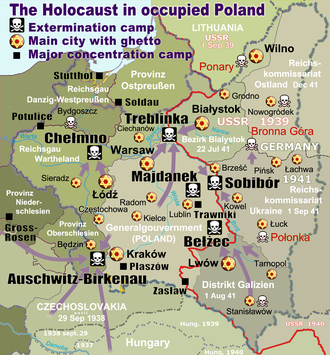
The Holocaust: Karl Fritzsch, deputy camp commandant of the Auschwitz concentration camp, experiments with the use of Zyklon B in the gassing of Soviet POWs.
Genocide of European Jews by Nazi Germany
The Holocaust, known in Hebrew as the Shoah, was the genocide of European Jews during World War II. From 1941 to 1945, Nazi Germany and its collaborators systematically murdered around six million Jews across German-occupied Europe, approximately two-thirds of Europe's Jewish population. The murders were committed primarily through mass shootings across Eastern Europe and poison gas chambers in extermination camps, chiefly Auschwitz-Birkenau, Treblinka, Belzec, Sobibor, Chełmno and Majdanek death camps in occupied Poland. Concurrent Nazi persecutions killed millions of other non-Jewish civilians and prisoners of war (POWs); the term Holocaust is sometimes used to include the murder and persecution of non-Jewish groups, such as the Romani and Soviet POWs.
1941
Łachwa_Ghetto
World War II: In response to news of its coming liquidation, Dov Lopatyn leads an uprising in the Ghetto of Lakhva (present-day Belarus).
Nazi ghetto in occupied Belarus
Łachwa Ghetto was a Nazi ghetto in Łachwa, Nazi German-occupied Poland during World War II. The ghetto was created with the aim of persecution and exploitation of the local Jews. The ghetto existed until September 1942. One of the first Jewish ghetto uprisings had happened there.
1942
Operation_Baytown
World War II: British and Canadian troops land on the Italian mainland.
On the same day, Walter Bedell Smith and Giuseppe Castellano sign the Armistice of Cassibile, although it is not announced for another five days.
Operation Baytown was an Allied amphibious landing on the mainland of Italy that took place on 3 September 1943, part of the Allied invasion of Italy, itself part of the Italian Campaign, during the Second World War.
1943
Diary
Holocaust: Diarist Anne Frank and her family are placed on the last transport train from the Westerbork transit camp to the Auschwitz concentration camp, arriving three days later.
Record of events with entries arranged by date
A diary is a written or audiovisual memorable record, with discrete entries arranged by date reporting on what has happened over the course of a day or other period. Diaries have traditionally been handwritten but are now also often digital. A personal diary may include a person's experiences, thoughts, and/or feelings, excluding comments on current events outside the writer's direct experience. Someone who keeps a diary is known as a diarist. Diaries undertaken for institutional purposes play a role in many aspects of human civilization, including government records, business ledgers, and military records. In British English, the word may also denote a preprinted journal format.
1944
Victory_over_Japan_Day
A three-day celebration begins in China, following the Victory over Japan Day on September 2.
Celebration of the end of World War II
Victory over Japan Day is the day on which Imperial Japan surrendered in World War II, in effect bringing the war to an end. The term has been applied to both of the days on which the initial announcement of Japan's surrender was made – 15 August 1945, in Japan, and because of time zone differences, 14 August 1945 – as well as to 2 September 1945, when the surrender document was signed, officially ending World War II.
1945
Giuseppe_Farina
"Nino" Farina becomes the first Formula One Drivers' champion after winning the 1950 Italian Grand Prix.
Italian racing driver (1906–1966)
Emilio Giuseppe "Nino" Farina was an Italian racing driver, who competed in Formula One from 1950 to 1956. Farina won the Formula One World Drivers' Championship in its inaugural 1950 season with Alfa Romeo, and won five Grands Prix across seven seasons.
1950
People's_Liberation_Army
The People's Liberation Army begins shelling the Republic of China-controlled islands of Quemoy, starting the First Taiwan Strait Crisis.
Combined military forces of the People's Republic of China
The People's Liberation Army (PLA) is the military wing of the Chinese Communist Party (CCP) and the primary armed forces of the People's Republic of China (PRC). It consists of four services—Ground Force, Navy, Air Force, and Rocket Force—and four arms—Aerospace Force, Cyberspace Force, Information Support Force, and Joint Logistics Support Force. It operates under the CCP's absolute control and is led by the Central Military Commission (CMC) with its chairman as commander-in-chief. Alongside the paramilitary People's Armed Police (PAP) and the Militia, the PLA forms the bulk of the country's armed forces.
1954
Dagen_H
Dagen H in Sweden: Traffic changes from driving on the left to driving on the right overnight.
3 Sept 1967 in Sweden, when traffic changed from left- to right-hand
Dagen H (H-day), today usually called "Högertrafikomläggningen", was on 3 September 1967, the day on which Sweden switched from driving on the left-hand side of the road to the right. The "H" stands for "Högertrafik", the Swedish word for right-hand traffic. It was by far the largest logistical event in Sweden's history.
1967
Qatar
Qatar becomes an independent state.
Country in West Asia
Qatar, officially the State of Qatar, is a country in West Asia. It occupies the Qatar Peninsula on the northeastern coast of the Arabian Peninsula in the Middle East; it shares its sole land border with Saudi Arabia to the south, with the rest of its territory surrounded by the Persian Gulf. The Gulf of Bahrain, an inlet of the Persian Gulf, separates Qatar from nearby Bahrain. The capital is Doha, home to over 80% of the country's inhabitants. Most of the land area is made up of flat, low-lying desert.
1971
Viking_program
Viking program: The American Viking 2 spacecraft lands at Utopia Planitia on Mars.
Pair of NASA landers and orbiters sent to Mars in 1976
The Viking program consisted of a pair of identical American space probes, Viking 1 and Viking 2 both launched in 1975, and landed on Mars in 1976. The mission effort began in 1968 and was managed by the NASA Langley Research Center. Each spacecraft was composed of two main parts: an orbiter spacecraft which photographed the surface of Mars from orbit, and a lander which studied the planet from the surface. The orbiters also served as communication relays for the landers once they touched down.
1976
Rhodesian_Bush_War
During the Rhodesian Bush War a group of ZIPRA guerrillas shot down civilian Vickers Viscount aircraft (Air Rhodesia Flight 825) with a Soviet-made SAM Strela-2; of 56 passengers and crew 38 people died in crash, 10 were massacred by the guerrillas at the site.
1964–1979 conflict in Southern Africa
The Rhodesian Bush War, also known as the Rhodesian Civil War, the Second Chimurenga or the Zimbabwe War of Independence, was a civil conflict from July 1964 to December 1979 in the unrecognised state of Rhodesia.
1978
Convention_on_the_Elimination_of_All_Forms_of_Discrimination_Against_Women
The Convention on the Elimination of All Forms of Discrimination Against Women, an international bill of rights for women, is instituted by the United Nations.
International bill of rights for women
The Convention on the Elimination of all Forms of Discrimination Against Women (CEDAW) is an international treaty adopted in 1979 by the United Nations General Assembly. Described as an international bill of rights for women, it was instituted on 3 September 1981 and has been ratified by 189 states. Over fifty countries that have ratified the convention have done so subject to certain declarations, reservations, and objections, including 38 countries who rejected the enforcement article 29, which addresses means of settlement for disputes concerning the interpretation or application of the convention. Australia's declaration noted the limitations on central government power resulting from its federal constitutional system. The United States and Palau have signed, but not ratified the treaty. The Holy See, Iran, Somalia, Sudan, and Tonga are not signatories to CEDAW.
1981
1987_Burundian_coup_d'état
In a coup d'état in Burundi, President Jean-Baptiste Bagaza is deposed by Major Pierre Buyoya.
1987 coup d'état in Burundi
The 1987 Burundian coup d'état was a bloodless military coup that took place in Burundi on 3 September 1987. Tutsi president Jean-Baptiste Bagaza was deposed whilst traveling abroad and succeeded by Tutsi Major Pierre Buyoya.
1987
Cubana_de_Aviación_Flight_9046
Cubana de Aviación Flight 9046 crashes into a residential area of Havana shortly after takeoff from José Martí International Airport, killing 150.
1989 aviation accident
Cubana de Aviación Flight 9046 was a chartered Ilyushin Il-62M airliner operated by Cubana, which crashed on 3 September 1989, shortly after takeoff from José Martí International Airport.
1989
Varig_Flight_254
Varig Flight 254 crashes in the Amazon rainforest near São José do Xingu in Brazil, killing 12.
1989 aviation accident in Brazil
Varig Flight 254 was a scheduled domestic passenger flight from São Paulo, Brazil, to Belém, capital city of the state of Pará in the country's North Region. On 3 September 1989, the Boeing 737-200 operating this flight had several intermediate stopovers, the last being in Marabá, Pará. Prior to takeoff from Marabá, the crew entered an incorrect heading into the flight computer, flying deep into a remote area of the Amazon jungle. Attempts to reach an alternative airport were unsuccessful and the plane eventually ran out of fuel, crashing during a belly landing in the jungle 1,700 kilometres northwest of Rio de Janeiro. Of the 54 passengers and crew, 12 passengers died and many more sustained serious injuries. The survivors were rescued two days later.
1989
Vietnam_Airlines
Vietnam Airlines Flight 815 (Tupolev Tu-134) crashes on approach into Phnom Penh airport, killing 64.
National airline of Vietnam
Vietnam Airlines is the flag carrier of Vietnam. The airline was founded in 1956 and later established as a state-owned enterprise in April 1989. Vietnam Airlines is headquartered in Long Biên district, Hanoi, with hubs at Noi Bai International Airport in Hanoi and Tan Son Nhat International Airport in Ho Chi Minh City. The airline flies 117 routes across 19 countries, excluding codeshared services.
1997
Belfast
In Belfast, Protestant loyalists begin a picket of Holy Cross, a Catholic primary school for girls.
Capital and largest city in Northern Ireland
Belfast is the capital city and main port of Northern Ireland, which stands on the banks of the river Lagan, and is connected to the open sea through Belfast Lough and the North Channel. It is the largest city in Northern Ireland and the second-largest city in Ireland, after Dublin, with a recorded population in 2021 of 345,418 and of 704,406 for the greater metropolitan area.
2001
Beslan school siege results in over 330 fatalities, including 186 children.
2004 Russian hostage crisis and massacre
The Beslan school siege, also referred to as the Beslan school hostage crisis or the Beslan massacre, was a terrorist attack that occurred from 1 September 2004 to 3 September 2004 in the town of Beslan, North Ossetia, Russian Federation. It lasted three days, and involved the imprisonment of more than 1,100 people as hostages, including 777 children, ending with the deaths of 334 people, 186 of them children, as well as 31 of the attackers. It is considered the deadliest school shooting in history.
2004
Dubai_International_Airport
After taking off from Dubai International Airport, UPS Airlines Flight 6 develops an in-flight fire in the cargo hold and crashes near Nad Al Sheba, killing both crew members on board.
Major international airport in Dubai, United Arab Emirates
Dubai International Airport is the primary international airport serving Dubai, United Arab Emirates, and is the world's busiest airport by international passenger traffic as of 2025. It is also the busiest airport in the Middle East as of 2025, the second-busiest airport in the world by passenger traffic as of 2025, the busiest airport for Airbus A380 and Boeing 777 movements, and the airport with the highest average number of passengers per flight. In 2025, the airport handled over 95.2 million passengers, over 2.2 million tonnes of cargo and registered over 454,000 aircraft movements.
2010
China
The U.S.
and China, together responsible for 40% of the world's carbon emissions, both formally ratify the Paris global climate agreement.
China, officially the People's Republic of China (PRC), is a country in East Asia. It is the world's second-most populous country after India, with a population exceeding 1.4 billion, across an area of 9.6 million square kilometers (3,700,000 sq mi), making it the third-largest country by area. It is divided into 33 province-level divisions, including two special administrative regions. Beijing is the capital, while Shanghai is the most populous city by urban area. Its geography features the vast Central Plain, major rivers such as the Yangtze and Yellow River, deserts, subtropical and temperate forests, plateaus, and mountain ranges such as the Himalayas.
2016
North_Korea
North Korea conducts its sixth and most powerful nuclear test.
Country in East Asia
North Korea, officially the Democratic People's Republic of Korea (DPRK), is a country in East Asia. It constitutes the northern half of the Korean Peninsula and borders China and Russia to the north at the Yalu (Amnok) and Tumen rivers, and South Korea to the south at the Korean Demilitarized Zone (DMZ). The country's western border is formed by the Yellow Sea, while its eastern border is defined by the Sea of Japan. Pyongyang is the capital and largest city.
2017

History runs on facts, and this project runs on coffee!

Your support is incredibly helpful and genuinely appreciated.

Support with a coffee ☕