September 6 in History

Democratically elected Argentine president Hipólito Yrigoyen is deposed in a mil

1930 — Democratically elected Argentine president Hipólito Yrigoyen is deposed in a military coup

September 6 spans 56 recorded events across recorded history, from 394 to 2022. Below is a curated digest of the most significant moments tied to this date.

By · Wikipedia

Historical Events 56 events 394 – 2022

More major events on September 6

The featured story and these ranked highlights form a quick summary. Every recorded event remains available in the chronology below.

  1. 2013 The first Minotaur V rocket is launched from the Mid-Atlantic Regional Spaceport on Wallops Island, carrying NASA's LADEE spacecraft. Source
  2. 1936 Spanish Civil War: The Interprovincial Council of Asturias and León is established. Source
  3. 1522 The Victoria returns to Sanlúcar de Barrameda in Spain, the only surviving ship of Ferdinand Magellan's expedition and the first known ship to circumnavigate the world. Source

Did you know

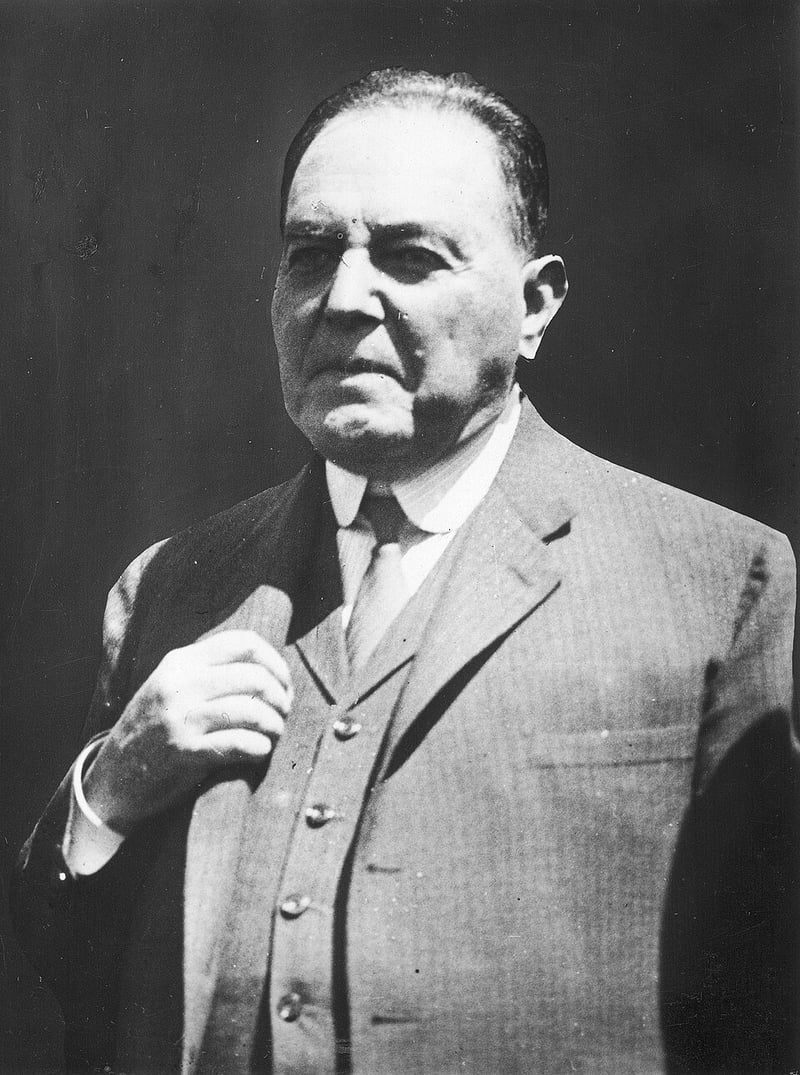
In 1930, Democratically elected Argentine president Hipólito Yrigoyen is deposed in a military coup. This featured entry focuses on the immediate decision and its direct historical impact.
Did you know

The 1930 Argentine coup d'état, also known as the September Revolution by its supporters, involved the overthrow of the Argentine government of Hipólito Yrigoyen by forces loyal to General José Félix Uriburu. This helps explain why the event mattered beyond the initial announcement.

Did you know

The coup took place on 6 September 1930 when Uriburu led a small detachment of troops into the capital, experiencing no substantial opposition and taking control of the Casa Rosada. This clarifies the institutional and public response around the event.

Did you know

Large crowds formed in Buenos Aires in support of the coup. This shows how the event shaped policy and public communication in the same period.

Did you know

Uriburu's forces took control of the capital and arrested Radical Civic Union supporters. This helps explain why the event mattered beyond the initial announcement.


Battle_of_the_Frigidus
Battle of the Frigidus: Roman emperor Theodosius I defeats and kills Eugenius the usurper.
His Frankish magister militum Arbogast escapes but commits suicide two days later.
The Battle of the Frigidus, also called the Battle of the Frigid River, was fought on 5 and 6 September 394 between the armies of the Roman emperor Theodosius the Great and the rebel augustus Eugenius, in the eastern border of Roman Italy. Theodosius won the battle and defeated the usurpation of Eugenius and Arbogast, restoring unity to the Roman Empire. The battlefield, in the Claustra Alpium Iuliarum near the Julian Alps through which Theodosius's army had passed, was probably in the Vipava Valley – with the Frigidus River being the modern Vipava – or possibly in the valley of the Isonzo.
394
Christopher_Columbus
Christopher Columbus sails from La Gomera in the Canary Islands, his final port of call before crossing the Atlantic Ocean for the first time.
Italian navigator and explorer (1451–1506)
Christopher Columbus was an Italian explorer and navigator from the Republic of Genoa who completed four Spanish transatlantic voyages in the name of the Catholic Monarchs, opening the way for the widespread European exploration and colonization of the Americas. His expeditions were the first known European contact with the Caribbean and Central and South America.
1492
Victoria_(ship)
The Victoria returns to Sanlúcar de Barrameda in Spain, the only surviving ship of Ferdinand Magellan's expedition and the first known ship to circumnavigate the world.
Carrack used in Ferdinand Magellan's expeditions; first ship to circumnavigate the globe
Victoria or Nao Victoria was a carrack famed as the first ship to successfully circumnavigate the world. Victoria was part of the Spanish expedition to the Moluccas commanded by the Portuguese explorer Ferdinand Magellan.
1522
Pilgrims_(Plymouth_Colony)
The Pilgrims sail from Plymouth, England on the Mayflower to settle in North America.
(Old Style date; September 16 per New Style date.)
The Pilgrims, also known as the Pilgrim Fathers, were the English settlers who travelled to North America on the ship Mayflower and established the Plymouth Colony at what now is Plymouth, Massachusetts, United States. John Smith named this territory New Plymouth in 1614, sharing the name of the Pilgrims' final departure port of Plymouth, Devon, England. The Pilgrims' leadership came from religious congregations of Brownists or Separatists who had fled religious persecution in England for the tolerance of 17th-century Holland in the Netherlands.
1620
Galleon
The Spanish treasure galleon Atocha sinks during a hurricane off Key West in the Straits of Florida, taking 40 short tons (36 t) of gold and silver and 260 of its 265 passengers and crew to the bottom.
Large and multi-decked sailing ships
Galleons were large, multi-decked sailing ships developed in the early 16th century from ships such as the caravel and the carrack, in Portugal and in Spain. They were first used by Europeans as armed cargo carriers from the 16th to 18th centuries during the Age of Sail, and they were the principal vessels drafted for use as warships until the Anglo-Dutch Wars of the mid-17th century.
1622
Puritans settle Salem, which became part of Massachusetts Bay Colony.
Subclass of English Reformed Protestants
The Puritans were English Protestants in the 16th and 17th centuries who sought to rid the Church of England of what they considered to be Roman Catholic practices, maintaining that the Church of England had not been fully reformed and should become more Protestant. Puritanism played a significant role in English and early American history, especially in the Protectorate in Great Britain, and the earlier European settlement of New England.
1628
Thirty_Years'_War
Thirty Years' War: In the Battle of Nördlingen, the Catholic Imperial army defeats Swedish and German Protestant forces.
Major war in Central Europe (1618–1648)
The Thirty Years' War, fought primarily in Central Europe between 1618 and 1648, was one of the most destructive conflicts in European history. An estimated 4.5 to 8 million soldiers and civilians died from the effects of battle, famine, or disease, with parts of Germany reporting population declines of more than 50%. Related conflicts include the Eighty Years' War, the War of the Mantuan Succession, the Franco-Spanish War, the Torstenson War, the Dutch–Portuguese War, and the Portuguese Restoration War.
1634
American_Revolutionary_War
American Revolutionary War: The Battle of Groton Heights takes place, resulting in a British victory.
1775–1783 conflict in North America
The American Revolutionary War, also known as the Revolutionary War or American War of Independence or simply the American Revolution, was the armed conflict that comprised the final eight years of the broader American Revolution, in which American Patriot forces organized as the Continental Army and commanded by George Washington defeated the British Army. The conflict was fought in North America, the Caribbean, and the Atlantic Ocean. The war's outcome seemed uncertain for most of the war, but Washington and the Continental Army's decisive victory in the Siege of Yorktown in 1781 led King George III and the Kingdom of Great Britain to negotiate an end to the war. In 1783, in the Treaty of Paris, the British monarchy acknowledged the independence of the Thirteen Colonies, leading to the establishment of the United States as an independent and sovereign nation.
1781
John_Dalton
British scientist John Dalton begins using symbols to represent the atoms of different elements.
British chemist and physicist (1766–1844)
John Dalton was an English chemist, physicist, and meteorologist whose work laid the foundations of modern atomic theory and stoichiometric chemistry. Building on earlier ideas about the indivisibility of matter and his own precise measurements of combining ratios, Dalton proposed that each chemical element consists of identical atoms of characteristic weight, and that compounds are formed when atoms of different elements combine in fixed whole-number proportions. His A New System of Chemical Philosophy (1808) presented a coherent atomic model, supplied relative atomic weights and symbolic notation, and established the quantitative framework that shaped nineteenth-century chemistry and remains the basis of modern chemical thought.
1803
American_Civil_War
American Civil War: Forces under Union General Ulysses S.
Grant bloodlessly capture Paducah, Kentucky, giving the Union control of the Tennessee River's mouth.
The American Civil War was a civil war in the United States between the Union and the Confederacy, which was formed in 1861 by states that had seceded from the Union to preserve slavery in the United States. The South saw slavery as threatened because of the election of Abraham Lincoln and the growing abolitionist movement in the North. The war ended with Union victory, the dissolution of the Confederacy and the abolition of slavery, freeing four million African Americans.
1861
Confederate_States_of_America
American Civil War: Confederate forces evacuate Battery Wagner and Morris Island in South Carolina.
Unrecognized state in North America (1861–1865)
The Confederate States of America (CSA), also known as the Confederate States or the Confederacy, was a republic in the Southern United States from 1861 to 1865, unrecognized as a sovereign nation by either foreign governments or the United States. It was formed by seven states that had seceded from the Union and were later joined by four more. The original seven were South Carolina, Mississippi, Florida, Alabama, Georgia, Louisiana, Texas; the additional four were Virginia, Arkansas, Tennessee, and North Carolina. These states fought against the United States during the American Civil War in the wake of the 1860 election of Abraham Lincoln as president, with the principal aim of safeguarding slavery amid fears of northern abolitionist influence and federal interference in slave property. The South also feared that Lincoln's insistence that slavery not be permitted to expand into the Western territories would result in the admission of additional free states and the eventual demise of slavery.
1863
Louisa_Swain
Louisa Ann Swain of Laramie, Wyoming becomes the first woman in the United States to cast a vote legally after 1807.
First American woman to vote in a general election
Louisa Ann Swain was the first woman in the United States to vote in a general election after the repeal of women's suffrage in New Jersey in 1807. She cast her ballot on September 6, 1870, in Laramie, Wyoming.
1870
Eastern_Rumelia
Eastern Rumelia declares its union with Bulgaria, thus accomplishing Bulgarian unification.
Autonomous territory in the Ottoman Empire from 1878–1885
Eastern Rumelia was an autonomous province of the Ottoman Empire with a total area of 32,978 km2 (12,733 sq mi), which was created in 1878 by virtue of the Treaty of Berlin and de facto ceased to exist in 1885, when it was united with the Principality of Bulgaria, also under nominal Ottoman suzerainty. It continued to be an Ottoman province de jure until 1908, when Bulgaria declared independence. Ethnic Bulgarians formed a majority of the population in Eastern Rumelia, but there were significant Turkish and Greek minorities. Its capital was Plovdiv. The official languages of Eastern Rumelia were Bulgarian, Greek and Ottoman Turkish.
1885
Leon_Czolgosz
Leon Czolgosz, an unemployed anarchist, shoots and fatally wounds US president William McKinley at the Pan-American Exposition in Buffalo, New York.
Assassin of William McKinley (1873–1901)
Leon Frank Czolgosz was an American wireworker and anarchist who assassinated United States president William McKinley in 1901. Czolgosz had lost his job during the economic Panic of 1893 and turned to anarchism. He regarded McKinley as a symbol of oppression and believed that it was his duty as an anarchist to assassinate him. Czolgosz shot McKinley in Buffalo, New York, on September 6, 1901, and was immediately arrested. McKinley died on September 14 after his wound became infected. A month later, Czolgosz was convicted of first degree murder and was sentenced to death. He was executed by the electric chair on October 29.
1901
World_War_I
World War I: The First Battle of the Marne, which would halt the Imperial German Army's advance into France, begins.
Global conflict from 1914 to 1918
World War I, or the First World War, also known as the Great War, was a global conflict between two coalitions: the Allies and the Central Powers. Major theatres of war included Europe and the Middle East, and well as parts of Africa and the Asia-Pacific. One of the deadliest conflicts in history, World War I resulted in an estimated 15 to 22 million deaths, including in mass war crimes against civilians and genocides. The conflict saw important developments in weaponry, including the first large-scale use of machine guns, artillery, aircraft, chemical weapons, and tanks, and was a major factor in the deadly Spanish flu pandemic.
1914
British_heavy_tanks_of_the_First_World_War
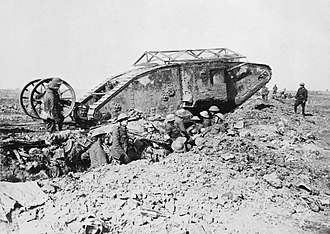
World War I: The first tank prototype, developed by William Foster & Co.
for the British army, was completed and given its first test drive.
British heavy tanks were a series of related armoured fighting vehicles developed by the UK during the First World War. The Mark I was the world's first tank, a tracked, armed, and armoured vehicle, to enter combat. The name "tank" was initially a code name to maintain secrecy and disguise its true purpose. The tank was developed in 1915 to break the stalemate of trench warfare. It could survive the machine gun and small-arms fire in "no man's land", travel over difficult terrain, crush barbed wire, and cross trenches to assault fortified enemy positions with powerful armament. Tanks also carried supplies and troops.
1915
Spanish_Civil_War
Spanish Civil War: The Interprovincial Council of Asturias and León is established.
1936–1939 civil war in Spain
The Spanish Civil War was fought from 1936 to 1939 between the Republicans and the Nationalist rebels. Republicans loyal to the left-leaning Popular Front government of the Second Spanish Republic included socialists, anarchists, communists, and separatists, supported by the Soviet Union. The opposing Nationalists were an alliance of fascist Falangists, monarchists, conservatives, and traditionalists, supported by Nazi Germany and Fascist Italy. Initially led by a military junta, until General Francisco Franco was appointed supreme leader on 1 October 1936 of what he called the Spanish State. Due to the international political climate at the time, the war was variously viewed as class struggle, religious struggle, or struggle between republican democracy and dictatorship, revolution and counterrevolution, or between fascism and communism. The Nationalists won the war in early 1939, and ruled Spain until Franco's death in November 1975.
1936
World_War_II
World War II: The British Royal Air Force suffers its first fighter pilot casualty of the Second World War at the Battle of Barking Creek as a result of friendly fire.
Global conflict (1939–1945)
World War II, or the Second World War, was a global conflict between two coalitions: the Allies and the Axis powers. Nearly all of the world's countries participated, with many engaging in total war on an unprecedented scale. World War II was the deadliest conflict in history, causing the deaths of 60 to 75 million people, a majority of whom were civilians. Millions died as a result of massacres, starvation, disease, and genocides including the Holocaust. After the Allied victory, Germany, Austria, Japan, and Korea were occupied, and German and Japanese leaders were tried for war crimes.
1939
Union_of_South_Africa
World War II: Union of South Africa declares war on Germany.
British dominion in southern Africa from 1910 to 1961
The Union of South Africa was a British Dominion and, later, a Commonwealth realm in southern Africa from 1910 to 1961. It was the historical predecessor to the present-day Republic of South Africa. It came into existence on 31 May 1910 with the unification of the Cape, Natal, Transvaal, and Orange River colonies. It included the territories that were formerly part of the South African Republic and the Orange Free State.
1939
Carol_II_of_Romania
King Carol II of Romania abdicates and is succeeded by his son Michael.
General Ion Antonescu becomes the Conducător of Romania.
Carol II was King of Romania from 8 June 1930 following a coup that deposed his son, until his forced abdication on 6 September 1940. As the eldest son of King Ferdinand I, he was crown prince from 1914 at the death of his granduncle King Carol I, until 1925 when he was forced by a marital scandal to renounce his right to the throne in favor of his son.
1940
Monterrey_Institute_of_Technology_and_Higher_Education
The Monterrey Institute of Technology is founded in Monterrey, Mexico as one of the largest and most influential private universities in Latin America.
Private university in Monterrey, Mexico
Monterrey Institute of Technology and Higher Education, also known as the Technological Institute of Monterrey or simply Tec De Monterrey or El Tec is a private research university based in Monterrey, Mexico. It has expanded to include 35 campuses across 25 cities in the country and 22 liaison offices in 15 other countries.
1943
Pennsylvania Railroad's premier train derails at Frankford Junction in Philadelphia, killing 79 people and injuring 117 others.
American Class I railroad (1846–1968)
The Pennsylvania Railroad, officially the Pennsylvania Railroad Company, also known as the "Pennsy," was an American Class I railroad established in 1846 and headquartered in Philadelphia, Pennsylvania. In 1882 it was the largest railroad, transportation enterprise, and corporation in the world.
1943
Ypres
World War II: The city of Ypres, Belgium is liberated by Allied forces.
City in West Flanders, Belgium
Ypres is a Belgian city and municipality in the province of West Flanders. Though the Dutch name Ieper is the official one, the city's French name Ypres is most commonly used in English. The municipality comprises the city of Ypres/Ieper and the villages of Boezinge, Brielen, Dikkebus, Elverdinge, Hollebeke, Sint-Jan, Vlamertinge, Voormezele, Zillebeke, and Zuidschote. Together, they are home to about 34,900 inhabitants.
1944
Tartu_offensive
World War II: Soviet forces capture the city of Tartu, Estonia.
Campaign fought over southeastern Estonia in 1944
The Tartu offensive operation, also known as the Battle of Tartu and the Battle of Emajõgi was a campaign fought over southeastern Estonia in 1944. It took place on the Eastern Front during World War II between the Soviet 3rd Baltic Front and parts of the German Army Group North.
1944
Restatement_of_Policy_on_Germany
United States Secretary of State James F.
Byrnes announces that the U.S. will follow a policy of economic reconstruction in postwar Germany.
"Restatement of Policy on Germany", or the "Speech of Hope", is a speech given by James F. Byrnes, the US secretary of state, in Stuttgart on September 6, 1946.
1946
Farnborough_Airshow_crash
A prototype aircraft crashes at the Farnborough Airshow in Hampshire, England, killing 29 spectators and the two on board.
Jet fighter crash in England
On 6 September 1952, a prototype de Havilland DH.110 jet fighter crashed during an aerial display at the Farnborough Airshow in Hampshire, England. The jet disintegrated mid-air during an aerobatic manoeuvre, killing pilot John Derry and onboard flight test observer Anthony Richards. Debris fell onto a crowd of spectators, killing 29 and injuring 60.
1952
Istanbul
Istanbul's Greek, Jewish, and Armenian minorities are the target of a government-sponsored pogrom; dozens are killed in ensuing riots.
Largest city in Turkey
Istanbul is the largest city in Turkey, constituting the country's economic, cultural, and historical center. With a population of over 15 million, it is home to 18% of the population of Turkey. Istanbul is among the largest cities in Europe and in the world by population. It is a city on two continents; about two-thirds of its population live in Europe and the rest in Asia. Istanbul straddles the Bosphorus – one of the world's busiest waterways – in northwestern Turkey, between the Sea of Marmara and the Black Sea. Its area of 5,461 square kilometers (2,109 mi2) is coterminous with Istanbul Province.
1955
The United States government begins the Exercise Spade Fork nuclear readiness drill.
Nuclear attack response plan by the U.S. government during 1950s
Federal Emergency Plan D-Minus was a plan developed by the United States in the 1950s to guide the federal government in the immediate aftermath of a catastrophic nuclear attack. Plan D-Minus was part of the National Plan for Emergency Preparedness, which also included Mobilization Plan C.
1962
Archaeologist Peter Marsden discovers the first of the Blackfriars Ships dating back to the second century AD in the Blackfriars area of the banks of the River Thames in London.
Shipwrecks on the River Thames in London discovered in the 1960s–70s
The Blackfriars shipwrecks were a series of wrecks discovered by archaeologist Peter Marsden in the Blackfriars area of the banks of the River Thames in London, England. The wrecks were discovered while building a riverside embankment wall along the River Thames. Marsden discovered the first on 6 September 1962 and the other three were discovered in 1969–1970. Together they are now known as the four Blackfriars wrecks.
1962
Operation_Grand_Slam
India retaliates following Pakistan's Operation Grand Slam which results in the Indo-Pakistani War of 1965 that ends in a stalemate followed by the signing of the Tashkent Declaration.
Pakistani military operation in the 1965 Indo-Pakistani War
Operation Grand Slam was a key military operation of the Indo-Pakistani War of 1965. It refers to a plan drawn up by the Pakistan Army in May 1965, that consisted of an attack on the vital Akhnoor Bridge in Jammu and Kashmir, India. The bridge was not only the lifeline of an entire infantry division of the Indian Army, but could also be used to threaten the city of Jammu, an important logistical point for Indian forces. The operation saw initial success, but was aborted when the Indian Army opened a new front in the Pakistani province of Punjab in order to relieve pressure in Kashmir. This forced Pakistan to abandon Grand Slam and fight in Punjab, so that the operation ended in failure and stated objectives were not achieved.
1965
Prime_Minister_of_South_Africa
Prime Minister Hendrik Verwoerd, the architect of apartheid, is stabbed to death in Cape Town, South Africa during a parliamentary meeting.
Head of government of South Africa (1910–1984)
The prime minister of South Africa was the head of government in South Africa between 1910 and 1984.
1966
Eswatini
Swaziland becomes independent.
Country in Southern Africa
Eswatini, formally the Kingdom of Eswatini, also known by its former official names Swaziland and the Kingdom of Swaziland, is a landlocked country in Southern Africa. It is bordered by South Africa on all sides except the east, where it shares a border with Mozambique. At no more than 200 km (120 mi) north to south and 130 km (81 mi) east to west, Eswatini is the second smallest country in Africa. However, its climate and topography are diverse, ranging from a cool and mountainous highveld to a hot and dry lowveld. The executive capital and largest city is Mbabane, and the legislative and second capital is Lobamba.
1968
Palestinians
Two passenger jets bound from Europe to New York are simultaneously hijacked by Palestinian terrorist members of the PFLP and taken to Dawson's Field, Jordan.
Arab national group of the Levant
Palestinians are an Arab national group native to the region of Palestine, descended from those who have inhabited the area over the millennia. They represent a highly homogenized community who share a cultural and ethnic identity, and close linguistic and cultural ties with other Levantine Arabs.
1970
Paninternational_Flight_112
Paninternational Flight 112 crashes on the Bundesautobahn 7 highway near Hamburg Airport, in Hamburg, Germany, killing 22.
1971 aviation accident in West Germany
Paninternational Flight 112 was a BAC One-Eleven operated by German airline Paninternational that crashed in Hamburg on 6 September 1971 while attempting to land on an autobahn following the failure of both engines. The accident killed 22 passengers and crew out of 121 on board.
1971
Munich_massacre
Munich massacre: Nine Israeli athletes die (along with a German policeman) at the hands of the Palestinian "Black September" terrorist group after being taken hostage at the Munich Olympic Games.
Two other Israeli athletes were slain in the initial attack the previous day.
The Munich massacre was a terrorist attack during the 1972 Summer Olympics in Munich, West Germany, carried out by eight members of the Palestinian militant organisation Black September. The militants infiltrated the Olympic Village, killed two members of the Israeli Olympic team, and took nine other Israeli team members hostage. Those hostages were later also killed by the militants during a failed rescue attempt.
1972
Cold_War
Cold War: Soviet Air Defence Forces pilot Viktor Belenko lands a Mikoyan-Gurevich MiG-25 jet fighter at Hakodate in Japan and requests political asylum in the United States; his request is granted.
1947–1991 geopolitical rivalry between US and USSR
The Cold War was a period of international geopolitical rivalry between the United States (US) and the Soviet Union (USSR) and their respective allies, the capitalist Western Bloc and communist Eastern Bloc. It began in the aftermath of the Second World War and ended with the dissolution of the Soviet Union in 1991. The term cold war is used because there was no direct fighting between the two superpowers, though each supported opposing sides in regional conflicts known as proxy wars. In addition to the struggle for ideological and economic influence and an arms race in both conventional and nuclear weapons, the Cold War was expressed through technological rivalries such as the Space Race, espionage, propaganda campaigns, embargoes, and sports diplomacy.
1976
Soviet_Union
The Soviet Union admits to shooting down Korean Air Lines Flight 007, stating that its operatives did not know that it was a civilian aircraft when it reportedly violated Soviet airspace.
Country in Eurasia from 1922 to 1991
The Soviet Union, officially the Union of Soviet Socialist Republics (USSR), was a transcontinental country that spanned much of Eurasia from its formation in 1922 until its dissolution in 1991. It was the world's third-most populous country, the largest by area, and bordered twelve other countries. A diverse multinational state, it was organized as a federal union of national republics, with the largest and most populous being the Russian Soviet Federative Socialist Republic (SFSR). The world's flagship communist state, it was governed by the Communist Party under Marxism–Leninism, through soviet councils. The Soviet economy was also centrally planned. Its capital and largest city was Moscow.
1983
Midwest_Express_Airlines_Flight_105
Midwest Express Airlines Flight 105 crashes near Milwaukee Mitchell International Airport in Milwaukee, Wisconsin, killing all 31 people on board.
1985 aviation accident in Wisconsin
Midwest Express Airlines Flight 105 was a scheduled domestic passenger flight that crashed into an open field in Oak Creek, Wisconsin shortly after taking off from General Mitchell International Airport on September 6, 1985. The airplane, a McDonnell Douglas DC-9, was carrying 31 passengers and crew. None of them survived the crash.
1985
Istanbul
In Istanbul, two terrorists from Abu Nidal's organization kill 22 and wound six congregants inside the Neve Shalom Synagogue during Shabbat services.
Largest city in Turkey
Istanbul is the largest city in Turkey, constituting the country's economic, cultural, and historical center. With a population of over 15 million, it is home to 18% of the population of Turkey. Istanbul is among the largest cities in Europe and in the world by population. It is a city on two continents; about two-thirds of its population live in Europe and the rest in Asia. Istanbul straddles the Bosphorus – one of the world's busiest waterways – in northwestern Turkey, between the Sea of Marmara and the Black Sea. Its area of 5,461 square kilometers (2,109 mi2) is coterminous with Istanbul Province.
1986
Soviet_Union
The Soviet Union recognizes the independence of the Baltic states Estonia, Latvia, and Lithuania.
Country in Eurasia from 1922 to 1991
The Soviet Union, officially the Union of Soviet Socialist Republics (USSR), was a transcontinental country that spanned much of Eurasia from its formation in 1922 until its dissolution in 1991. It was the world's third-most populous country, the largest by area, and bordered twelve other countries. A diverse multinational state, it was organized as a federal union of national republics, with the largest and most populous being the Russian Soviet Federative Socialist Republic (SFSR). The world's flagship communist state, it was governed by the Communist Party under Marxism–Leninism, through soviet councils. The Soviet economy was also centrally planned. Its capital and largest city was Moscow.
1991
Saint_Petersburg
The Russian parliament approves the name change of Leningrad back to Saint Petersburg.
The change is effective October 1.
Saint Petersburg, formerly known as Petrograd (Петроград) and later Leningrad (Ленинград), is the second-largest city in Russia, after Moscow, the nation's capital. Situated on the Neva River at the head of the Gulf of Finland on the Baltic Sea, its area of 1,439 square kilometers (556 sq mi) makes it the smallest administrative division of Russia by area. The city had a population of 5,601,911 residents as of 2021, with more than 6.4 million people living in the metropolitan area. Saint Petersburg is the fourth-most populous city in Europe, the most populous city on the Baltic Sea, and the world's northernmost city of more than 1 million residents. As the former capital of the Russian Empire, and a historically strategic Baltic port, it is governed as a federal city.
1991
Healy,_Alaska
A group of hunters at the Stampede trail near Healy, Alaska came across a male corpse in abandoned bus, later identified as Christopher McCandless.
Census-designated place in Alaska
Healy is a census-designated place (CDP) and the borough seat of Denali Borough, Alaska. The population was 966 at the time of the 2020 census, down from 1,021 in 2010.
1992
Cal_Ripken_Jr.
Cal Ripken Jr.
of the Baltimore Orioles plays in his 2,131st consecutive game, breaking a record that had stood for 56 years.
Calvin Edwin Ripken Jr., nicknamed "the Iron Man", is an American former professional baseball shortstop and third baseman who played his entire 21-season career in Major League Baseball (MLB) for the Baltimore Orioles (1981–2001). One of his position's most productive offensive players, Ripken compiled 3,184 hits, 431 home runs, 1,695 runs batted in, and won two Gold Glove Awards for his defense during his career. He was a 19-time All-Star and was twice named American League (AL) Most Valuable Player (MVP), in 1983 and 1991.
1995
Funeral_of_Diana,_Princess_of_Wales
The funeral of Diana, Princess of Wales takes place in London.
Well over a million people line the streets and 21⁄2 billion watch around the world on television.
The funeral of Diana, Princess of Wales, started on Saturday 6 September 1997 at 9:08 am in London, when the tenor bell of Westminster Abbey started tolling to signal the departure of the cortège from Kensington Palace. Diana's coffin was carried from the palace on a gun carriage by riders of the King's Troop and escorted by mounted police along Hyde Park to St James's Palace, where her body had remained for five days before being taken to Kensington Palace. The Union Flag on top of the palace was lowered to half mast. The official ceremony was held at Westminster Abbey in London and finished at the resting place in Diana's family estate of Althorp, Northamptonshire.
1997
Royal_Brunei_Airlines_Flight_839
Royal Brunei Airlines Flight 839 crashes in the Lambir Hills National Park while on approach to Miri Airport in Malaysia, killing 10.
1997 aviation accident in Malaysia
Royal Brunei Airlines Flight 839 was a charter flight from Labuan to Bandar Seri Begawan and Miri, operated by Merpati Intan on behalf of Royal Brunei Airlines. On 6 September 1997, a Dornier 228, registered as 9M-MIA, conducting the flight crashed on approach to Miri, killing both crew members and all eight passengers on board.
1997
Mahmoud_Abbas
Mahmoud Abbas resigns from his position of Palestinian Prime Minister.
President of Palestine since 2005
Mahmoud Abbas, also known by the kunya Abu Mazen, is a Palestinian politician who has been serving as the second president of Palestine and the Palestinian National Authority (PNA) since 2005. He has also been the fourth chairman of the Palestine Liberation Organization (PLO) since 2004. Abbas is also a member of the Fatah party and was elected the party's chairman in 2009.
2003
Israel
Israel executes the air strike Operation Orchard to destroy a nuclear reactor in Syria.
Country in West Asia
Israel, officially the State of Israel, is a country in the Southern Levant region of West Asia. It is bordered by Lebanon to the north, Syria to the northeast, Jordan to the east, and Egypt to the southwest. Israel's western coast lies on the Mediterranean Sea, its southern tip reaches the Red Sea, and to the east is Earth's lowest point near the Dead Sea. Jerusalem is the government seat and proclaimed capital, while Tel Aviv is Israel's largest urban area and economic centre.
2007
Roll-on/roll-off
The ro-ro ferry SuperFerry 9 sinks off the Zamboanga Peninsula in the Philippines with 971 persons aboard; all but ten are rescued.
Vessels designed to carry wheeled cargo
Roll-on/roll-off ships are cargo ships designed specifically to transport wheeled cargo, such as cars, motorcycles, trucks, semi-trailer trucks, buses, trailers and railroad cars, which are moved directly onto and off the ship by their own wheels or on a platform vehicle such as a self-propelled modular transporter. This is in contrast to lift-on/lift-off (LoLo) vessels, which rely on cranes to load and unload cargo.
2009
September_2012_Baradan_Bay,_Turkey,_migrant_boat_disaster
Sixty-one people die after a fishing boat capsizes off the İzmir Province coast of Turkey, near the Greek Aegean islands.
Fatal boat accident
The September 2012 Baradan Bay, Turkey migrant boat disaster occurred in the early hours of September 6, 2012, in Baradan Bay, İzmir Province, western Turkey. A fishing boat carrying illegal migrants hit rocks and sank. 61 people died, 48 survived the incident.
2012
Cyanide
Forty-one elephants are poisoned with cyanide in salt pans, by poachers in Hwange National Park.
Any molecule with a cyano group (C≡N)
In chemistry, cyanide is an inorganic chemical compound that contains a C≡N functional group. This group, known as the cyano group, consists of a carbon atom triple-bonded to a nitrogen atom.
2013
Minotaur_V
The first Minotaur V rocket is launched from the Mid-Atlantic Regional Spaceport on Wallops Island, carrying NASA's LADEE spacecraft.
American expendable launch system
Minotaur V is a small-lift launch vehicle repurposed from the retired LGM-118 Peacekeeper, an intercontinental ballistic missile (ICBM). Minotaur V was developed by Orbital Sciences Corporation and made its maiden, and to date only, flight on September 7, 2013, carrying the LADEE spacecraft for NASA. Although Minotaur V is still offered for launch services, no further flights are scheduled as of 2026.
2013
Supreme_Court_of_India
Supreme Court of India decriminalised all consensual sex among adults in private, making homosexuality legal on the Indian lands.
Highest court of jurisdiction in India
The Supreme Court of India is the supreme judicial authority and the highest court in India. It is the highest appellate court for all civil and criminal cases in India. The court is led by the Chief Justice of India and has a maximum sanctioned strength of 37 judges excluding the chief justice. It was established on 28 January 1950, two days after India became a republic, and replaced the Judicial Committee of the Privy Council as the highest court of appeal. It has operated from the Supreme Court building in New Delhi since 1958. With expansive authority to initiate actions and wield appellate jurisdiction over all courts and the ability to invalidate amendments to the constitution, the Supreme Court of India is widely acknowledged as one of the most powerful supreme courts in the world.
2018
Jair_Bolsonaro
Brazilian presidential candidate Jair Bolsonaro survives a stabbing at a campaign rally in Juiz de Fora, Minas Gerais.
President of Brazil from 2019 to 2023
Jair Messias Bolsonaro is a Brazilian politician and former military officer who served as the 38th president of Brazil from 2019 to 2023. He previously served as a member of the Chamber of Deputies from 1991 to 2019.
2018
Boris_Johnson
Boris Johnson resigns as Prime Minister of the United Kingdom, and is replaced by Liz Truss.
Their meetings with Queen Elizabeth II at Balmoral Castle were the Queen's final official duties before her death two days later.
Alexander Boris de Pfeffel Johnson is a British politician and writer who was Prime Minister of the United Kingdom and Leader of the Conservative Party from 2019 to 2022. He was previously Foreign Secretary from 2016 to 2018 and Mayor of London from 2008 to 2016. He was Member of Parliament (MP) for Henley from 2001 to 2008 and for Uxbridge and South Ruislip from 2015 to 2023.
2022
Russo-Ukrainian_war
Russo-Ukrainian war: Ukraine begins its Kharkiv counteroffensive, surprising Russian forces and retaking over 3,000 square kilometers of land, recapturing the entire Kharkiv Oblast west of the Oskil River, within the next week.
Ongoing conflict since 2014
The Russo-Ukrainian war began in February 2014 and is ongoing. Following Ukraine's Revolution of Dignity, Russia occupied Crimea and annexed it from Ukraine. It then supported Russian separatist armed groups who started a war in the eastern Donbas region against Ukraine's military. In 2018, Ukraine declared the region to be occupied by Russia. The first eight years of conflict also involved naval incidents and cyberwarfare. In February 2022, Russia launched a full-scale invasion of Ukraine and began occupying more of the country, starting the current phase of the war, the largest conflict in Europe since World War II. The war has resulted in a refugee crisis and hundreds of thousands of deaths.
2022

History runs on facts, and this project runs on coffee!

Your support is incredibly helpful and genuinely appreciated.

Support with a coffee ☕