Althing
National legislature of Iceland

What was Althing?
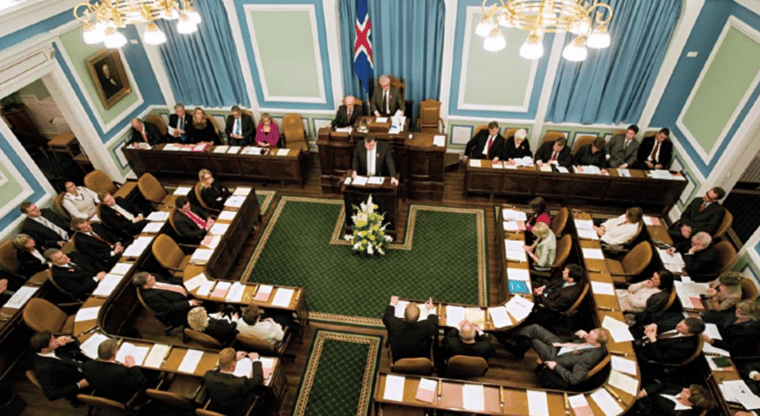
The Alþingi (Icelandic: [ˈalˌθiɲcɪ]; Icelandic for 'general meeting', anglicised as Althing or Althingi) is the national legislature of Iceland, which is also known in the English language as the Icelandic Parliament or as the Parliament of Iceland. Established in 930, it is the oldest legislature in the world. The original Althing was founded in 930 at Þingvellir ('thing fields' or 'assembly fields', anglicised as Thingvellir), about 45 kilometres (28 mi) east of what later became the country's capital, Reykjavík. The present parliament building, the Alþingishús, was built in 1881 of hewn Icelandic stone. The unicameral parliament has 63 members, and is elected every four years based on party-list proportional representation. Þórunn Sveinbjarnardóttir became speaker of the Althing in February 2025.
 Gustchen oder Geschichte dreier Hochzeitsnachte
Christian Althing · 1986
Erotische Schriften Von Christian Althing
Christian August Fischer · 2022
Erotische Schriften Von Christian Althing, Viertes Baendchen
Christian August Fischer · 2022
The Althing, Iceland's thousand year old Parliament
Matthias Thórdarson · 1930
Gustchen oder Geschichte dreier Hochzeitsnachte
Christian Althing · 1986
Erotische Schriften Von Christian Althing
Christian August Fischer · 2022
Erotische Schriften Von Christian Althing, Viertes Baendchen
Christian August Fischer · 2022
The Althing, Iceland's thousand year old Parliament
Matthias Thórdarson · 1930
Background and consequences
After Iceland's union with Norway in 1262, the Althing lost its legislative power, which was not restored until 1904, when Iceland gained home rule from Denmark. For 641 years, the Althing did not serve as the parliament of Iceland; ultimate power rested with the Norwegian, and subsequently, Danish throne. Even after Iceland's union with Norway in 1262, the Althing still held its sessions at Þingvellir until 1800, when it was discontinued. It was restored in 1845 by royal decree and moved to Reykjavík. The restored unicameral legislature first came together in 1845, and after 1874 operated in two chambers with an additional third chamber taking on a greater role as the decades passed, until 1991, when Althing became once again unicameral.

Why it matters
The constitution of Iceland provides for six electoral constituencies with the possibility of an increase to seven. The constituency boundaries and the number of seats allocated to each constituency are fixed by legislation. No constituency can be represented by fewer than six seats. Furthermore, each party with more than 5% of the national vote is allocated seats based on its proportion of the national vote in order that the number of members in parliament for each political party should be more or less proportional to its overall electoral support.