D-Day
World War II landing operation in Europe
Cite this page
“D-Day.” thisDay, thisday.info/history/d-day/. Accessed 19 Oct. 2026.
D-Day. (n.d.). thisDay. Retrieved October 19, 2026, from https://thisday.info/history/d-day/
“D-Day.” thisDay. Accessed October 19, 2026. https://thisday.info/history/d-day/.
What was D-Day?
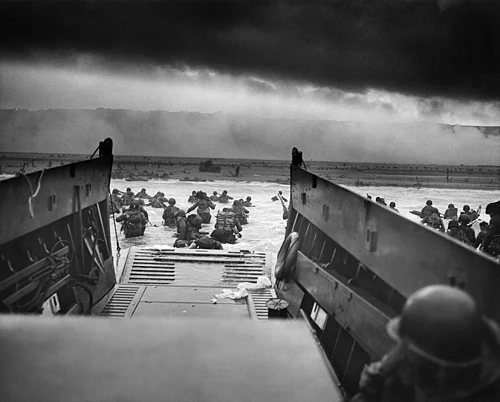
The Normandy landings were the landing operations and associated airborne operations on 6 June 1944 of the Allied invasion of Normandy in Operation Overlord during the Second World War. Codenamed Operation Neptune and often referred to as D-Day (after the military term), it is the largest seaborne invasion in history. The operation began the liberation of France and the rest of Western Europe, and laid the foundations for the Allied victory on the Western Front. Planning for the operation began in 1943. In the months leading up to the invasion, the Allies conducted a substantial military deception, codenamed Operation Bodyguard, to mislead the Germans as to the date and location of the main Allied landings.


Background and consequences
The weather on the day selected for D-Day was not ideal, and the operation had to be delayed 24 hours; a further postponement would have meant a delay of at least two weeks, as the planners had requirements for the phase of the moon, the tides, and time of day, that meant only a few days each month were deemed suitable. German leader Adolf Hitler placed Field Marshal Erwin Rommel in command of German forces and developing fortifications along the Atlantic Wall in anticipation of an invasion. US president Franklin D. Roosevelt placed Major General Dwight D. Eisenhower in command of Allied forces.

Why it matters
The invasion began shortly after midnight on the morning of 6 June with extensive aerial and naval bombardment as well as an airborne assault—the landing of 24,000 American, British, and Canadian airborne troops. The early morning aerial assault was soon followed by Allied amphibious landings on the coast of France c. 06:30. The target 80-kilometre (50 mi) stretch of the Normandy coast was divided into five sectors: Utah, Omaha, Gold, Juno, and Sword. Strong winds blew the landing craft east of their intended positions, particularly at Utah and Omaha. The men landed under heavy fire from gun emplacements overlooking the beaches, and the shore was mined and covered with obstacles such as wooden stakes, metal tripods, and barbed wire, making the work of the beach-clearing teams difficult and dangerous.
Related on thisDay
Cite this page
“D-Day.” thisDay, thisday.info/history/d-day/. Accessed 19 Oct. 2026.
D-Day. (n.d.). thisDay. Retrieved October 19, 2026, from https://thisday.info/history/d-day/
“D-Day.” thisDay. Accessed October 19, 2026. https://thisday.info/history/d-day/.