Gothic architecture
Architectural style of Medieval Europe

Cite this page
“Gothic architecture.” thisDay, thisday.info/history/gothic-architecture/. Accessed 19 Oct. 2026.
Gothic architecture. (n.d.). thisDay. Retrieved October 19, 2026, from https://thisday.info/history/gothic-architecture/
“Gothic architecture.” thisDay. Accessed October 19, 2026. https://thisday.info/history/gothic-architecture/.
What was Gothic architecture?
Gothic architecture is an architectural style that was prevalent in Europe from the late 12th to the 16th century, during the High and Late Middle Ages, surviving into the 17th and 18th centuries in some areas. It evolved from Romanesque architecture and was succeeded by Renaissance architecture. It originated in the Île-de-France and Picardy regions of northern France. The style at the time was sometimes known as opus Francigenum (lit. 'French work'); the term Gothic was first applied contemptuously during the later Renaissance, by those ambitious to revive the architecture of classical antiquity. The defining design element of Gothic architecture is the pointed arch.
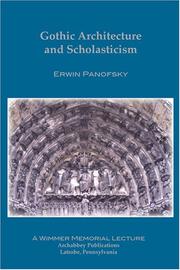 Gothic architecture and scholasticism
Erwin Panofsky · 1951
Gothic architecture and scholasticism
Erwin Panofsky · 1951
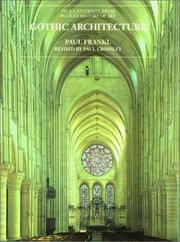 Gothic architecture
Paul Frankl · 1962
Gothic architecture
Paul Frankl · 1962
![Essays on Gothic Architecture, by T. Warton [and Others]. to Which Is Added, a List of the Cathedrals of England, with Their Dimensions cover](https://covers.openlibrary.org/b/id/11217130-M.jpg) Essays on Gothic Architecture, by T. Warton [and Others]. to Which Is Added, a List of the Cathedrals of England, with Their Dimensions
Gothic Architecture · 2018
Essays on Gothic Architecture, by T. Warton [and Others]. to Which Is Added, a List of the Cathedrals of England, with Their Dimensions
Gothic Architecture · 2018
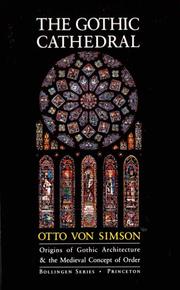 The Gothic cathedral
Otto Georg von Simson · 1956
The Gothic cathedral
Otto Georg von Simson · 1956
 Development & character of Gothic architecture
Charles Herbert Moore · 1890
Development & character of Gothic architecture
Charles Herbert Moore · 1890
Background and consequences
The use of the pointed arch in turn led to the development of the pointed rib vault and flying buttresses, combined with elaborate tracery and stained glass windows. At the Abbey of Saint-Denis, near Paris, the choir was reconstructed between 1140 and 1144, drawing together for the first time the developing Gothic architectural features. In doing so, a new architectural style emerged that emphasized verticality and the effect created by the transmission of light through stained glass windows. Common examples are found in Christian ecclesiastical architecture, and Gothic cathedrals and churches, as well as abbeys, and parish churches. It is also the architecture of many castles, palaces, town halls, guildhalls, universities, and, less prominently today, private dwellings.
Why it matters
Many of the finest examples of medieval Gothic architecture are listed by UNESCO as World Heritage Sites. With the development of Renaissance architecture in Italy during the mid-15th century, the Gothic style was supplanted by the new style, but in some regions, notably England and what is now Belgium, Gothic continued to flourish and develop into the 16th century. A series of Gothic revivals began in mid-18th century England, spread through 19th-century Europe and continued, largely for churches and university buildings, into the 20th century.
Related on thisDay
Cite this page
“Gothic architecture.” thisDay, thisday.info/history/gothic-architecture/. Accessed 19 Oct. 2026.
Gothic architecture. (n.d.). thisDay. Retrieved October 19, 2026, from https://thisday.info/history/gothic-architecture/
“Gothic architecture.” thisDay. Accessed October 19, 2026. https://thisday.info/history/gothic-architecture/.