May Coup
1903 military coup against King Alexander I of Serbia; Peter I installed
Cite this page
“May Coup.” thisDay, thisday.info/history/may-coup/. Accessed 19 Oct. 2026.
May Coup. (n.d.). thisDay. Retrieved October 19, 2026, from https://thisday.info/history/may-coup/
“May Coup.” thisDay. Accessed October 19, 2026. https://thisday.info/history/may-coup/.
What was May Coup?
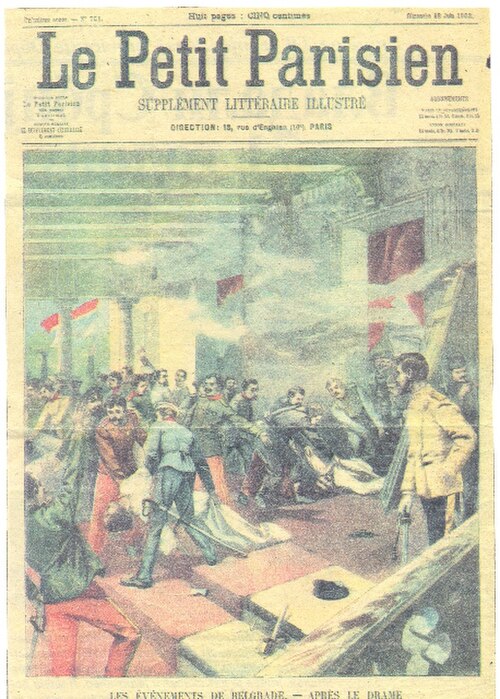
The May Coup (Serbian: Мајски преврат, romanized: Majski prevrat) was a coup d'état in the Kingdom of Serbia which resulted in the assassination of King Alexander I and his consort, Queen Draga, inside the Stari Dvor in Belgrade on the night of 10–11 June [O.S. 28–29 May] 1903. This act resulted in the extinction of the Obrenović dynasty that had ruled Serbia since the mid-19th century. A group of army officers led by Captain Dragutin Dimitrijević (Apis) organized the assassination. After the May Coup, the throne passed to King Peter I of the Karađorđević dynasty. Along with the royal couple, the conspirators killed prime minister Dimitrije Cincar-Marković, minister of the army Milovan Pavlović, and general-adjutant Lazar Petrović.

Background and consequences
The coup had a significant influence on Serbia's relations with other European powers; the Obrenović dynasty had mostly allied with Austria-Hungary, while the Karađorđević dynasty had close ties both with Russia and with France. Each dynasty received ongoing financial support from their powerful foreign sponsors.
Related on thisDay
Cite this page
“May Coup.” thisDay, thisday.info/history/may-coup/. Accessed 19 Oct. 2026.
May Coup. (n.d.). thisDay. Retrieved October 19, 2026, from https://thisday.info/history/may-coup/
“May Coup.” thisDay. Accessed October 19, 2026. https://thisday.info/history/may-coup/.