Mountaineering
Activity involving ascending mountains
Cite this page
“Mountaineering.” thisDay, thisday.info/history/mountaineering/. Accessed 19 Oct. 2026.
Mountaineering. (n.d.). thisDay. Retrieved October 19, 2026, from https://thisday.info/history/mountaineering/
“Mountaineering.” thisDay. Accessed October 19, 2026. https://thisday.info/history/mountaineering/.
What was Mountaineering?
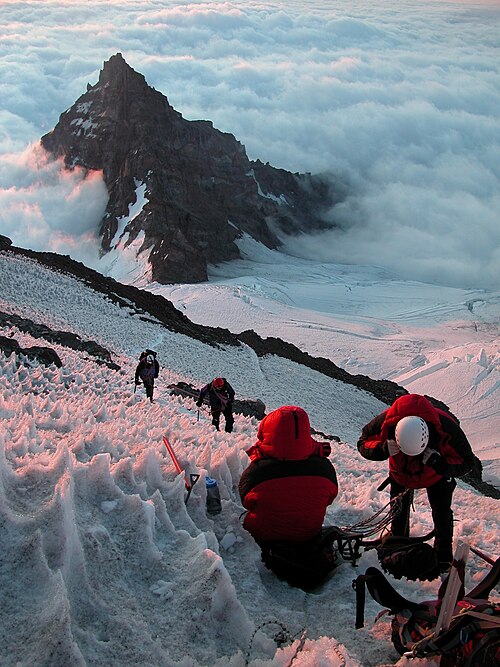
Mountaineering is a set of outdoor activities that involves ascending mountains. Mountaineering-related activities include traditional outdoor climbing, skiing, and traversing via ferratas that have become sports in their own right. Indoor climbing, sport climbing, and bouldering are also considered variants of mountaineering by some, but are part of a wide group of mountain sports. In everyday language, the term "mountaineering" means mountain climbing or alpinism. Unlike most sports, mountaineering lacks widely applied formal rules, regulations, and governance; mountaineers adhere to a large variety of techniques and philosophies (including grading and guidebooks) when climbing mountains. Numerous local alpine clubs support mountaineers by hosting resources and social activities. A federation of alpine clubs, the International Climbing and Mountaineering Federation (UIAA), is the International Olympic Committee-recognized world organization for mountaineering and climbing.
Background and consequences
The consequences of mountaineering on the natural environment can be seen in terms of individual components of the environment (land relief, soil, vegetation, fauna, and landscape) and the location/zone of mountaineering activity (hiking, trekking, or climbing zone). However, it should be borne in mind that tourism in mountain areas, by shifting the sector from agriculture to services, has a positive balance of change - agriculture is more invasive. Mountaineering impacts communities on economic, political, social, and cultural levels, often leading to changes in people's worldviews influenced by globalization, specifically foreign cultures and lifestyles.
Why it matters
In terms of both its impact on the natural environment and local communities, the significance of this impact depends on the location in the vertical (altitude above sea level) and horizontal (zone) dimensions, and is therefore an example of environmental determinism.
Related on thisDay
Cite this page
“Mountaineering.” thisDay, thisday.info/history/mountaineering/. Accessed 19 Oct. 2026.
Mountaineering. (n.d.). thisDay. Retrieved October 19, 2026, from https://thisday.info/history/mountaineering/
“Mountaineering.” thisDay. Accessed October 19, 2026. https://thisday.info/history/mountaineering/.