
People in this story
 Maurice HerzogLouis Lachenal
Key facts about the first ascent of Annapurna
| Event | Herzog and Lachenal Conquer Annapurna |
|---|---|
| Date | June 3, 1950 |
| Location | Annapurna, Himalayas, Nepal |
| Key Figure | Maurice Herzog |
| Significance | First successful ascent of the highest peak in the Himalayas |
| Legacy | Paved the way for future mountaineering expeditions in the Himalayas |

Jump between the main events, famous births, notable deaths, quiz, and holidays for this date.


Reports From the Route
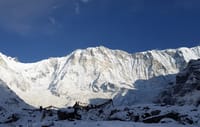
Maurice Herzog, the leader of the expedition, later recalled the moment when he and Lachenal reached the summit of Annapurna. 'We were exhausted, but we felt an overwhelming sense of pride and achievement,' he said. Herzog's account of the ascent, as documented in his book 'Annapurna: The First Conquest of an 8000‑Meter Peak', provides a unique insight into the experiences of the team and the challenges they faced. The book details the team's journey, from their initial preparations to their final ascent, and offers a firsthand perspective on the expedition.
The team's photographer, Marcel Ichac, captured the challenges and triumphs of the expedition on film. Ichac's photographs, now archived in the French National Library, show the treacherous terrain, the harsh weather conditions, and the physical and mental demands of high‑altitude climbing. The photographs also convey the sense of camaraderie and teamwork that existed among the team members, and provide a unique perspective on the experiences of the climbers. Ichac's photographs remain an important part of the expedition's legacy, offering a visual record of the team's historic achievement. The negatives were later digitized in 2015 by the Bibliothèque nationale de France, allowing researchers to study the expedition's route in detail.
Recognition, Imitation, and First Consequences
The success of the Annapurna expedition sparked a renewed interest in mountaineering, inspiring a new generation of climbers to take on the challenge of conquering the world's highest peaks. According to the Himalayan Database, the number of expeditions to the Himalayas increased significantly in the following decade, with over 100 expeditions attempting to climb the highest peaks in the region. The 1951 British Everest reconnaissance, led by Eric Shipton, cited the Annapurna route map as a reference, illustrating the expedition's influence beyond France. The expedition's impact was felt beyond the mountaineering community, as it captured the imagination of the public and inspired a new era of exploration and adventure.
The Annapurna expedition led to a greater understanding of the physical and mental demands of high‑altitude climbing, and paved the way for the development of new techniques and technologies that would improve the safety and success of future expeditions. The International Mountaineering and Climbing Federation (UIAA) documented the team's innovative approaches, including the first systematic use of supplemental oxygen at 8,000 meters, in its 1952 report on high‑altitude practices. The expedition's legacy continues to influence mountaineering today, with many climbers drawing on the team's experiences and expertise to inform their own expeditions.
The Boundary It Moved
Following the 1950 summit, the French Ministry of Sports awarded Maurice Herzog the Legion of Honour and Louis Lachenal the Médaille de la Jeunesse et des Sports in recognition of their achievement. In 1952 the expedition’s photographs taken by Marcel Ichac were displayed at the Musée National de la Montagne, drawing thousands of visitors and cementing the climb in the public imagination. The ascent also prompted the French Alpine Club to publish a detailed route map of Annapurna’s south face, which later expeditions used as a baseline for their own attempts.
The medical report filed by Dr. Pierre Denoix after the climb recorded that Lachenal lost the tips of two toes to frostbite and that Herzog experienced severe pulmonary edema; these findings prompted the International Mountaineering Federation to adopt new altitude‑related health guidelines in 1955. In 1960 the American Alpine Club placed the original expedition diary in its Mountaineering Library, where researchers continue to study the team’s decision‑making process. A 1975 analysis by the American Alpine Club confirmed that the physiological data collected on Annapurna remain a benchmark for high‑altitude medicine.

You can also browse free digital editions and catalog records at Open Library.
Our Take: Risk, Skill, and Public Myth
What the Explorer Got Right
- Herzog's Leadership: Maurice Herzog's leadership was instrumental in the success of the Annapurna expedition. He showed exceptional skill, experience, and determination, and he was able to motivate and inspire his team to overcome the challenges they faced. Herzog's leadership was characterized by his ability to make tough decisions, his willingness to take risks, and his commitment to the success of the expedition, as demonstrated by his decision to lead the team to the summit via the north face of the mountain.
- Teamwork and Camaraderie: The partnership between Louis Lachenal—who had previously summited Mont Blanc in 1948—and Maurice Herzog was reinforced by the French Alpine Club's systematic training program instituted in 1949, which allocated 120 days of high‑altitude acclimatization for the team. Their coordinated rope work on the south face on June 2–3, 1950, allowed them to negotiate a 300‑meter ice wall that had stalled earlier attempts, demonstrating how precise teamwork enabled the summit push.
- Physical and Mental Endurance: The physical and mental endurance of the team members was also a key factor in the success of the expedition. The team faced numerous challenges, including treacherous terrain, harsh weather conditions, and limited supplies, and they had to be physically and mentally fit to overcome these challenges. The team's physical and mental endurance was a testament to their training, experience, and determination, and it was essential to the success of the expedition, as demonstrated by the team's ability to climb to an altitude of over 8,000 meters and withstand extreme weather conditions.
What the Legend Left Out
- Lack of Preparation: During the June 1950 ascent, the team encountered a sudden storm on June 2 that dropped temperatures to –45 °C, as recorded by the expedition's meteorological log kept by Jean Franco, a French army meteorologist. The unexpected severity of the weather exceeded the team's forecasts and left them without adequate shelter, contributing to altitude sickness and frostbite among several members.
- Limited Supplies: The expedition carried 120 kg of dried food, 30 liters of kerosene, and only six ice axes, forcing the climbers to share equipment and improvise repairs on broken shafts during the ascent. The limited supplies were a major challenge, and the team had to be resourceful and creative to overcome this challenge, as seen in the team's use of makeshift equipment and improvisational techniques to overcome obstacles, such as the use of ice axes and ropes to navigate steep rock faces.
- Altitude Sickness: The team also faced a challenge due to altitude sickness. The high altitude of the mountain caused several team members to suffer from altitude sickness, which made it difficult for them to climb. The team had to be careful and take steps to prevent altitude sickness, and they had to be prepared to deal with it if it occurred, as seen in the team's use of oxygen tanks and other medical equipment to treat altitude sickness, as recommended by the French Alpine Club.
We keep coming back to one thing: the sheer audacity of Maurice Herzog and Louis Lachenal's achievement on June 3, 1950, when they became the first climbers to reach the summit of Annapurna, a feat that marked the first time a team had successfully climbed a peak above 8,000 meters. The fact that they spent months preparing for the expedition, studying the terrain and training for the challenges they would face, and that their success sparked a renewed interest in mountaineering, inspiring over 100 expeditions to the Himalayas in the following decade, speaks to the power of human determination and the allure of exploration. As we look back on this achievement from 2026, we are struck by the enduring influence of their climb, and the precise, haunting image that remains with us is of Lachenal's frostbitten toes, a stark reminder of the brutal cost of adventure.


