New Deal
1930s programs of U.S. president Franklin D. Roosevelt
Cite this page
“New Deal.” thisDay, thisday.info/history/new-deal/. Accessed 19 Oct. 2026.
New Deal. (n.d.). thisDay. Retrieved October 19, 2026, from https://thisday.info/history/new-deal/
“New Deal.” thisDay. Accessed October 19, 2026. https://thisday.info/history/new-deal/.
What was New Deal?
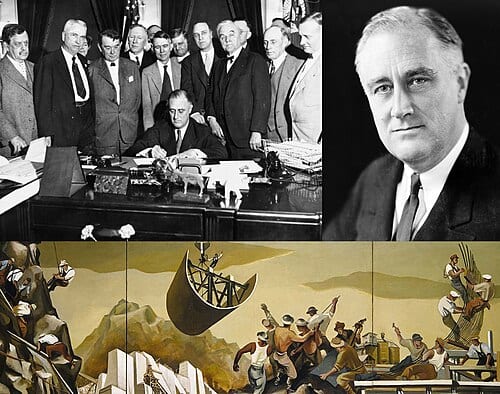
The New Deal was a 1933–1938 series of economic, social, and political reforms in response to the Great Depression in the United States under President Franklin D. Roosevelt. He introduced the phrase when accepting the Democratic Party presidential nomination in the 1932 United States presidential election, winning in a landslide over incumbent Herbert Hoover, whose administration was widely viewed as ineffective. Roosevelt attributed the Depression to inherent market instability and inadequate aggregate demand (following the Keynesian economic model), and argued that stabilizing and rationalizing the economy required massive government intervention.

Background and consequences
During Roosevelt's first hundred days in office in 1933 until 1935, Roosevelt introduced what historians refer to as the "First New Deal", which focused on the "3 R's": relief for the unemployed and for the poor, recovery of the economy back to normal levels, and reforms of the financial system to prevent a repeat depression. Roosevelt signed the Emergency Banking Act, which authorized the Federal Reserve to insure deposits to restore confidence, and the 1933 Banking Act made this permanent with the Federal Deposit Insurance Corporation (FDIC).
Why it matters
Other laws created the National Recovery Administration (NRA), which allowed industries to create "codes of fair competition"; the Securities and Exchange Commission (SEC), which protected investors from abusive stock market practices; and the Agricultural Adjustment Administration (AAA), which raised rural incomes by controlling production. Public works were undertaken in order to find jobs for the unemployed (25 percent of the workforce when Roosevelt took office): the Civilian Conservation Corps (CCC) enlisted young men for manual labor on government land, and the Tennessee Valley Authority (TVA) promoted electricity generation and other forms of economic development in the drainage basin of the Tennessee River.
Related on thisDay
Cite this page
“New Deal.” thisDay, thisday.info/history/new-deal/. Accessed 19 Oct. 2026.
New Deal. (n.d.). thisDay. Retrieved October 19, 2026, from https://thisday.info/history/new-deal/
“New Deal.” thisDay. Accessed October 19, 2026. https://thisday.info/history/new-deal/.