Tank Man
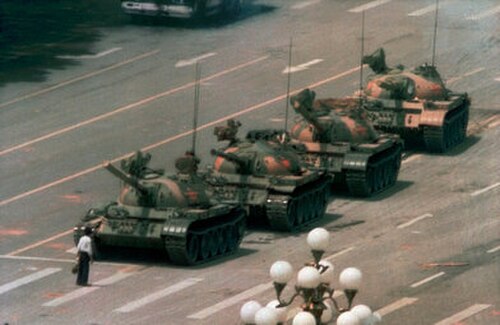
Unknown Tiananmen Square protester
Cite this page
“Tank Man.” thisDay, thisday.info/history/tank-man/. Accessed 19 Oct. 2026.
Tank Man. (n.d.). thisDay. Retrieved October 19, 2026, from https://thisday.info/history/tank-man/
“Tank Man.” thisDay. Accessed October 19, 2026. https://thisday.info/history/tank-man/.
What was Tank Man?
Tank Man (also known as the Unknown Protester or the Unknown Rebel) is an unidentified individual, presumed to be a Chinese man, who stood in front of a column of Type 59 tanks on Chang'an Avenue near Tiananmen Square in Beijing on June 5, 1989. The confrontation occurred one day after the government of China forcibly cleared the square following six weeks of pro-democracy demonstrations, resulting in the deaths of hundreds of people, primarily in areas surrounding the square. On the morning of June 5th, a long column of tanks proceeded east along Chang'an Avenue after the military's clearing operations. A lone man carrying shopping bags stepped into the path of the lead tank and refused to move.

Background and consequences
When the tank attempted to steer around him, he repeatedly shifted positions to block its movement. The tanks came to a complete stop rather than run him over. The man then climbed onto the lead tank, where he appeared to speak with members of the PLA inside before returning to the road. The moment was captured by international photographers and television crews watching from balconies and hotel rooms overlooking the avenue. Broadcast around the world, the scene quickly became one of the most iconic and widely recognized images of all time. Inside China, the image and the accompanying events are subject to censorship. Multiple documentaries and exhibitions related to the Tiananmen protests highlight the tank confrontation, and the figure of "Tank Man" has become an enduring symbol of nonviolent resistance.
Why it matters
The Sunday Express was the first to circulate the name "Wang Weilin" for the protester, though this identification has never been confirmed. His true identity and fate remain unknown, and various news organizations have reported different speculative names. In 2006, Frontline produced a detailed documentary focusing on the events surrounding the incident. In April 1998, Time magazine included "The Unknown Rebel" in its list of the 100 most influential people of the 20th century. Life magazine's 2003 book 100 Photos That Changed the World also featured the photographs of the tank confrontation. Despite the image's global status as a symbol of individual courage, the Chinese government continues to restrict the distribution and discussion of the photographs and the broader protests on the Internet.
Related on thisDay
Cite this page
“Tank Man.” thisDay, thisday.info/history/tank-man/. Accessed 19 Oct. 2026.
Tank Man. (n.d.). thisDay. Retrieved October 19, 2026, from https://thisday.info/history/tank-man/
“Tank Man.” thisDay. Accessed October 19, 2026. https://thisday.info/history/tank-man/.