Hassan al-Turabi
Sudanese religious and political leader
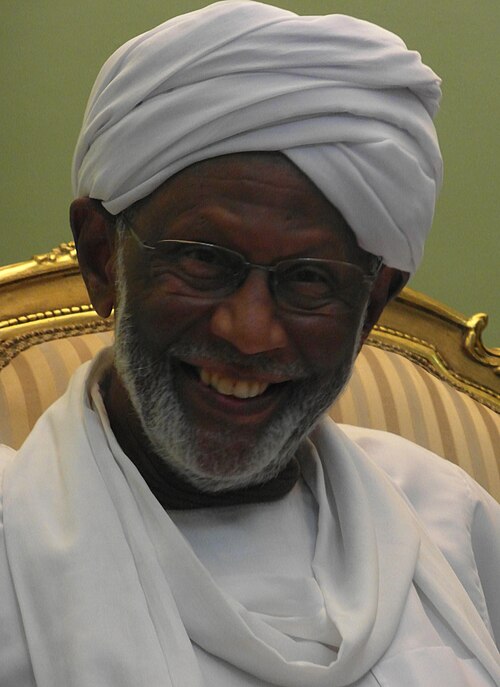
Who was Hassan al-Turabi?
Hassan al-Turabi (Arabic: حسن الترابي, romanized: Ḥasan al-Turābī; 1 February 1932 – 5 March 2016) was a Sudanese politician and scholar. Hassan al-Turabi was born, and died. He was the alleged architect of the 1989 Sudanese military coup that overthrew Sadiq al-Mahdi and installed Omar al-Bashir as president. He was instrumental in institutionalizing Sharia (Islamic law) in the northern part of the country and was frequently imprisoned in Sudan, but these "periods of detention" were "interspersed with periods of high political office". It embraced a "top down" approach to Islamisation by placing party members in high posts in government and security services.
al-Turabi oversaw highly controversial policies such as the creation of the "NIF police state" and associated NIF militias that consolidated Islamist power and prevented a popular uprising, but according to Human Rights Watch committed many human rights abuses, including "summary executions, torture, ill treatment, arbitrary detentions, denial of freedoms of speech, assembly, and religion, and violations of the rules of war, particularly in the south". Turabi was a leader of opposition to the American–Saudi "coalition forces" in the Gulf War, establishing in 1990–1991 the Popular Arab and Islamic Congress (PAIC), a regional umbrella for political Islamist militants, headquartered in Khartoum. After 1996, al-Turabi and his party's "internationalist and ideological wing" saw a decline in influence in favor of more pragmatic leaders, brought on by the imposition of UN sanctions on Sudan in punishment for Sudan's assistance to Egyptian Islamic Jihad in their attempt to assassinate Egyptian President Hosni Mubarak.
He was imprisoned by Omar Al-Bashir on 17 January 2011 for nine days, following civil unrest across the Arab world. He died in 2016 without facing trial for his role in the 1989 coup. This article provides a detailed and nuanced account of the 1989 Sudanese coup d'état, including the historical and cultural context of the event, the key figures and organizations involved, and the far-reaching consequences of the coup.

Historical significance
He has been called "one of the most influential figures in modern Sudanese politics" and a "longtime hard-line ideological leader". al-Turabi was leader of the National Islamic Front (NIF) (which later changed its name to National Congress Party in the late 1990s), a political movement that developed considerable political power in Sudan while never obtaining significant popularity among Sudanese voters. al-Turabi and the NIF reached the peak of their power from 1989 following a military coup d'état, until 2001, as what Human Rights Watch have called "the power behind the throne", head of the first Sunni Islamist movement to take control of a state. al-Turabi was out of power beginning in 1999, leading a splinter group of the National Congress known as the Popular National Congress.
The article also highlights the importance of understanding the complex and multifaceted nature of Sudanese politics, and the need for sustained international engagement and support to help Sudan transition to a democratic government and rebuild its economy. Unlike the Wikipedia entry on the same event, this article provides a more in-depth analysis of the coup and its legacy, and offers a unique perspective on the significance of the event in modern Sudanese history.
