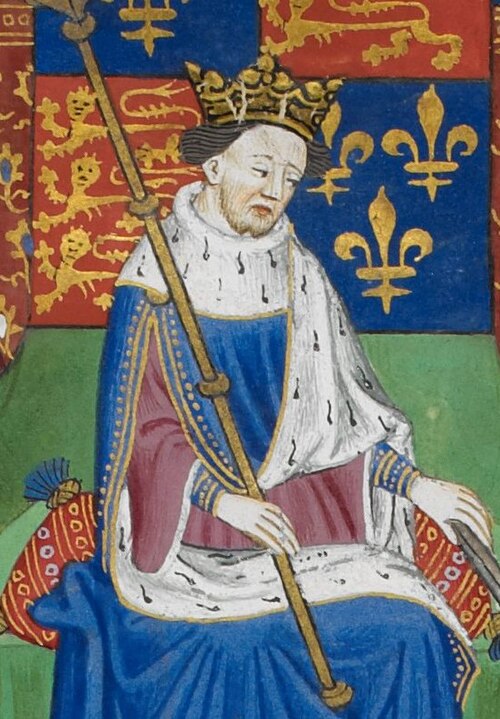
King Henry VI
King of England (1422–61, 1470–71)
Cite this page
“King Henry VI.” thisDay, thisday.info/people/king-henry-vi/. Accessed 2 Oct. 2026.
King Henry VI. (n.d.). thisDay. Retrieved October 2, 2026, from https://thisday.info/people/king-henry-vi/
“King Henry VI.” thisDay. Accessed October 2, 2026. https://thisday.info/people/king-henry-vi/.
Who was King Henry VI?
Henry VI (6 December 1421 – 21 May 1471) was King of England from 1422 to 1461 and again from 1470 to 1471, and claimant to the French throne from 1422 to 1453 under the terms of the Treaty of Troyes. He became king of England at the age of nine months following the death of his father, Henry V, and inherited the French claim upon the death of his maternal grandfather, Charles VI of France. Henry was born during the Hundred Years' War (1337–1453). In contrast to his father, Henry VI was described as timid, passive, benevolent and averse to warfare and violence. Because of military defeats and political crises, Henry suffered a mental breakdown in 1453, triggering a power struggle between the royal family; Richard, 3rd Duke of York; Edmund Beaufort, 2nd Duke of Somerset; and Queen Margaret.
He left a legacy of educational institutions, having founded Eton College, King's College, Cambridge, and All Souls College, Oxford. Henry VI's claim to France was increasingly challenged during the latter stages of the Hundred Years' War, and by 1453 English authority there had collapsed entirely. His reign in England was marked by weak royal authority, factional conflict among the nobility, and a prolonged period of mental incapacity beginning in 1453, which contributed significantly to political instability and the outbreak of the Wars of the Roses. His early reign, when England was ruled by a regency government, saw the pinnacle of English power in France. However, setbacks followed once he assumed full control in 1437. The young king faced military reversals in France, as well as political and financial crises in England, where divisions among the nobility in his government began to widen.
His reign saw the near total loss of English lands in France. In 1445, Henry married Charles VII's niece Margaret of Anjou in the hope of achieving peace. However, the peace policy failed and war recommenced. Henry's domestic popularity declined in the 1440s, and political unrest in England grew as a result. Henry was deposed in March 1461 by York's eldest son, who took the throne as Edward IV. Henry was captured by Edward's forces in 1465 and imprisoned in the Tower of London. Henry was restored to the throne by Richard Neville ("Warwick the Kingmaker") in 1470. Henry died in the Tower in May 1471, possibly killed on the orders of King Edward. Henry may have been bludgeoned to death: his corpse was found much later to have light brown hair matted with what appeared to be blood.
He was buried at Chertsey Abbey and moved to Windsor Castle in 1484. William Shakespeare wrote a trilogy of plays about his life, depicting him as weak-willed and easily influenced by his wife.

Historical significance
He is the only English monarch to have been crowned King of France, following his coronation at Notre-Dame de Paris in 1431 as Henry II. By 1453, Calais was the only English-governed territory on the continent. Civil war broke out in 1455, leading to a long period of dynastic conflict known as the Wars of the Roses (1455–1487). However, in 1471, Edward retook power, killing Henry's only son, Edward of Westminster, and imprisoning Henry once again.

Related on thisDay
Cite this page
“King Henry VI.” thisDay, thisday.info/people/king-henry-vi/. Accessed 2 Oct. 2026.
King Henry VI. (n.d.). thisDay. Retrieved October 2, 2026, from https://thisday.info/people/king-henry-vi/
“King Henry VI.” thisDay. Accessed October 2, 2026. https://thisday.info/people/king-henry-vi/.