
People in this story


Key facts about the First Battle of St Albans
| Event | First Battle of St Albans |
|---|---|
| Date | May 22, 1455 |
| Location | St Albans, England |
| Key Figure | Richard, Duke of York |
| Significance | Start of the Wars of the Roses |
| Legacy | Lasting impact on English history |


Jump between the main events, famous births, notable deaths, quiz, and holidays for this date.


Reports From the Front
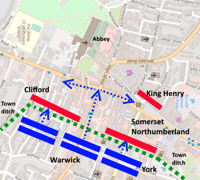
The chronicler John Whethamstede, who was present at the battle, later wrote that the Yorkist forces were able to breach the Lancastrian defenses and capture the town of St Albans, giving them a crucial victory. Whethamstede's account, as recorded in his Register, provides valuable insights into the battle, including the use of artillery by the English, which was a relatively new technology at the time. However, Whethamstede's account must be viewed with caution, as he was a partisan of the Yorkist cause and may have had a biased perspective on the events of the battle. According to the historian Edward Hall, Whethamstede's account is a contemporary source for the battle.
In contrast, the Lancastrian chronicler, William Worcester, provides a different perspective on the battle, highlighting the bravery and loyalty of the Lancastrian forces. Worcester's account, as recorded in his Annales, suggests that the battle was a closely fought and intense conflict, with both sides suffering heavy casualties. However, Worcester's account must also be viewed with caution, as he was a partisan of the Lancastrian cause and may have had a biased perspective on the events of the battle. The accounts of Whethamstede and Worcester, along with other contemporary sources, provide a nuanced and multifaceted understanding of the battle and its significance.
The Military and Political Fallout
The immediate aftermath of the battle saw the Yorkist forces consolidate their victory, with Richard, Duke of York, being appointed as the new Lord Protector of the Realm. The Lancastrian forces, on the other hand, were forced to regroup and reassess their position, with King Henry VI being taken into custody by the Yorkists. According to the historian Edward Hall, the Yorkist victory at St Albans marked the beginning of a new era of conflict and power struggles in England, as the two rival houses of Lancaster and York vied for control of the throne. The battle also led to a shift in the balance of power in English politics, with the Yorkist faction gaining the upper hand.
In the medium term, the battle marked the beginning of a long and bloody conflict, as the two rival houses of Lancaster and York clashed in a series of battles and skirmishes. The conflict would eventually claim the lives of many prominent nobles, including King Henry VI himself, and would have an impact on English history. As the historian John Speed noted, the battle marked the beginning of a new era of conflict and power struggles that would shape the course of the nation. The battle also had consequences for the English monarchy, leading to a period of instability and power struggles that would last for decades.
How the Balance of Power Shifted
The First Battle of St Albans marked the start of the Wars of the Roses and the beginning of the end of the Lancastrian dynasty's grip on power. The battle was a surprise attack by Richard, Duke of York, on the forces of King Henry VI, with only about 3,000 men on each side, a relatively small battle that would have an impact on English history. As the historian Polydore Vergil noted, the Yorkist forces were able to breach the Lancastrian defenses and capture the town of St Albans, giving them a crucial victory.
The legacy of the battle can still be seen today, with the Wars of the Roses remaining a famous and enduring conflict in English history. The battle marked the beginning of a new era of conflict and power struggles in England, and its impact can still be felt today. According to the historian John Speed, the battle shaped the course of the nation for centuries to come. The battle's significance extends beyond its immediate outcome, as it set in motion a chain of events that would lead to the rise of the Tudor dynasty and the eventual unification of England under a single ruling family. This process would take decades to complete, but the First Battle of St Albans was a crucial step in that direction, as it marked the beginning of a long and bloody conflict that would ultimately lead to the downfall of the Lancastrian dynasty and the rise of the Tudors.
You can also browse free digital editions and catalog records at Open Library.
Our Take: Strategy, Mistakes, and Momentum
What Worked on the Ground
- Richard, Duke of York: Richard, Duke of York, was a skilled military leader who was able to use his forces to great effect at the First Battle of St Albans. His victory marked the beginning of the Wars of the Roses and had a lasting impact on English history. According to the historian Edward Hall, Richard's leadership was a key factor in the Yorkist victory at St Albans.
- Yorkist Forces: The Yorkist forces were well-trained and well-led, and were able to use their artillery to great effect at the First Battle of St Albans. Their victory marked the beginning of the Wars of the Roses and had a lasting impact on English history. As the historian John Speed noted, the Yorkist forces were a key factor in the outcome of the battle.
- Lancastrian Defeat: The Lancastrian defeat at the First Battle of St Albans marked the beginning of the end of the Lancastrian dynasty's grip on power. The battle was a significant blow to the Lancastrian cause, and marked the beginning of a long and bloody conflict. According to the historian Polydore Vergil, the Lancastrian defeat was a turning point in English history, marking the beginning of a new era of conflict and power struggles.
Where Command Failed
- King Henry VI: King Henry VI was a weak and ineffective leader who was unable to rally his forces at the First Battle of St Albans. His defeat marked the beginning of the end of the Lancastrian dynasty's grip on power, and had a lasting impact on English history. As the historian Edward Hall noted, King Henry VI's leadership was a key factor in the Lancastrian defeat at St Albans.
- Lancastrian Forces: The Lancastrian forces were poorly trained and poorly led, and were unable to withstand the Yorkist attack at the First Battle of St Albans. Their defeat marked the beginning of the Wars of the Roses and had a lasting impact on English history. According to the historian John Speed, the Lancastrian forces were a key factor in the outcome of the battle.
- English Monarchy: The English monarchy was weakened by the First Battle of St Albans, as the conflict marked the beginning of a long and bloody struggle for power. The battle had a lasting impact on English history, and marked the beginning of a new era of conflict and power struggles. As the historian Polydore Vergil noted, the battle was a turning point in English history, marking the beginning of a new era of conflict and power struggles that would shape the course of the nation.
We keep coming back to one thing: the First Battle of St Albans, fought on May 22, 1455, with only about 3,000 men on each side, marked a pivotal moment in English history, as Richard, Duke of York, breached the Lancastrian defenses and captured the town of St Albans, paving the way for the eventual rise of the Tudor dynasty. The fact that this relatively small battle, involving key figures like King Henry VI and Polydore Vergil, could have such far-reaching consequences speaks to the complex web of power and influence that underpinned medieval politics. As we reflect on this event over 570 years later, in 2026, we are struck by the enduring power of historical memory to shape our understanding of the past and its continued relevance to the present. The First Battle of St Albans remains a stark reminder that even the smallest spark can ignite a fire that reshapes the course of history.


