Michael Andreas Barclay de Tolly
Russian general
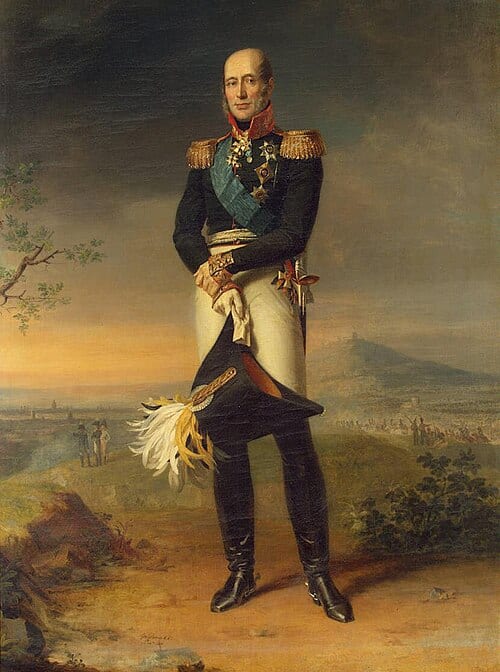
Who was Michael Andreas Barclay de Tolly?
Prince Michael Andreas Barclay de Tolly (baptised 27 December [O.S. 16 December] 1761 – 26 May [O.S. 14 May] 1818) was a Russian field marshal who figured prominently in the Napoleonic Wars. Barclay was born into a Baltic German family from Livland. His father was the first of his family to be accepted into the Russian nobility. Born on December 16, 1761, Michael Andreas Barclay de Tolly died on May 14, 1818. In Russian service he was known as Mikhail Bogdanovich. Barclay joined the Imperial Russian Army at a young age in 1776. He served with distinction in the Russo-Turkish War (1787–92), the Russo-Swedish War (1788–1790), and the Kościuszko Uprising (1794). In 1806, Barclay began commanding in the Napoleonic Wars, distinguishing himself at the Battle of Pułtusk that same year.
He was wounded at the Battle of Eylau in 1807 while his troops were covering the retreat of the Russian army. Because of his wounds, he was forced to leave command. The following year, he carried out successful operations in the Finnish War against Sweden. Barclay led approximately 3,500 troops approximately 100 km (62 mi) across the frozen Gulf of Bothnia in winter during a snowstorm. For his accomplishments, Barclay de Tolly was made a General of the Infantry and appointed Governor-General of the Grand Duchy of Finland. From 20 January 1810 to 24 August 1812 he was the Minister of War of the Russian Empire. When the French invasion of Russia began in 1812, Barclay de Tolly was commander of the 1st Army of the West, the largest Army to face Napoleon.
Barclay initiated a scorched earth policy from the beginning of the campaign, though this made him unpopular among Russians. On the eve of the invasion, he also carried out military reforms. After the Battle of Smolensk failed to halt the French and discontent among Russians continued to grow, Alexander I appointed Mikhail Kutuzov as Commander-in-Chief, though Barclay remained in charge of the 1st Army. However, Kutuzov continued the same scorched earth retreat up to Moscow where the Battle of Borodino took place nearby. Barclay commanded the right wing and center of the Russian army for the battle. After Napoleon's retreat, the eventual success of Barclay's tactics made him a hero among Russians. He became Commander-in-Chief in 1813 after the Battle of Bautzen, replacing Wittgenstein (who had been appointed after Kutuzov's death early in 1813) and led the taking of Paris, for which he was made a Field Marshal.
His health later declined and he died on a visit to Germany in 1818.

Historical significance
A reader of this article gains a focused narrative that ties the formal war declaration to the exact timing of the Grande Armée's crossing, a connection rarely emphasized in standard encyclopedia entries. By foregrounding the diplomatic note, the bulletin, and the immediate military actions, the piece reveals how legal and operational decisions were synchronized, offering a nuanced perspective on the interplay between paperwork and warfare that Wikipedia's broader overview does not provide.
