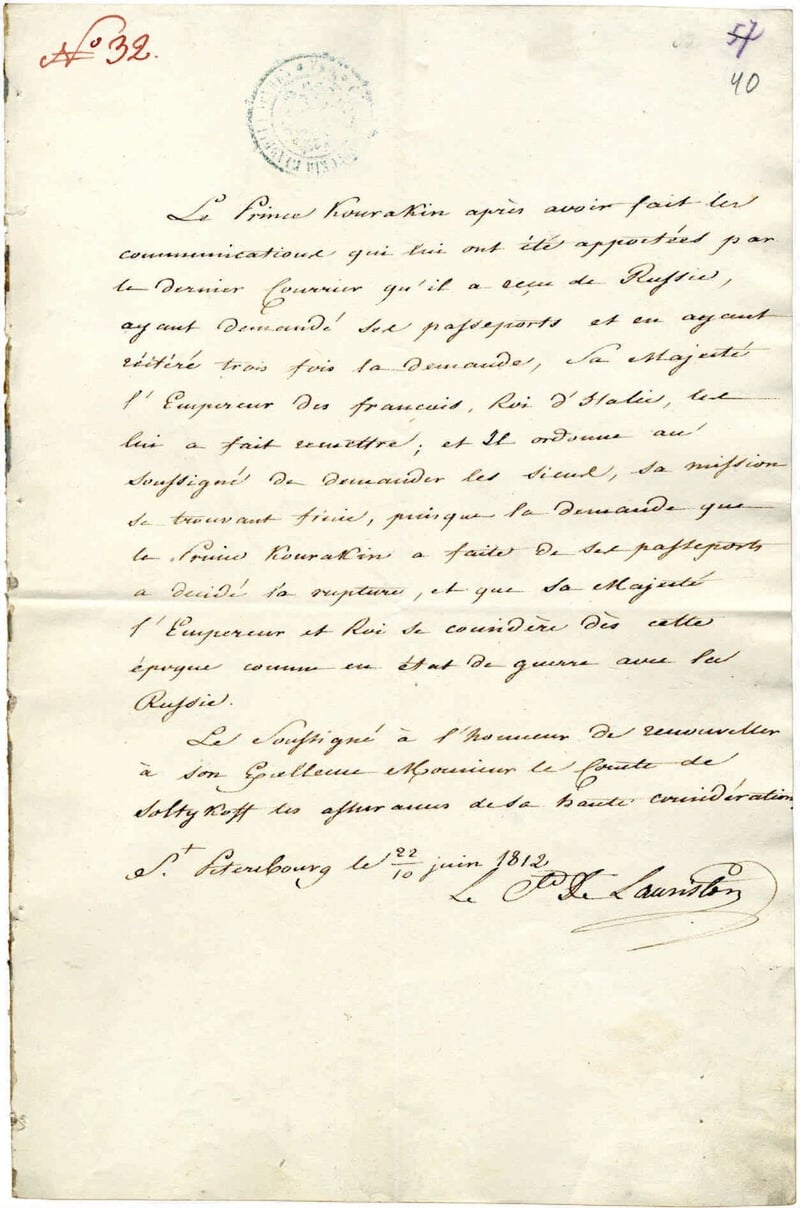
People in this story
 Jacques LauristonAlexander SaltykovAlexander Kurakin
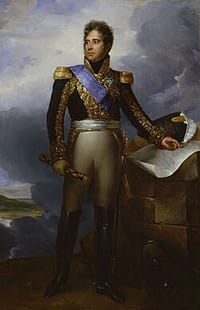
 Napoleon Bonaparte
 Michael Andreas Barclay de Tolly
| Event | France declares war on Russia, starting Napoleon's invasion |
|---|---|
| Date | June 22, 1812 |
| Location | Saint Petersburg, Russian Empire |
| Key Figure | Jacques Lauriston |
| Significance | Triggers Napoleon's 1812 invasion of Russia |
| Legacy | Debated status of the war declaration in Russian historiography |

Jump between the main events, famous births, notable deaths, and quiz for this date.


Voices From the Moment

The primary source material itself is a diplomatic note, not a battlefield report, and it provides the only direct evidence of the French declaration. It records the exact wording used by Lauriston and the reaction of Saltykov, confirming that the French ambassador acted on instructions to formalize the rupture. The source also notes that Lauriston attempted to delay the declaration, indicating internal French hesitation. This record, however, does not include any Russian eyewitness account of the moment the note was received, leaving a gap in the personal perspective of Russian officials present in Saint Petersburg.
Contrasting the French note, Russian historian Alexander Mikhailovsky‑Danilevsky emphasizes that the tsar regarded Napoleon's refusal to withdraw from Prussia as an act of war, suggesting that the declaration merely codified an already accepted reality. Soviet historian Yevgeny Tarle omitted Lauriston's note entirely, focusing instead on Napoleon's proclamation to his troops at Vilkaviškis Manor on the same day. These divergent historiographical treatments illustrate how the same event can be framed either as a formal diplomatic act or as an implied prelude to invasion, depending on which sources are foregrounded.
Timeline: the road to France and its aftermath
- April 14, 1812 Russian representatives present an ultimatum in Paris
- April 1812 French crossing of the Oder and Russian demand for passports
- June 22, 1812 France declares war on Russia
- June 24, 1812 French Grande Armee crosses the Neman River
Recognition, Resistance, and First Consequences

Within hours of the note's delivery the French Grande Armée began its march toward the Russian border, crossing the Neman River on June 24, 1812 and initiating the invasion that would become known as the Russian campaign. The same day the French bulletin proclaimed the impossibility of peace, while Russian troops under Barclay de Tolly prepared defensive positions along the Neman. In the following weeks the French forces advanced through present‑day Belarus, and Russian commanders adjusted their contingency plans, moving troops deeper into Russian territory to avoid encirclement. These immediate actions underscore how the diplomatic declaration translated directly into military movement and strategic repositioning on both sides. According to historian Alexander Mikhailovsky‑Danilevsky, the Russian army's defensive strategy was influenced by the works of early 19th-century military theorists, such as Antoine-Henri Jomini, who emphasized the importance of maneuver warfare and strategic retreats.
Later, the war's formal status continued to be contested. The Russian Ministry of Foreign Affairs published Lauriston's note in 1962, providing documentary proof of the declaration, while the Research Institute of Military History maintained that the invasion began without a prior declaration because the note reached Alexander I only after hostilities commenced. Historians such as Konstantin Zalessky and Alexander Podmazo have accepted the note's validity, whereas others still describe the campaign as undeclared. This ongoing debate reflects how the aftermath of a single diplomatic act can reverberate through centuries of scholarly interpretation. As noted by the historian Yevgeny Tarle, the controversy surrounding the declaration of war highlights the complexities of interpreting historical events, where the availability of primary sources and the perspectives of different historians can shape our understanding of the past.
The Nation That Emerged Afterward

June 22, 1812, marked a decisive shift in the diplomatic landscape between France and Russia, as the declaration of war converted a prolonged standoff into an explicit state of conflict. The French ambassador's action, the bulletin's public statement, and the subsequent crossing of the Neman together illustrate a coordinated shift from negotiation to conquest. Historians such as Alexander Mikhailovsky-Danilevsky and Konstantin Zalessky remain divided over whether the invasion was formally declared, a division that highlights the fragile boundary between diplomatic formality and military reality.
On June 22, 1812, the Grande Armée was already poised to cross the Neman, while the diplomatic note was being delivered in Saint Petersburg. This parallel movement of the pen and the sword underscores the complexities of 19th-century warfare, where the distinction between diplomatic and military actions becomes increasingly blurred. As historian Yevgeny Tarle noted, the Russian campaign of 1812 is a prime example of this phenomenon, where the interplay between diplomatic maneuvering and military strategy played a decisive role in shaping the outcome of the conflict, influencing later military strategists like Carl von Clausewitz.
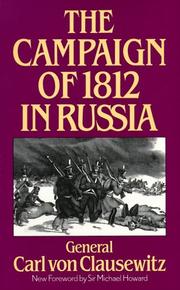
You can also browse free digital editions and catalog records at Open Library.
Our Take: Courage, Timing, and Cost
What the Leaders Got Right
- Strategic Timing: Lauriston's decision to present the war note on June 22, just two days before the Grande Armée's crossing of the Neman, reflects a calculated synchronization of diplomatic and military timelines. By formalizing the rupture immediately prior to the invasion, the French leadership ensured that the legal justification for the campaign was in place, reducing the risk of internal dissent within the French administration. This timing also prevented the Russian government from exploiting any diplomatic lag to negotiate a last‑minute settlement, thereby locking both sides into a path of armed conflict. The strategic alignment of paperwork and troop movements demonstrates a sophisticated understanding of how international law and battlefield logistics can be leveraged together.
- Diplomatic Persistence: The French note explicitly linked the Russian ambassador Kurakin's demand for passports to a severance of diplomatic relations, a claim that reveals how France used procedural grievances to justify war. By framing the passport demand as an affront, Napoleon could portray Russia as the aggressor, a narrative that bolstered domestic support for the campaign. This diplomatic persistence mirrors earlier French tactics during the Napoleonic era, where legal pretexts were often employed to mask expansionist ambitions. The note's language, therefore, serves not only as a declaration but also as a propaganda tool that shaped contemporary and later perceptions of the conflict.
- Operational Continuity: The second Bulletin of the Grande Armée, released on the same day as the declaration, emphasized that all attempts at understanding had failed, reinforcing the notion that the invasion was a continuation of an already deteriorating relationship. This bulletin provided troops with a clear narrative that their march into Russian territory was a justified response to diplomatic breakdown, maintaining morale and cohesion. By coupling the public bulletin with the private note, French command ensured that both the political elite and the rank‑and‑file soldiers received a consistent message, thereby preserving operational continuity throughout the early phases of the campaign.
What the Break Could Not Solve
- Misreading Russian Intent: French officials repeatedly misinterpreted Russian diplomatic signals, assuming that Kurakin's passport demand signified a willingness to negotiate rather than a strategic move toward war. This misreading led to a delayed formal declaration, allowing Russia to solidify its contingency plans and position forces deeper within its own territory. The failure to recognize the seriousness of the Russian ultimatum in April 1812 contributed to a strategic surprise that forced Napoleon to confront a well‑prepared defensive posture, ultimately undermining the French campaign's initial momentum.
- Neglect of Local Intelligence: The French high command relied heavily on diplomatic correspondence while neglecting on‑the‑ground intelligence about Russian troop dispositions along the Neman. This oversight meant that the Grande Armée entered a region where Russian forces had already begun strategic withdrawals, reducing the likelihood of a decisive early battle. By focusing on the diplomatic narrative rather than accurate field reports, Napoleon's planners missed an opportunity to exploit potential weaknesses in the Russian defensive line, a lapse that contributed to the protracted nature of the campaign.
- Overconfidence in Logistics: Napoleon's belief that his massive army could be sustained across the vast Russian plains rested on an overconfident assessment of supply lines, a belief reinforced by the formal declaration of war that suggested a swift resolution. The French logistical apparatus, however, proved incapable of supporting the half‑million‑strong force over the extended distances, leading to severe shortages once the army advanced beyond the initial supply depots. This logistical overreach became a critical factor in the eventual attrition that decimated the Grande Armée.
- Institutional Failure: The French diplomatic corps, under pressure from both the Ministry of Foreign Affairs and the Imperial command, failed to present a unified front on the timing of the war declaration. Lauriston's personal attempt to delay the note conflicted with Parisian directives, creating confusion within the embassy and undermining the credibility of the French position. This institutional discord reflected a broader weakness in the coordination between political and military branches, a flaw that hampered coherent decision‑making throughout the early stages of the invasion.
We keep coming back to one thing: the deliberate and calculated nature of Napoleon's declaration of war on Russia, as evidenced by the diplomatic note delivered by Ambassador Jacques Lauriston on June 22, 1812, and the simultaneous publication of the second Bulletin of the Grande Armée. The fact that the French army was already poised to cross the Neman River on June 24, 1812, underscores the intricate dance between diplomatic maneuvering and military strategy. As we reflect on this historical event in 2026, we are struck by the enduring complexity of the relationship between words and actions, particularly in the realm of international relations. The declaration of war on Russia reveals the profound significance of timing and coordination in shaping the course of history, and the fact that a single diplomatic note can forever alter the trajectory of nations. History is written in the space between the pen and the sword.
You Might Also Like


Questions readers ask about France
The lead-up included Russian representatives present an ultimatum in Paris; French crossing of the Oder and Russian demand for passports.
Key figures included Jacques Lauriston, Alexander Saltykov, Alexander Kurakin.
In the aftermath: French Grande Armee crosses the Neman River.
Triggers Napoleon's 1812 invasion of Russia