President Nixon
President of the United States from 1969 to 1974
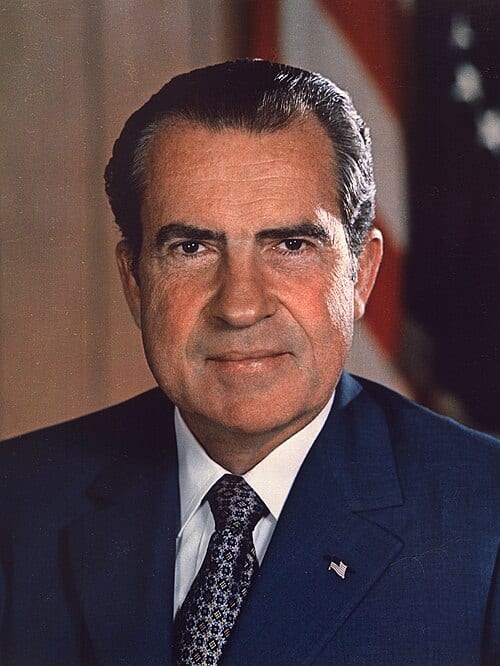
Who was President Nixon?
Richard Milhous Nixon (January 9, 1913 – April 22, 1994) was the 37th president of the United States, serving from 1969 until his resignation in 1974. Nixon was born into a poor family of Quakers in Yorba Linda, Southern California. He graduated from Whittier College with a Bachelor of Arts in 1934 and from Duke University School of Law with a Juris Doctor in 1937, practiced law in California, and then moved with his wife Pat to Washington, D.C., in 1942 to work for the federal government. A member of the Republican Party, he represented California in both houses of the United States Congress before serving as the 36th vice president under President Dwight D. Eisenhower from 1953 to 1961.
His presidency saw the reduction of U.S. involvement in the Vietnam War, détente with the Soviet Union and China, the Apollo 11 Moon landing, and the establishment of the Environmental Protection Agency and Occupational Safety and Health Administration. After serving in the Naval Reserve during World War II, he was elected to the House of Representatives in 1946. In 1950, he was elected to the Senate. Nixon was the running mate of Eisenhower, the Republican Party's presidential nominee in the 1952 and 1956 elections. Nixon served for eight years as vice president, and his two terms saw an increase in the notability of the office. He narrowly lost the 1960 presidential election to John F. Kennedy. After his loss in the 1962 race for governor of California, Nixon announced his retirement from politics.
However, he ran again for the presidency in 1968 and defeated the Democratic candidate, Vice President Hubert Humphrey. Seeking to bring the North Vietnamese to the negotiating table, Nixon ordered military operations and carpet bombing campaigns in Cambodia. He covertly aided Pakistan during the Bangladesh Liberation War in 1971 and ended American combat involvement in Vietnam in 1973, and the military draft the same year. His visit to China in 1972 led to diplomatic relations between the two nations, and he finalized the Anti-Ballistic Missile Treaty with the Soviet Union. In addition to implementing the Twenty-sixth Amendment that lowered the voting age from 21 to 18, he ended the direct international convertibility of the U.S. dollar to gold in 1971, effectively taking the United States off the gold standard.
He also imposed wage and price controls for 90 days, launched the wars on cancer and drugs, passed the Controlled Substances Act, and presided over the end of the Space Race by overseeing the Apollo 11 Moon landing. He was re-elected in 1972, when he defeated George McGovern in one of the largest landslide victories in American history. In his second term, Nixon ordered an airlift to resupply Israeli materiel losses in the Yom Kippur War, a conflict which led to the oil crisis at home. From 1973, ongoing revelations from the Nixon administration's involvement in Watergate eroded his support in Congress and the country. The scandal began with a break-in at the Democratic National Committee office, ordered by administration officials, and escalated despite cover-up efforts by the Nixon administration, of which he was aware. On August 9, 1974, facing almost certain impeachment and removal from office, Nixon resigned.
Afterward, he was issued a controversial pardon by his successor, Gerald Ford. On April 18, 1994, he suffered a debilitating stroke, and died four days later.

Historical significance
Nixon's second term ended early when he became the only U.S. president to resign from office, as a result of the Watergate scandal. His work on the Alger Hiss case established his reputation as a leading anti-communist. During the course of his first term, he enacted many progressive environmental policy shifts, such as creating the Environmental Protection Agency and passing laws, including the Endangered Species and Clean Air Acts. During nearly 20 years of retirement, Nixon wrote nine books and undertook many foreign trips, rehabilitating his image into that of an elder statesman and leading expert on foreign affairs.
