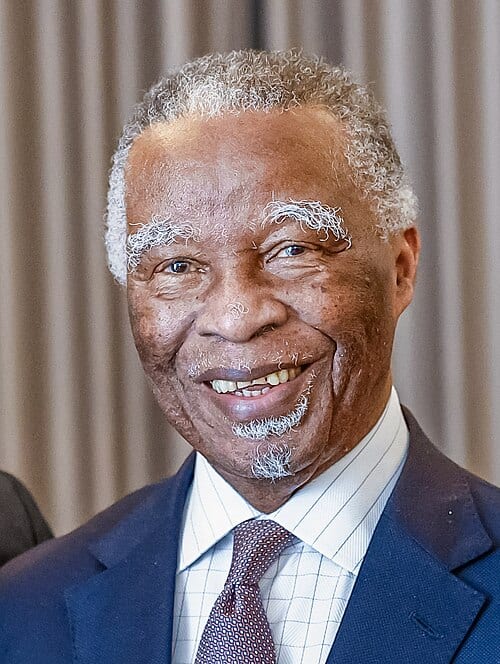
Thabo Mbeki
President of South Africa from 1999 to 2008
Cite this page
“Thabo Mbeki.” thisDay, thisday.info/people/thabo-mbeki/. Accessed 5 Oct. 2026.
Thabo Mbeki. (n.d.). thisDay. Retrieved October 5, 2026, from https://thisday.info/people/thabo-mbeki/
“Thabo Mbeki.” thisDay. Accessed October 5, 2026. https://thisday.info/people/thabo-mbeki/.
Who is Thabo Mbeki?
Thabo Mvuyelwa Mbeki (Xhosa: [tʰaɓɔ ʼmbɛːki]; born 18 June 1942) is a South African politician and economist who served as the president of South Africa from 14 June 1999 to 24 September 2008, when he resigned at the request of his party, the African National Congress (ANC). The son of Govan Mbeki, an ANC intellectual, Mbeki has been involved in ANC politics since 1956, when he joined the ANC Youth League, and has been a member of the party's National Executive Committee since 1975. Born in the Transkei, he left South Africa aged twenty to attend university in England, and spent almost three decades in exile abroad, until the ANC was unbanned in 1990. His government did not introduce a national mother-to-child transmission prevention programme until 2002, when it was mandated by the Constitutional Court, nor did it make antiretroviral therapy available in the public healthcare system until late 2003.
Before that, he was deputy president under Nelson Mandela from 1994 to 1999. He rose through the organisation in its information and publicity section and as Oliver Tambo's protégé, but he was also an experienced diplomat, serving as the ANC's official representative in several of its African outposts. He was an early advocate for and leader of the diplomatic engagements which led to the negotiations to end apartheid. In subsequent years, it became apparent that he was Mandela's chosen successor, and he was elected unopposed as ANC president in 1997, enabling his rise to the presidency as the ANC's candidate in the 1999 elections. During his presidency, South Africa experienced falling public debt, a narrowing budget deficit, and consistent, moderate economic growth.
On these grounds, Mbeki grew increasingly alienated from the left wing of the ANC, and from the leaders of the ANC's Tripartite Alliance partners, the Congress of South African Trade Unions and South African Communist Party. It was these leftist elements which supported Jacob Zuma over Mbeki in the political rivalry that erupted after Mbeki removed the latter from his post as deputy president in 2005. As president, Mbeki had an apparent predilection for foreign policy and particularly for multilateralism. His pan-Africanism and vision for an "African renaissance" are central parts of his political persona, and commentators suggest that he secured for South Africa a role in African and global politics that was disproportionate to the country's size and historical influence.
After the IBSA Dialogue Forum was launched in 2003, his government collaborated with India and Brazil to lobby for reforms at the United Nations, advocating for a stronger role for developing countries. Among South Africa's various peacekeeping commitments during his presidency, Mbeki was the primary mediator in the conflict between ZANU-PF and the Zimbabwean opposition in the 2000s. However, he was frequently criticised for his policy of "quiet diplomacy" in Zimbabwe, under which he refused to condemn Robert Mugabe's regime or institute sanctions against it. Also highly controversial worldwide was Mbeki's HIV/AIDS policy. Subsequent studies have estimated that these delays caused hundreds of thousands of preventable deaths. Mbeki himself, like his Health Minister Manto Tshabalala-Msimang, has been described as an AIDS denialist, "dissident", or sceptic.
Although he did not explicitly deny the causal link between HIV and AIDS, he often posited a need to investigate alternate causes of and alternative treatments for AIDS, frequently suggesting that immunodeficiency was the indirect result of poverty. His political descent began at the ANC's Polokwane conference in December 2007, when he was replaced as ANC president by Zuma. Although his term as national president was not due to expire until June 2009, he announced on 20 September 2008 that he would resign at the request of the ANC National Executive Committee. The ANC's decision to "recall" Mbeki was understood to be linked to a High Court judgement, handed down earlier that month, in which judge Chris Nicholson had alleged improper political interference in the National Prosecuting Authority and specifically in the corruption charges against Zuma.
Nicholson's judgement was overturned by the Supreme Court of Appeal in January 2009, by which time Mbeki had been replaced as president by Kgalema Motlanthe.

Historical significance
After South Africa's first democratic elections in 1994, he was appointed national deputy president. While deputy president, Mbeki had been regarded as a steward of the government's Growth, Employment and Redistribution policy, introduced in 1996, and as president he continued to subscribe to relatively conservative, market-friendly macroeconomic policies. However, despite his retention of various social democratic programmes, and notable expansions to the black economic empowerment programme, critics often regarded Mbeki's economic policies as neoliberal, with insufficient consideration for developmental and redistributive objectives. He was the central architect of the New Partnership for Africa's Development and, as the inaugural chairperson of the African Union, spearheaded the introduction of the African Peer Review Mechanism.

Related on thisDay
Cite this page
“Thabo Mbeki.” thisDay, thisday.info/people/thabo-mbeki/. Accessed 5 Oct. 2026.
Thabo Mbeki. (n.d.). thisDay. Retrieved October 5, 2026, from https://thisday.info/people/thabo-mbeki/
“Thabo Mbeki.” thisDay. Accessed October 5, 2026. https://thisday.info/people/thabo-mbeki/.