Thurgood Marshall
US Supreme Court justice from 1967 to 1991
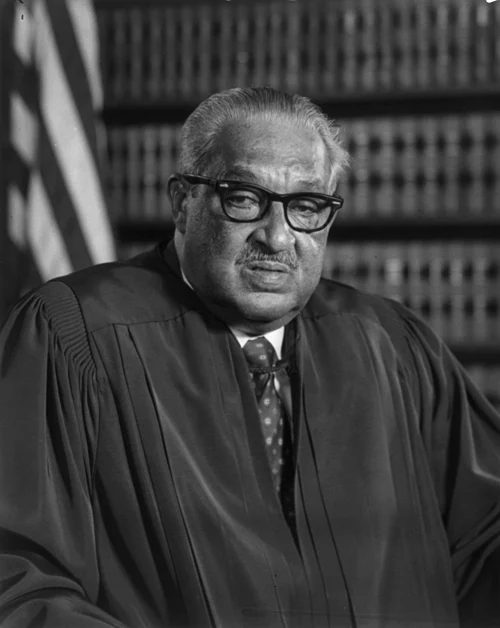
Who was Thurgood Marshall?
Thoroughgood "Thurgood" Marshall (July 2, 1908 – January 24, 1993) was an American lawyer who served as an associate justice of the Supreme Court of the United States from 1967 until 1991. He won 29 of the 32 civil rights cases he argued before the Supreme Court, culminating in the Court's landmark 1954 decision in Brown v. Board of Education, which rejected the separate but equal doctrine and held segregation in public education to be unconstitutional. Born in Baltimore, Maryland, Marshall attended Lincoln University and the Howard University School of Law. Marshall was a prominent figure in the movement to end racial segregation in American public schools. President Lyndon B. Johnson appointed Marshall to the Supreme Court in 1967. A staunch liberal, he frequently dissented as the Court became increasingly conservative.
At Howard, he was mentored by Charles Hamilton Houston, who taught his students to be "social engineers" willing to use the law to fight for civil rights. Marshall opened a law practice in Baltimore but soon joined Houston at the NAACP in New York. They worked together on the segregation case of Missouri ex rel. Gaines v. Canada; after Houston returned to Washington, Marshall took his place as special counsel of the NAACP, and he became director-counsel of the newly formed NAACP Legal Defense and Educational Fund. He participated in numerous landmark Supreme Court cases involving civil rights, including Smith v. Allwright, Morgan v. Virginia, Shelley v. Kraemer, McLaurin v. Oklahoma State Regents, Sweatt v. Painter, Brown, and Cooper v. Aaron. His approach to desegregation cases emphasized the use of sociological data to show that segregation was inherently unequal.
In 1961, President John F. Kennedy appointed Marshall to the U.S. Court of Appeals for the Second Circuit, where he favored a broad interpretation of constitutional protections. Four years later, Johnson appointed him as the U.S. Solicitor General. In 1967, Johnson nominated Marshall to replace Justice Tom C. Clark on the Supreme Court; despite opposition from Southern senators, he was confirmed by a 69–11 vote. He was often in the majority during the consistently liberal Warren Court period, but after appointments by President Richard Nixon made the Court more conservative, Marshall frequently found himself in dissent. His closest ally on the Court was Justice William J. Brennan Jr., and the two voted the same way in most cases. One of Marshall's contributions to constitutional doctrine, the "sliding-scale" approach to the Equal Protection Clause, called on courts to apply a flexible balancing test instead of a more rigid tier-based analysis.
He fervently opposed the death penalty, which in his view constituted cruel and unusual punishment; he and Brennan dissented in more than 1,400 cases in which the majority refused to review a death sentence. Marshall retired from the Supreme Court in 1991 and was replaced by Clarence Thomas.

Historical significance
He was the Supreme Court's first African-American justice. Before his judicial service, he was an attorney who fought for civil rights, leading the NAACP Legal Defense and Educational Fund. He favored a robust interpretation of the First Amendment in decisions such as Stanley v. Georgia, and he supported abortion rights in Roe v. Wade and other cases.
