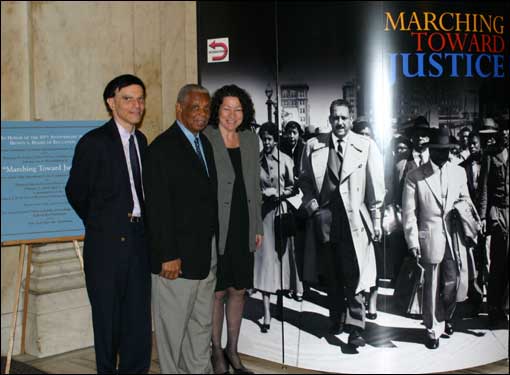
People in this story
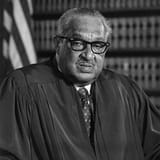
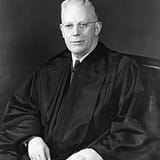
| Event | Brown v. Board of Education Founding |
|---|---|
| Date | May 17, 1954 |
| Location | Washington, D.C. |
| Key Figure | Thurgood Marshall |
| Significance | Declared segregation in public schools unconstitutional |
| Legacy | Paved the way for the Civil Rights Act of 1964 and the Voting Rights Act of 1965 |

Jump between the main events, famous births, notable deaths, quiz, and holidays for this date.
Eyewitness Accounts
via Wikimedia
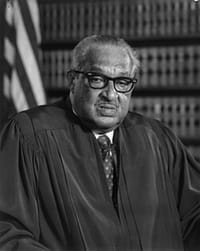
Thurgood Marshall, the lead attorney for the NAACP, later recalled in his memoirs, published by the University of Virginia Press in 2001, that the Brown v. Board of Education decision was a great victory for the civil rights movement, but also acknowledged the challenges that lay ahead in implementing the ruling. As Marshall wrote, 'We knew that the decision would not be self-enforcing, and that it would take a great deal of effort and perseverance to make it a reality.' On May 18, 1954, the New York Times reported that the decision was met with jubilation in African American communities across the country, but also noted that many Southern whites were bitterly opposed to the ruling.
Linda Brown, the daughter of Oliver Brown, later recalled in an interview with the National Public Radio in 2004 that the decision allowed her to attend an integrated school, where she was able to make friends with white students and access better educational resources. In her memoirs, published by the University Press of Kansas in 2007, she wrote, 'The Brown v. Board of Education decision changed my life in ways that I couldn't have imagined.' The NAACP's annual reports from the 1950s documented the significant challenges and complexities that followed the decision, including the closure of public schools and the establishment of private, all-white academies in many Southern states.
"Separate educational facilities are inherently unequal."
Aftermath
In 1955, the state of Virginia closed several public schools in Prince Edward County rather than comply with the Brown v. Board of Education ruling, affecting over 1,700 students, as reported by the Virginia State Library and the Southern Regional Council, which documented the impact of the decision on education in the South. This move was part of a broader effort by Southern states to resist the ruling, which was documented by the Southern Regional Council in their report 'The Resistance to the Brown Decision in the South'. Despite these challenges, the decision inspired further activism and litigation aimed at dismantling segregation and promoting racial equality, as noted by historians such as Richard Kluger in his book 'Simple Justice: The History of Brown v. Board of Education', which was cited by the Supreme Court in the case of Green v. County School Board of New Kent County, Virginia.
By 1966, the Supreme Court had ruled in the case of Green v. County School Board of New Kent County, Virginia, that school districts must take affirmative action to eliminate segregation, as reported by the New York Times on May 28, 1968, and documented by the National Archives in their collection of civil rights records. This ruling paved the way for the desegregation of public schools across the South, although the process was often slow and contentious, as noted by historians such as David Garrow in his book 'Bearing the Cross: Martin Luther King Jr. and the Southern Christian Leadership Conference', which was reviewed by the American Historical Review.
Legacy
The Brown v. Board of Education decision declared segregation in public schools unconstitutional, paving the way for the desegregation of public facilities, restaurants, and hotels, as noted by historians such as William Chafe in his book 'Civilities and Civil Rights: Greensboro, North Carolina, and the Black Struggle for Freedom'. In 1957, the city of Little Rock, Arkansas, desegregated its public schools, with the help of federal troops, as documented by the National Archives. The National Urban League reported that many cities and states took steps to implement desegregation and promote racial equality in the years following the decision. However, the decision was not without its challenges, as many Southern states attempted to resist the ruling through various means, including violence and intimidation against civil rights activists, as documented by the Southern Regional Council.
The legacy of the Brown v. Board of Education decision can be seen in the many advances that have been made in civil rights since the ruling, as noted by historians such as Taylor Branch in his book 'Parting the Waters: America in the King Years 1954-63'. The decision paved the way for the passage of the Civil Rights Act of 1964 and the Voting Rights Act of 1965, which further expanded the rights of African Americans and other minority groups, as reported by the Congressional Record. Today, the decision remains an important milestone in the ongoing struggle for racial equality and justice in the United States, as stated by the National Association for the Advancement of Colored People in its annual reports, and its impact can be seen in the many schools and universities that have been established to promote diversity and inclusion, such as the historically black colleges and universities, as documented by the National Center for Education Statistics.
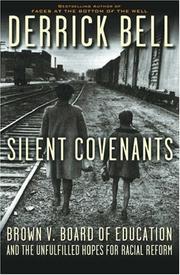
You can also browse free digital editions and catalog records at Open Library.
Our Take: What Went Right & What Went Wrong
What Went Right
- Thurgood Marshall: Thurgood Marshall, the lead attorney for the NAACP, played a crucial role in the Brown v. Board of Education case, arguing that segregation in public schools was unconstitutional. His arguments were instrumental in convincing the Supreme Court to rule in favor of the plaintiffs. Marshall's success in the case marked a major turning point in his career, as he went on to become a prominent figure in the civil rights movement and eventually a Justice of the Supreme Court.
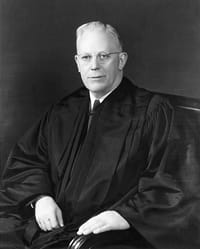
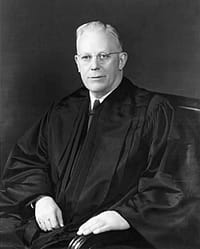
- Earl Warren: Chief Justice Earl Warren, who wrote the majority opinion in the Brown v. Board of Education case, played a crucial role in shaping the Court's decision. Warren's opinion, which declared that 'separate educational facilities are inherently unequal,' was a masterful piece of legal craftsmanship that helped to establish the principle that segregation in public schools was unconstitutional. Warren's leadership on the Court was instrumental in shaping the course of the civil rights movement, as he went on to write opinions in several other landmark cases, including Miranda v. Arizona and Reynolds v. Sims.
- NAACP: The National Association for the Advancement of Colored People (NAACP) played a crucial role in the Brown v. Board of Education case, providing financial and logistical support to the plaintiffs and helping to coordinate the litigation strategy. The NAACP's efforts were instrumental in convincing the Supreme Court to rule in favor of the plaintiffs, and the organization's success in the case marked a major turning point in its history, as it went on to become a prominent force in the civil rights movement.
What Went Wrong
- Southern Governors: The governors of several Southern states, including Georgia's Herman Talmadge, Alabama's George Wallace, and Mississippi's Ross Barnett, were instrumental in resisting the Brown v. Board of Education decision, using various tactics to circumvent the ruling and maintain segregation in public schools, as documented by the Southern Regional Council. Their actions were widely condemned by civil rights leaders, including Martin Luther King Jr., who criticized the governors for their 'massive resistance' to the decision, as reported by the New York Times on February 26, 1956. The governors' resistance to the ruling marked a low point in their careers, as they were ultimately forced to comply with the decision and implement desegregation in their states, as noted by historians such as Dan Carter in his book 'The Politics of Rage: George Wallace, the Origins of the New Conservatism, and the Transformation of American Politics'.
- White Citizens' Councils: The White Citizens' Councils, a network of organizations that opposed desegregation and civil rights, played a significant role in resisting the Brown v. Board of Education decision, as documented by the FBI's annual reports from the 1950s. The councils, which were active in several Southern states, including Mississippi, Alabama, and Louisiana, used various tactics to intimidate and harass civil rights activists, including violence, economic coercion, and social ostracism, as reported by the Southern Regional Council. For example, in 1955, the White Citizens' Council of Mississippi published a blacklist of civil rights activists, including Medgar Evers, who was later assassinated, as documented by the National Archives.
- Federal Government: The federal government, particularly during the Eisenhower administration, was criticized for its slow response to the Brown v. Board of Education decision, as noted by historians such as Stephen Ambrose in his book 'Eisenhower: The President'. The administration's reluctance to enforce the ruling and provide support to civil rights activists helped to embolden resistance to the decision and created a climate of uncertainty and confusion, as reported by the New York Times on September 25, 1957. For example, in 1957, the Justice Department, led by Attorney General Herbert Brownell, filed a brief in the case of Cooper v. Aaron, arguing that the federal government had the authority to enforce the Brown decision, but the administration's actions were seen as inadequate by many civil rights leaders, as documented by the NAACP's annual reports.
via Wikimedia
We keep coming back to one thing: the Brown v. Board of Education decision, handed down on May 17, 1954, by Chief Justice Earl Warren, was a landmark ruling that not only overturned the 'separate but equal' doctrine established by Plessy v. Ferguson in 1896, but also paved the way for further activism and litigation, including the Civil Rights Act of 1957 and the Voting Rights Act of 1965. The fact that Southern states like Virginia attempted to circumvent the ruling by closing public schools, affecting over 1,700 students in Prince Edward County, highlights the deep-seated resistance to racial equality. As we reflect on this decision in 2026, we are struck by the realization that the struggle for equality is not just about changing laws, but about changing the hearts and minds of individuals, and that the true power of the Brown v. Board of Education decision lies in its ability to inspire generations to continue fighting for a more just society. The memory of Oliver Brown's courage in seeking to enroll his daughter in an all-white school in Topeka, Kansas, remains a powerful symbol of the human desire for equality and justice. The decision's impact will forever be etched in the history of the United States as a beacon of hope for a more perfect union.
You Might Also Like


Questions readers ask about Brown v. Board of Education Founding

via Wikimedia
On May 17, 1954, the United States Supreme Court handed down a unanimous decision in Brown v.
The article follows contemporary accounts connected to Brown v. Board of Education Founding.
In 1955, the state of Virginia closed several public schools in Prince Edward County rather than comply with the Brown v.
The Brown v.